Thank you for visiting SNEWPapers!
Sign up free
The National Intelligencer And Washington Advertiser
Washington, District Of Columbia
What is this article about?
National Intelligencer article (No. VI) quotes a federal pamphlet arguing for the Louisiana Purchase's value, highlighting the region's potential to produce sugar, coffee, and other crops abundantly, fostering economic independence and small-scale farming by white planters in the Mississippi valley.
Clipping
OCR Quality
Full Text
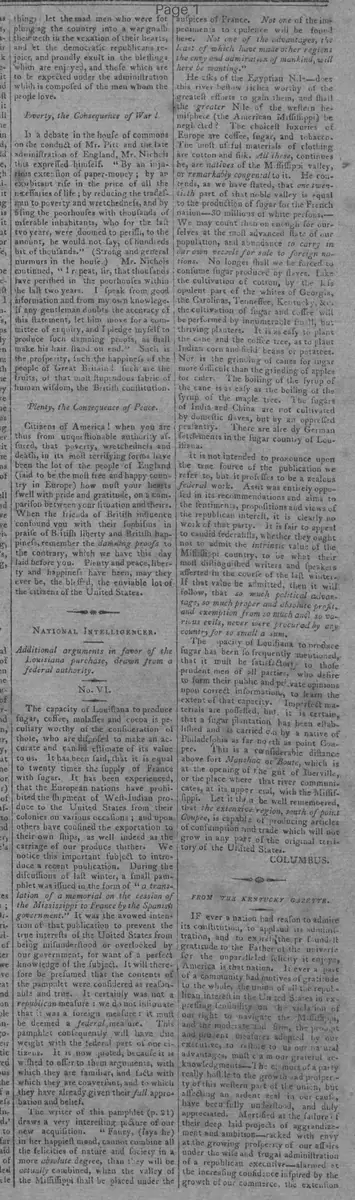
Additional arguments in favor of the Louisiana purchase, drawn from a federal authority.
No. VI.
The capacity of Louisiana to produce sugar, coffee, molasses and cocoa is peculiarly worthy of the consideration of those, who are disposed to make an accurate and candid estimate of its value to us. It has been said, that it is equal to twenty times the supply of France with sugar. It has been experienced, that the European nations have prohibited the shipment of West-India produce to the United States from their colonies on various occasions; and upon others have confined the exportation to their own ships, as well indeed as the carriage of our produce thither. We notice this important subject to introduce a recent publication. During the discussions of last winter, a small pamphlet was issued in the form of "a translation of a memorial on the cession of the Mississippi to France by the Spanish government." It was the avowed intention of that publication to prevent the true interests of the United States from being misunderstood or overlooked by our government, for want of a perfect knowledge of the subject. It will therefore be presumed that the contents of the pamphlet were considered as reasonable and true. It certainly was not a republican measure: we do not insinuate that it was a foreign measure: it must be deemed a federal measure. This pamphlet consequently will have due weight with the federal part of our citizens. It is now quoted, because it is wished to offer to them arguments, with which they are familiar, and facts with which they are conversant, and to which they have already given their full approbation and belief.
The writer of this pamphlet (p. 21) draws a very interesting picture of our new acquisition. "Fancy, says he, in her happiest mood, cannot combine all the felicities of nature and society in a more absolute degree, than they will be actually combined, when the valley of the Mississippi shall be placed under the auspices of France. Not one of the impediments to opulence will be found here. Not one of the advantages, the least of which have made other regions the envy and admiration of mankind, will here be wanting."
He asks of the Egyptian Nile--does this river bestow riches worthy of the greatest efforts to gain them, and shall the greater Nile of the western hemisphere (the American Mississippi) be neglected? The choicest luxuries of Europe are coffee, sugar, and tobacco. The most useful materials of clothing are cotton and silk. All these, continues he, are natives of the Mississippi valley, or remarkably congenial to it. He contends, as we have stated, that one twentieth part of that noble valley is equal to the production of sugar for the French nation--30 millions of white persons.-- We may count then on enough for ourselves at the most advanced state of our population, and abundance to carry in our own vessels for sale to foreign nations. No longer shall we be forced to consume sugar produced by slaves. Like the cultivation of cotton, by the less opulent part of the whites of Georgia, the Carolinas, Tennessee, Kentucky, &c. the cultivation of sugar and coffee will be performed by innumerable small, but thriving planters. It is as easy to plant the cane and the coffee tree, as to plant Indian corn and field beans or potatoes. Nor is the grinding of canes for sugar more difficult than the grinding of apples for cider. The boiling of the syrup of the cane is as easy as the boiling of the syrup of the maple tree. The sugars of India and China are not cultivated by domestic slaves, but by an oppressed peasantry. There are already German settlements in the sugar country of Louisiana.
It is not intended to pronounce upon the true source of the publication we refer to, but it professes to be a zealous federal work. As it was entirely opposed in its recommendations and aims to the sentiments, propositions and views of the republican interest, it is clearly no work of that party. It is fair to appeal to candid federalists, whether they ought not to admit the intrinsic value of the Mississippi country, to be what their most distinguished writers and speakers asserted in the course of the last winter-- If that value be admitted, then it will follow, that so much political advantage, so much proper and absolute profit, and exemption from so much and so various evils, never were procured by any country for so small a sum.
The capacity of Louisiana to produce sugar has been so frequently mentioned, that it must be satisfactory to those prudent men of all parties, who desire to form their public and private opinions upon correct information, to learn the extent of that capacity. Imperfect materials are possessed, but. it is certain that a sugar plantation has been established and is carried on by a native of Philadelphia as far north as point Coupee This is a considerable distance above fort Manshac or Boute, which is at the opening of the gut of Iberville, or the place where that river communicates, at its upper end, with the Mississippi. Let it then be well remembered, that the extensive region, south of point Coupee, is capable of producing articles of consumption and trade which will not grow in any part of the original territory of the United States.
COLUMBUS.
What sub-type of article is it?
What keywords are associated?
Where did it happen?
Domestic News Details
Primary Location
Louisiana
Event Date
Last Winter
Event Details
Article presents additional arguments from a federal pamphlet in favor of the Louisiana Purchase, emphasizing the capacity of the Mississippi valley and Louisiana to produce sugar, coffee, molasses, cocoa, cotton, and tobacco, sufficient to supply the US and for export, reducing dependence on foreign slave-produced goods and enabling cultivation by small white planters.