Thank you for visiting SNEWPapers!
Sign up free
The Ashland Union
Ashland, Ashland County, Ohio
What is this article about?
An 1864 editorial criticizes war profiteers ('shoddy interest') for misleading the public into believing the U.S. Civil War debt is manageable through real estate value, projecting debt at $3.5 billion by 1866, equating to $170 per head in the North, and arguing only annual production can pay taxes.
Merged-components note: These components form a single continuous article analyzing the national debt, war expenditures, and real estate as a resource, split due to initial parsing.
Clipping
OCR Quality
Full Text
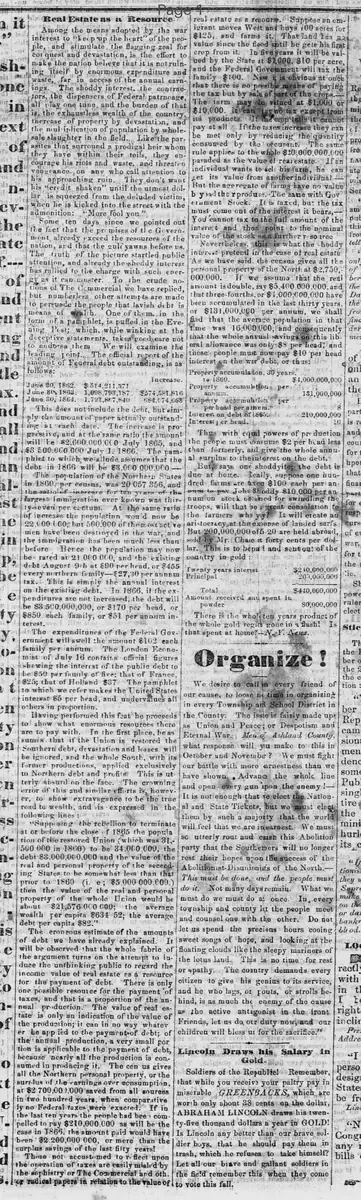
Among the means adopted by the war interest to "keep up the heart" of the people, and stimulate the flagging zeal for conquest and devastation, is the effort to make the nation believe that it is not ruining itself by enormous expenditure and waste, far in excess of the annual earnings. The shoddy interest, the contractors, the dispensers of Federal patronage, all play one tune, and the burden of that is, the exhaustless wealth of the country, increase of property by devastation, and the multiplication of population by wholesale slaughter in the field. Like the parasites that surround a prodigal heir whom they have within their toils, they encourage his riots and waste, and threaten vengeance on any who call attention to his approaching ruin. They don't want his "credit shaken" until the utmost dollar is squeezed from the deluded victim, when he is kicked into the street with the admonition: "More fool you"
Some ten days since we pointed out the fact that the promises of the Government already exceed the resources of the nation, and that the gulf yawns before us. The truth of the picture startled public attention, and already the shoddy interest has rallied to the charge with such energy as it can muster. To the crude notions of The Commercial we have replied, but numberless other attempts are made to persuade the people that lavish debt is means of wealth. One of them, in the form of a pamphlet, is puffed in the Evening Post; which, while winking at the deceptive statements, takes good care not to endorse them. We will examine the leading points. The official report of the amount of Federal debt outstanding, is as follows.
June 30, 1862. $514,211,371
June 30, 1863. 1,098,793,187. $584,581,816
June 30, 1864. 2,791,867,840 1,693,074,653
This does not include the debt, but simply other amounts of paper actually outstanding at each date. The increase is progressive, and at the same ratio the amount will be $2,600,000,000 July 1865, and $3,500,000,000 July 1, 1866. The pamphlet to which we allude assumes that the debt in 1866 will be $3,000,000,000.
The population of the Northern States in 1860 per census, was 20,057,356, and the natural increase for ten years of the largest immigration ever known was thirty-seven per centum. At the same ratio of increase the population would now be 22,000,000; but 500,000 of the most active men have been destroyed in the war, and the immigration has been much less than before. Hence the population may now be rated at 21,000,000, and the existing debt August 9th at $90 per head, or $455 every northern family—$27.30 per annum tax. This is simply the annual interest on the existing debt. In 1866, if the expenditures are not increased, the debt will be $3,500,000,000, or $170 per head, or $850 each family, or $51 per annum interest.
The expenditures of the Federal Government will swell the amount $102 each family per annum. The London Economist of July 16 contains official figures showing the interest of the public debt to be $5 per family of five; that of France, $25; that of Holland $37. The pamphlet to which we refer makes the United States interest $5 per head, and undervalues all others in proportion.
Having performed this feat he proceeds to show what enormous resources there are to pay with. In the first place, he assumes that if the Union is restored the Southern debt, devastation and losses, will be ignored, and the whole South, with its former productions, applied exclusively to Northern debt and profits. This is utterly absurd on the face. The crowning error of this and similar efforts is, however, to show extravagance to be the true road to wealth, and is expressed in the following lines:
"Suppose the rebellion to terminate at or before the close of 1865 the population of the restored Union (which was 31,500,000 in 1860) to be 34,000,000, the debt $3,000,000,000 and the value of the real and personal property of the seceding States to be somewhat less than that prior to 1860 (i.e. $5,000,000,000,) then the value of the real and personal property of the whole Union would be about $21,576,000,000;" the average wealth per capita $636.52; the average debt per capita $88."
The erroneous estimate of the amounts of debt we have already explained. It will be observed that the whole fabric of the argument turns on the attempt to induce the unthinking public to regard the income value of real estate as a resource for the payment of debt. There is only one possible resource for the payment of taxes, and that is a proportion of the annual production. The value of real estate is only an indication of the value of the production; it can in no way whatever be applied to the payment of debt; of the annual production, a very small portion is applicable to the payment of debt, because nearly all the production is consumed in producing it. The census gives all the Northern personal property, or the surplus of the earnings over consumption, as $2,700,000,000 saved from all sources in two hundred years, when comparatively no Federal taxes were exacted. If in the last ten years the people had been compelled to pay $210,000,000 as will be the case in 1866, the amount paid would have been $2,100,000,000, or more than the surplus savings of the last fifty years!
Those not accustomed to reflect upon the operation of taxes are easily misled by the sophistry of The Commercial and other radical papers in relation to the value of real estate as a resource. Suppose an emigrant moves West and buys 100 acres for $125, and farms it. That land has no value since the flood until he gets his first crop from it. In five years it will be valued by the State at $1000, $10 per acre, and the Federal Government will tax the family $100. Now it is obvious at once that there is no possible means of paying the tax but by sale of part of the crops. The farm may be valued at $1000 or $10,000, it can pay no tax except from its products. If a crop fails it cannot pay at all. If the taxes increase they can be met only by reducing the quantity consumed by the occupant. The same rule applies to the whole $30,000,000,000 paraded as the value of real estate. If an individual wants to sell his farm, he can get its value from another individual; But the aggregate of farms have no value beyond their produce. The same with Government Stock. It is taxed, but the tax must come out of the interest it bears. You cannot tax to the full amount of the interest and then point to the nominal value of the stock as a further resource. Nevertheless, this is what the shoddy interest pretend in the case of real estate. As we have said, the census gives all the personal property of the North at $2,750,000,000. If we assume that the real amount is double, say $5,400,000,000, and that three-fourths, or $4,000,000,000 have been accumulated in the last thirty years, or $133,000,000 per annum, we shall find that the average population in that time was 16,000,000, and consequently that the whole annual savings on this liberal allowance was only $8 per head, and those people must now pay $10 per head interest on the war debt, or thus:
Property accumulation, 30 years. $4,000,000,000
Property accumulation per annum. $133,000,000
Property accumulation per head per annum. $8
Interest on debt of 1865. $160,000,000
Interest per head. $10
Thus with equal powers of production the people must consume $2 per head less than formerly, and give the whole annual surplus to the interest on the debt.
But, says one shoddyite: the debt is due at home. Really, suppose one hundred farms are taxed $100 each per annum to pay John Shoddy $10,000 per annum on stock obtained for swindling the troops, will that be a great consolation to the farmers who pay? It will create an aristocracy at the expense of landed serfs. But $200,000,000 of 5-20 are held abroad, sold by Mr. Chase at forty cents per dollar. This is to be paid and sent out of the country in gold.
Principal $200,000,000
Twenty years interest 210,000,000
Total $410,000,000
Amount received and spent in powder 80,000,000
There is the whole ten years product of the whole gold region gone in a flash! Is that spent at home? N. Y. News.
What sub-type of article is it?
What themes does it cover?
What keywords are associated?
What entities or persons were involved?
Where did it happen?
Story Details
Key Persons
Location
Northern States, United States
Event Date
1862 1866
Story Details
Editorial argues that Civil War debt projections exceed national resources, real estate value cannot pay taxes which must come from annual production, criticizes shoddy interests and a pamphlet for deceptive claims on wealth and debt sustainability.