Thank you for visiting SNEWPapers!
Sign up free
Literary
December 22, 1847
Morning Star
Limerick, York County, Maine
What is this article about?
This essay explores love as the central element of Christianity, emphasizing love for God, Christ, humanity, and creation. It argues that true Christian love mirrors God's nature, surpasses faith and hope, and extends universally, supported by scripture, poetry, and reflections on divine compassion.
Clipping
OCR Quality
95%
Excellent
Full Text
For the Morning Star.
LOVE.
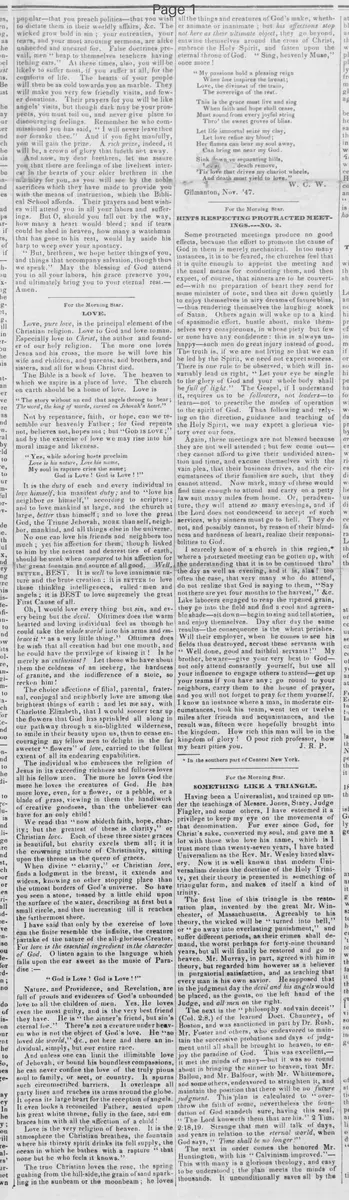
Love, pure love, is the principal element of the Christian religion. Love to God and love to man. Especially love to Christ, the author and founder of our holy religion. The more one loves Jesus and his cross, the more he will love his wife and children, and parents, and brothers, and sisters, and all for whom Christ died.
The Bible is a book of love. The heaven to which we aspire is a place of love. The church on earth should be a home of love. Love is
"The story without an end that angels throng to hear;
The word, the king of words, carved on Jehovah's heart."
Not by repentance, faith, or hope, can we resemble our heavenly Father; for God repents not, believes not, hopes not; but "God is Love;" and by the exercise of love we may rise into his moral image and likeness.
"Yes, while adoring hosts proclaim
Love is his nature, Love his name,
My soul in rapture cries the same;
God is Love! God is Love!!"
It is the duty of each and every individual to love himself, his manifest duty; and to "love his neighbor as himself," according to scripture; and to love mankind at large, and the church at large, better than himself; and to love the great God, the Triune Jehovah, more than self, neighbor, mankind, and all things else in the universe.
No one can love his friends and neighbors too much: yet his affection for them, though linked to him by the nearest and dearest ties of earth, should be weak when compared to his affection for the great fountain and source of all good. Well. Better, BEST. It is well to love inanimate nature and the brute creation: it is BETTER to love those thinking intelligences, called men and angels; it is BEST to love supremely the great First Cause of all.
Oh, I would love every thing but sin, and every being but the devil. "Ofttimes does the warm hearted and loving individual feel as though he could take the whole world into his arms and embrace it " as a very little thing." Oftimes does he wish that all creation had but one mouth, and he could have the privilege of kissing it! Is he merely an enthusiast? Let those who have about them the coldness of an iceberg, the hardness of granite, and the indifference of a stoic, so reckon him!
The choice affections of filial, parental, fraternal, conjugal and neighborly love are among the brightest things of earth: and let me say, with Charlotte Elizabeth, that I would sooner tear up the flowers that God has sprinkled all along in our pathway through a sin-blighted wilderness, to smile in their beauty upon us, than to cease encouraging my fellow men to delight in the far sweeter "flowers" of love, carried to the fullest extent of all its endearing capabilities.
The individual who embraces the religion of Jesus in its exceeding richness and fullness loves all his fellow men. The more he loves God the more he loves the creatures of God. He has more love, even, for a flower, or a pebble, or a blade of grass, viewing in them the handiwork of creative goodness, than the unbeliever can have for an only child!
We read that "now abideth faith, hope, charity; but the greatest of these is charity," or Christian love. Each of these three sister graces is beautiful, but charity excels them all; it is the crowning attribute of Christianity, sitting upon the throne as the queen of graces.
When divine "charity," or Christian love, finds a lodgment in the breast, it extends and widens, knowing no other stopping place than the utmost borders of God's universe. So have you seen a stone, tossed by a little child upon the surface of the water, describing at first but a small circle, and then increasing till it reaches the farthermost shore.
I have said that only by the exercise of love can the finite resemble the infinite, the creature partake of the nature of the all-glorious Creator. For love is the essential ingredient in the character of God. O listen again to the language which falls upon the ear sweet as the music of Paradise:-
"God is Love! God is Love!!"
Nature, and Providence, and Revelation, are full of proofs and evidences of God's unbounded love to all the children of men. Yes, He loves even the most guilty, and is the very best friend they have. He is "the sinner's friend, but sin's eternal foe." There's not a creature under heaven who is not the object of God's love. He "so loved the world," &c., not here and there an individual, simply, but our entire race.
And unless one can limit the illimitable love of Jehovah, or bound his boundless compassions, he can never confine the love of the truly pious soul to family, or sect, or country. It spurns such circumscribed barriers. It overleaps all party lines and reaches its arms around the globe. It opens its large heart for the reception of angels. It even looks a reconciled Father, seated upon his great white throne, fully in the face, and embraces him with all the affection of a child!
Love is the very religion of heaven. It is the atmosphere the Christian breathes, the fountain where his thirsty spirit drinks its full supply, the ocean in which he bathes with a rapture that none but he who feels it knows.
The true Christian loves the rose, the spring gushing from the hill-side, the grain of sand sparkling in the sunbeam or the moonbeam; he loves all the things and creatures of God's make, whether animate or inanimate; but his affections stop not here as their ultimate object, they go beyond, entwine themselves around the cross of Christ, embrace the Holy Spirit, and fasten upon the eternal throne of God. "Sing, heavenly Muse,"
once more!
"My passions hold a pleasing reign
When love inspires the breast;
Love, the divinest of the train,
The sovereign of the rest.
This is the grace must live and sing
When faith and hope shall cease,
Must sound from every joyful string
Thro'the sweet groves of bliss.
Let life immortal seize my clay,
Let love refine my blood;
Her flames can bear my soul away,
Can bring me near my God.
Sink down ye separating hills,
Let death remove,
'Tis love that drives my chariot wheels,
And death must yield to love."
W. C. W.
Gilmanton, Nov. '47.
LOVE.
Love, pure love, is the principal element of the Christian religion. Love to God and love to man. Especially love to Christ, the author and founder of our holy religion. The more one loves Jesus and his cross, the more he will love his wife and children, and parents, and brothers, and sisters, and all for whom Christ died.
The Bible is a book of love. The heaven to which we aspire is a place of love. The church on earth should be a home of love. Love is
"The story without an end that angels throng to hear;
The word, the king of words, carved on Jehovah's heart."
Not by repentance, faith, or hope, can we resemble our heavenly Father; for God repents not, believes not, hopes not; but "God is Love;" and by the exercise of love we may rise into his moral image and likeness.
"Yes, while adoring hosts proclaim
Love is his nature, Love his name,
My soul in rapture cries the same;
God is Love! God is Love!!"
It is the duty of each and every individual to love himself, his manifest duty; and to "love his neighbor as himself," according to scripture; and to love mankind at large, and the church at large, better than himself; and to love the great God, the Triune Jehovah, more than self, neighbor, mankind, and all things else in the universe.
No one can love his friends and neighbors too much: yet his affection for them, though linked to him by the nearest and dearest ties of earth, should be weak when compared to his affection for the great fountain and source of all good. Well. Better, BEST. It is well to love inanimate nature and the brute creation: it is BETTER to love those thinking intelligences, called men and angels; it is BEST to love supremely the great First Cause of all.
Oh, I would love every thing but sin, and every being but the devil. "Ofttimes does the warm hearted and loving individual feel as though he could take the whole world into his arms and embrace it " as a very little thing." Oftimes does he wish that all creation had but one mouth, and he could have the privilege of kissing it! Is he merely an enthusiast? Let those who have about them the coldness of an iceberg, the hardness of granite, and the indifference of a stoic, so reckon him!
The choice affections of filial, parental, fraternal, conjugal and neighborly love are among the brightest things of earth: and let me say, with Charlotte Elizabeth, that I would sooner tear up the flowers that God has sprinkled all along in our pathway through a sin-blighted wilderness, to smile in their beauty upon us, than to cease encouraging my fellow men to delight in the far sweeter "flowers" of love, carried to the fullest extent of all its endearing capabilities.
The individual who embraces the religion of Jesus in its exceeding richness and fullness loves all his fellow men. The more he loves God the more he loves the creatures of God. He has more love, even, for a flower, or a pebble, or a blade of grass, viewing in them the handiwork of creative goodness, than the unbeliever can have for an only child!
We read that "now abideth faith, hope, charity; but the greatest of these is charity," or Christian love. Each of these three sister graces is beautiful, but charity excels them all; it is the crowning attribute of Christianity, sitting upon the throne as the queen of graces.
When divine "charity," or Christian love, finds a lodgment in the breast, it extends and widens, knowing no other stopping place than the utmost borders of God's universe. So have you seen a stone, tossed by a little child upon the surface of the water, describing at first but a small circle, and then increasing till it reaches the farthermost shore.
I have said that only by the exercise of love can the finite resemble the infinite, the creature partake of the nature of the all-glorious Creator. For love is the essential ingredient in the character of God. O listen again to the language which falls upon the ear sweet as the music of Paradise:-
"God is Love! God is Love!!"
Nature, and Providence, and Revelation, are full of proofs and evidences of God's unbounded love to all the children of men. Yes, He loves even the most guilty, and is the very best friend they have. He is "the sinner's friend, but sin's eternal foe." There's not a creature under heaven who is not the object of God's love. He "so loved the world," &c., not here and there an individual, simply, but our entire race.
And unless one can limit the illimitable love of Jehovah, or bound his boundless compassions, he can never confine the love of the truly pious soul to family, or sect, or country. It spurns such circumscribed barriers. It overleaps all party lines and reaches its arms around the globe. It opens its large heart for the reception of angels. It even looks a reconciled Father, seated upon his great white throne, fully in the face, and embraces him with all the affection of a child!
Love is the very religion of heaven. It is the atmosphere the Christian breathes, the fountain where his thirsty spirit drinks its full supply, the ocean in which he bathes with a rapture that none but he who feels it knows.
The true Christian loves the rose, the spring gushing from the hill-side, the grain of sand sparkling in the sunbeam or the moonbeam; he loves all the things and creatures of God's make, whether animate or inanimate; but his affections stop not here as their ultimate object, they go beyond, entwine themselves around the cross of Christ, embrace the Holy Spirit, and fasten upon the eternal throne of God. "Sing, heavenly Muse,"
once more!
"My passions hold a pleasing reign
When love inspires the breast;
Love, the divinest of the train,
The sovereign of the rest.
This is the grace must live and sing
When faith and hope shall cease,
Must sound from every joyful string
Thro'the sweet groves of bliss.
Let life immortal seize my clay,
Let love refine my blood;
Her flames can bear my soul away,
Can bring me near my God.
Sink down ye separating hills,
Let death remove,
'Tis love that drives my chariot wheels,
And death must yield to love."
W. C. W.
Gilmanton, Nov. '47.
What sub-type of article is it?
Essay
What themes does it cover?
Religious
Moral Virtue
What keywords are associated?
Christian Love
God Is Love
Charity
Divine Compassion
Moral Likeness
Universal Affection
Scriptural Duty
What entities or persons were involved?
W. C. W., Gilmanton, Nov. '47.
Literary Details
Title
Love.
Author
W. C. W., Gilmanton, Nov. '47.
Subject
Love As The Principal Element Of The Christian Religion
Key Lines
"God Is Love;" And By The Exercise Of Love We May Rise Into His Moral Image And Likeness.
"Yes, While Adoring Hosts Proclaim
Love Is His Nature, Love His Name,
My Soul In Rapture Cries The Same;
God Is Love! God Is Love!!"
We Read That "Now Abideth Faith, Hope, Charity; But The Greatest Of These Is Charity," Or Christian Love.
"God Is Love! God Is Love!!"
"My Passions Hold A Pleasing Reign
When Love Inspires The Breast;
Love, The Divinest Of The Train,
The Sovereign Of The Rest.
This Is The Grace Must Live And Sing
When Faith And Hope Shall Cease,
Must Sound From Every Joyful String
Thro'the Sweet Groves Of Bliss."