Thank you for visiting SNEWPapers!
Sign up free
Literary
February 13, 1858
The Cecil Whig
Elkton, Cecil County, Maryland
What is this article about?
An article from Scientific American demonstrates that dissolving soluble substances in water does not increase its volume, unlike immersing solids. It describes saturating water with sugar, salt of tartar, green vitriol, nitre, sal ammoniac, alum, and borax without overflow.
Clipping
OCR Quality
75%
Good
Full Text
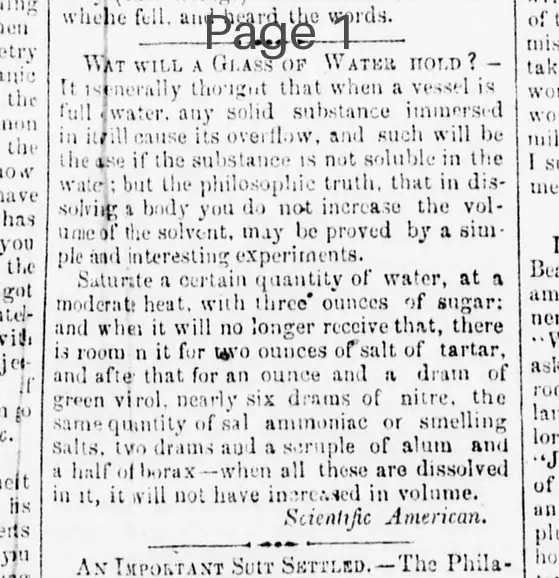
What will a glass of water hold? - It is generally thought that when a vessel is full of water, any solid substance immersed in it will cause its overflow, and such will be the case if the substance is not soluble in the water; but the philosophical truth, that in dissolving a body you do not increase the volume of the solvent, may be proved by a simple and interesting experiment. Saturate a certain quantity of water, at a moderate heat, with three ounces of sugar: and when it will no longer receive that, there is room in it for two ounces of salt of tartar, and after that for an ounce and a dram of green vitriol, nearly six drams of nitre, the same quantity of sal ammoniac or smelling salts, two drams and a scruple of alum and a half of borax—when all these are dissolved in it, it will not have increased in volume. Scientific American.
What sub-type of article is it?
Essay
What keywords are associated?
Water Volume
Dissolving Substances
Scientific Experiment
Sugar Saturation
Salts Dissolution
What entities or persons were involved?
Scientific American
Literary Details
Title
What Will A Glass Of Water Hold?
Author
Scientific American
Form / Style
Prose Demonstration
Key Lines
What Will A Glass Of Water Hold?
But The Philosophical Truth, That In Dissolving A Body You Do Not Increase The Volume Of The Solvent, May Be Proved By A Simple And Interesting Experiment.
When All These Are Dissolved In It, It Will Not Have Increased In Volume.