Thank you for visiting SNEWPapers!
Sign up free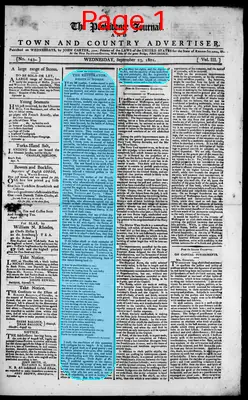
Editorial
September 23, 1801
The Providence Journal, And Town And Country Advertiser
Providence, Providence County, Rhode Island
What is this article about?
An editorial critiquing modern 'Rights of Woman' ideas by contrasting them with traditional female roles in ancient Athens and Rome, exemplified by figures like Lucretia and Cornelia, and quoting poet Thomson to advocate for women's domestic virtues and modesty over equality claims.
Clipping
OCR Quality
98%
Excellent
Full Text
From the Palladium.
THE RESTORATOR.
RIGHTS OF WOMEN.
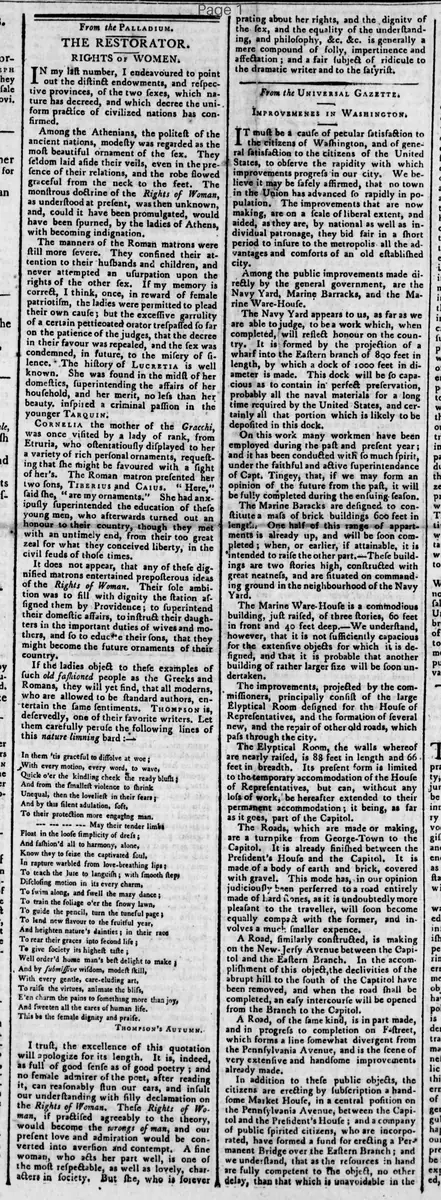
IN my last number, I endeavoured to point out the distinct endowments, and respective provinces, of the two sexes, which nature has decreed, and which decree the uniform practice of civilized nations has confirmed.
Among the Athenians, the politest of the ancient nations, modesty was regarded as the most beautiful ornament of the sex. They seldom laid aside their veils, even in the presence of their relations, and the robe flowed graceful from the neck to the feet. The monstrous doctrine of the Rights of Woman, as understood at present, was then unknown, and, could it have been promulgated, would have been spurned, by the ladies of Athens, with becoming indignation.
The manners of the Roman matrons were still more severe. They confined their attention to their husbands and children, and never attempted an usurpation upon the rights of the other sex. If my memory is correct, I think, once, in reward of female patriotism, the ladies were permitted to plead their own cause; but the excessive garrulity of a certain petticoated orator trespassed so far on the patience of the judges, that the decree in their favour was repealed, and the sex was condemned, in future, to the misery of silence. The history of Lucretia is well known. She was found in the midst of her domestics, superintending the affairs of her household, and her merit, no less than her beauty, inspired a criminal passion in the younger Tarquin.
Cornelia the mother of the Gracchi, was once visited by a lady of rank, from Etruria, who ostentatiously displayed to her a variety of rich personal ornaments, requesting that she might be favoured with a sight of hers. The Roman matron presented her two sons, Tiberius and Caius. "These," said she, "are my ornaments." She had anxiously superintended the education of these young men, who afterwards turned out an honour to their country, though they met with an untimely end, from their too great zeal for what they conceived liberty, in the civil feuds of those times.
It does not appear, that any of these dignified matrons entertained preposterous ideas of the Rights of Woman. Their sole ambition was to fill with dignity the station assigned them by Providence; to superintend their domestic affairs, to instruct their daughters in the important duties of wives and mothers, and so to educate their sons, that they might become the future ornaments of their country.
If the ladies object to these examples of such old fashioned people as the Greeks and Romans, they will yet find, that all moderns, who are allowed to be standard authors, entertain the same sentiments. Thomson is, deservedly, one of their favorite writers. Let them carefully peruse the following lines of this nature limning bard:
In them 'tis graceful to dissolve at woe;
With every motion, every word, to wave,
Quick o'er the kindling cheek the ready blush
And from the smallest violence to shrink
Unequal, then the loveliest in their fears;
And by this silent adulation, oft,
To their protection more engaging man.
--- May their tender limbs
Float in the loose simplicity of dress;
And fashion'd all to harmony, alone,
Know they to seize the captivated soul,
In rapture warbled from love-breathing lips;
To teach the lute to languish; with smooth steps
Disclosing motion in its every charm,
To swim along, and well the mazy dance;
To train the foliage o'er the snowy lawn,
To guide the pencil, turn the tuneful page;
To lend new flavour to the fruitful year,
And heighten nature's dainties; in their race
To rear their graces into second life;
To give society its highest state;
Well order'd home man's best delight to make;
And by submissive wisdom, modest skill,
With every gentle, care-eluding art,
To raise the virtues, animate the bliss,
E'en charm the pains to something more than joy,
And sweeten all the cares of human life.
This be the female dignity and praise.
Thomson's Autumn.
I trust, the excellence of this quotation will apologize for its length. It is, indeed, as full of good sense as of good poetry; and no female admirer of the poet, after reading it, can reasonably turn our ears, and insult our understanding with silly declamation on the Rights of Woman. These Rights of Woman, if practiced agreeably to the theory, would become the wrongs of man, and our present love and admiration would be converted into aversion and contempt. A fine woman, who acts her part well, is one of the most respectable, as well as lovely, characters in society. But she, who is forever prating about her rights, and the dignity of the sex, and the equality of the understanding, and philosophy, &c. &c. is generally a mere compound of folly, impertinence and affectation; and a fair subject of ridicule to the dramatic writer and to the satirist.
THE RESTORATOR.
RIGHTS OF WOMEN.
IN my last number, I endeavoured to point out the distinct endowments, and respective provinces, of the two sexes, which nature has decreed, and which decree the uniform practice of civilized nations has confirmed.
Among the Athenians, the politest of the ancient nations, modesty was regarded as the most beautiful ornament of the sex. They seldom laid aside their veils, even in the presence of their relations, and the robe flowed graceful from the neck to the feet. The monstrous doctrine of the Rights of Woman, as understood at present, was then unknown, and, could it have been promulgated, would have been spurned, by the ladies of Athens, with becoming indignation.
The manners of the Roman matrons were still more severe. They confined their attention to their husbands and children, and never attempted an usurpation upon the rights of the other sex. If my memory is correct, I think, once, in reward of female patriotism, the ladies were permitted to plead their own cause; but the excessive garrulity of a certain petticoated orator trespassed so far on the patience of the judges, that the decree in their favour was repealed, and the sex was condemned, in future, to the misery of silence. The history of Lucretia is well known. She was found in the midst of her domestics, superintending the affairs of her household, and her merit, no less than her beauty, inspired a criminal passion in the younger Tarquin.
Cornelia the mother of the Gracchi, was once visited by a lady of rank, from Etruria, who ostentatiously displayed to her a variety of rich personal ornaments, requesting that she might be favoured with a sight of hers. The Roman matron presented her two sons, Tiberius and Caius. "These," said she, "are my ornaments." She had anxiously superintended the education of these young men, who afterwards turned out an honour to their country, though they met with an untimely end, from their too great zeal for what they conceived liberty, in the civil feuds of those times.
It does not appear, that any of these dignified matrons entertained preposterous ideas of the Rights of Woman. Their sole ambition was to fill with dignity the station assigned them by Providence; to superintend their domestic affairs, to instruct their daughters in the important duties of wives and mothers, and so to educate their sons, that they might become the future ornaments of their country.
If the ladies object to these examples of such old fashioned people as the Greeks and Romans, they will yet find, that all moderns, who are allowed to be standard authors, entertain the same sentiments. Thomson is, deservedly, one of their favorite writers. Let them carefully peruse the following lines of this nature limning bard:
In them 'tis graceful to dissolve at woe;
With every motion, every word, to wave,
Quick o'er the kindling cheek the ready blush
And from the smallest violence to shrink
Unequal, then the loveliest in their fears;
And by this silent adulation, oft,
To their protection more engaging man.
--- May their tender limbs
Float in the loose simplicity of dress;
And fashion'd all to harmony, alone,
Know they to seize the captivated soul,
In rapture warbled from love-breathing lips;
To teach the lute to languish; with smooth steps
Disclosing motion in its every charm,
To swim along, and well the mazy dance;
To train the foliage o'er the snowy lawn,
To guide the pencil, turn the tuneful page;
To lend new flavour to the fruitful year,
And heighten nature's dainties; in their race
To rear their graces into second life;
To give society its highest state;
Well order'd home man's best delight to make;
And by submissive wisdom, modest skill,
With every gentle, care-eluding art,
To raise the virtues, animate the bliss,
E'en charm the pains to something more than joy,
And sweeten all the cares of human life.
This be the female dignity and praise.
Thomson's Autumn.
I trust, the excellence of this quotation will apologize for its length. It is, indeed, as full of good sense as of good poetry; and no female admirer of the poet, after reading it, can reasonably turn our ears, and insult our understanding with silly declamation on the Rights of Woman. These Rights of Woman, if practiced agreeably to the theory, would become the wrongs of man, and our present love and admiration would be converted into aversion and contempt. A fine woman, who acts her part well, is one of the most respectable, as well as lovely, characters in society. But she, who is forever prating about her rights, and the dignity of the sex, and the equality of the understanding, and philosophy, &c. &c. is generally a mere compound of folly, impertinence and affectation; and a fair subject of ridicule to the dramatic writer and to the satirist.
What sub-type of article is it?
Feminism
Moral Or Religious
What keywords are associated?
Women's Rights
Gender Roles
Modesty
Domestic Duties
Ancient Examples
Thomson Poetry
Female Dignity
What entities or persons were involved?
Athenians
Roman Matrons
Lucretia
Cornelia
Tiberius Gracchus
Caius Gracchus
Thomson
Editorial Details
Primary Topic
Critique Of Women's Rights And Advocacy For Traditional Female Roles
Stance / Tone
Strongly Anti Feminist And Traditionalist
Key Figures
Athenians
Roman Matrons
Lucretia
Cornelia
Tiberius Gracchus
Caius Gracchus
Thomson
Key Arguments
Nature Decrees Distinct Roles For Sexes Confirmed By Civilized Nations
Ancient Athenian Women Valued Modesty And Veiled Themselves
Roman Matrons Focused On Husbands, Children, And Household Without Usurping Male Rights
Historical Incident Where Women's Garrulity Led To Repeal Of Speaking Rights
Lucretia Exemplified Domestic Superintendence
Cornelia Prized Her Sons As Her True Ornaments Over Jewels
Ancient Women Did Not Entertain Ideas Of Women's Rights But Filled Domestic Stations With Dignity
Modern Authors Like Thomson Praise Women's Submissive, Modest Virtues In Poetry
Women's Rights Advocacy Leads To Folly, Impertinence, And Ridicule