Thank you for visiting SNEWPapers!
Sign up free
Story
October 3, 1868
The Cecil Whig
Elkton, Cecil County, Maryland
What is this article about?
A newspaper article warns former Union men against aligning with the Democratic party, citing a 1868 telegram from Confederate general G.T. Beauregard to Wm. P. Miles advocating execution of abolition prisoners and raising the black flag, portraying Democratic leadership as extreme.
Clipping
OCR Quality
95%
Excellent
Full Text
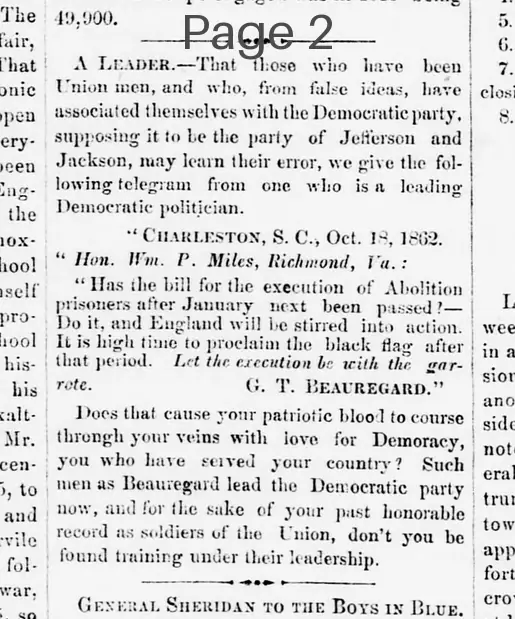
A LEADER.—That those who have been Union men, and who, from false ideas, have associated themselves with the Democratic party, supposing it to be the party of Jefferson and Jackson, may learn their error, we give the following telegram from one who is a leading Democratic politician.
CHARLESTON, S. C., Oct. 1, 1868.
"Hon. Wm. P. Miles, Richmond, Va.:
"Has the bill for the execution of Abolition prisoners after January next been passed?—Do it, and England will be stirred into action. It is high time to proclaim the black flag after that period. Let the execution be with the garrote.
G. T. BEAUREGARD."
Does that cause your patriotic blood to course through your veins with love for Democracy, you who have served your country? Such men as Beauregard lead the Democratic party now, and for the sake of your past honorable record as soldiers of the Union, don't you be found training under their leadership.
CHARLESTON, S. C., Oct. 1, 1868.
"Hon. Wm. P. Miles, Richmond, Va.:
"Has the bill for the execution of Abolition prisoners after January next been passed?—Do it, and England will be stirred into action. It is high time to proclaim the black flag after that period. Let the execution be with the garrote.
G. T. BEAUREGARD."
Does that cause your patriotic blood to course through your veins with love for Democracy, you who have served your country? Such men as Beauregard lead the Democratic party now, and for the sake of your past honorable record as soldiers of the Union, don't you be found training under their leadership.
What sub-type of article is it?
Historical Event
What themes does it cover?
Deception
Betrayal
What keywords are associated?
Beauregard Telegram
Democratic Party
Abolition Prisoners
Black Flag
Civil War Politics
What entities or persons were involved?
G. T. Beauregard
Wm. P. Miles
Where did it happen?
Charleston, S. C.
Story Details
Key Persons
G. T. Beauregard
Wm. P. Miles
Location
Charleston, S. C.
Event Date
Oct. 1, 1868
Story Details
Telegram from Beauregard to Miles urges passing bill to execute abolition prisoners after January, to provoke England, proclaim black flag, and use garrote; used to expose Democratic extremism and warn Union men.