Thank you for visiting SNEWPapers!
Sign up free
Literary
July 13, 1813
Alexandria Gazette, Commercial And Political
Alexandria, Virginia
What is this article about?
Narrative sketch by Poor Robert the Scribe in the Gleaner, portraying the compassionate Parson Mr. Clayton of Appleberry: rescuing a madwoman and her infant from a storm, joyfully attending a wedding, and delivering solemn sermons that inspire the congregation.
Merged-components note: Continuation of the literary piece 'From the Gleaner' from page 2 to page 3; text directly continues the narrative and song.
Clippings
1 of 2
OCR Quality
92%
Excellent
Full Text
From the Gleaner.
FROM THE DESK OF POOR ROBERT THE SCRIBE.
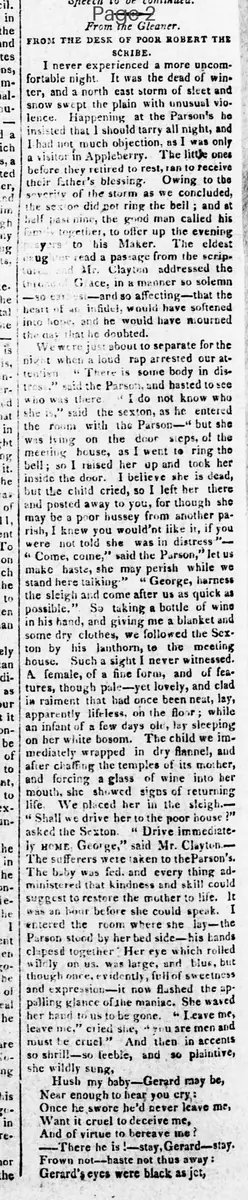
I never experienced a more uncomfortable night. It was the dead of winter, and a north east storm of sleet and snow swept the plain with unusual violence. Happening at the Parson's he insisted that I should tarry all night, and I had not much objection, as I was only a visitor in Appleberry. The little ones before they retired to rest, ran to receive their father's blessing. Owing to the severity of the storm as we concluded, the sexton did not ring the bell; and at half past nine, the good man called his family together, to offer up the evening prayers to his Maker. The eldest daughter read a passage from the scripture. and Mr. Clayton addressed the family Grace, in a manner so solemn—so earnest—and so affecting—that the heart of an infidel would have softened into love, and he would have mourned the day that he doubted.
We were just about to separate for the night when a loud rap arrested our attention. "There is somebody in distress," said the Parson, and hastened to see who was there. "I do not know who she is," said the sexton, as he entered the room with the Parson—"but she was sitting on the door steps, of the meeting house, as I went to ring the bell; so I raised her up and took her inside the door. I believe she is dead, but the child cried, so I left her there and posted away to you, for though she may be a poor hussey from another parish, I knew you wouldn't like it, if you were not told she was in distress"— "Come, come," said the Parson, "let us make haste, she may perish while we stand here talking:" "George, harness the sleigh and come after us as quick as possible." So taking a bottle of wine in his hand, and giving me a blanket and some dry clothes, we followed the Sexton by his lanthorn, to the meeting house. Such a sight I never witnessed. A female, of a fine form, and of features, though pale—yet lovely, and clad in raiment that had once been neat, lay, apparently lifeless, on the floor; while an infant of a few days old, lay sleeping on her white bosom. The child we immediately wrapped in dry flannel, and after chafing the temples of its mother, and forcing a glass of wine into her mouth, she showed signs of returning life. We placed her in the sleigh.— "Shall we drive her to the poor house?" asked the Sexton. "Drive immediately home, George," said Mr. Clayton.— The sufferers were taken to the Parson's. The baby was fed, and every thing administered that kindness and skill could suggest to restore the mother to life. It was an hour before she could speak. I entered the room where she lay—the Parson stood by her bed side—his hands clasped together: Her eye which rolled wildly on us, was large, and blue, but though once, evidently, full of sweetness and expression—it now flashed the appalling glance of the maniac. She waved her hand to us to be gone. "Leave me, leave me," cried she, "you are men and must be cruel" And then in accents so shrill—so feeble, and so plaintive, she wildly sung,
Hush my baby—Gerard may be,
Near enough to hear you cry:
Once he swore he'd never leave me,
Was it cruel to deceive me,
And of virtue to bereave me?
—There he is!—stay, Gerard—stay.
Frown not—haste not thus away:
Gerard's eyes were black as jet,
No, not—do not leave me yet;
--Hush, my baby—do not cry—
Oh! let wretched Mary die.
The composing draughts administered to the poor girl at length quieted her to rest, and we left her with the hope that sleep, "restorer of nature and kind nurse of men," might have a propitious influence on her health—we had not been from her room more than an hour before Mr. Clayton's daughter softly opened the door to see whether her charge was comfortable, when she discovered the window open and the poor maniac gone. All search for her was vain—but we afterwards learned from a distance that a young woman, answering to the description of wretched Mary, was seen wandering around singing as she went,
"Should you some coast be laid on,
Where gold and diamonds grow;
You may find some richer maiden,
But none that loves you so."
And then she'd ask, with a melancholy smile, "Was it wicked to drown my baby? It was a pretty baby, but they drowned it."
The manuscript left, and a gold chain that was on the neck of the infant, disclosed the mother's story, and if Mr. Clayton will permit me, shall be copied for the Gleaner, when the story is told of the life of the little orphan.
But such was the conduct of the Parson to the poor wanderer. He never shunned the bed of sickness, but "More apt to raise the wretched than to rise" himself, the house of mourning was to him the place of constant resort.
Christmas soon came, and I was invited to the wedding of John Wellwood and Fanny Aimwell, the daughter of the Squire. You knew Squire Aimwell, he was set the psalm at meeting. Mr. Clayton, of course, married them, aye, and published the banns in the good old fashioned way, beforehand. Half the young folks in Appleberry were there. The ceremony was performed with all solemnity. But do you think that Mr. Clayton put on a long face and sat in one corner, checking our mirth by his severity. I tell you what you know nothing about the man if you think, because he has good that he looks sour and couldn't smile. Not he! There wasn't a blither and merrier man in the circle. I know he kissed the bride, for the girls said, though she blushed and held down her head that they heard the smack. He took a glass of wine, and I remember showed his good humor by laughing merrily at a very simple thing. He asked Sir George Ardenburg that he could press a piece of money on his forehead. Fast that he could not rub or shake it off. So wetting George's forehead, he pressed the money on as hard as possible, but slyly slipped it off as he took away his hand. Feeling the impression and supposing the money left there, George, who was not naturally well featured, frowned and frowned and shook his head to get it off, till all the circle was in a roar of merriment at his expense. Oh! the good old times of our younger days! There's no such happiness now. All young men were so neat—No one thought of smoking till he was 49—and girls were so tidy, and in homespun.
Blest days! are ye gone forever!
Sigh too!
When the Parson went away, and he left us early, it would have done your heart good to see the young folks crowd around him, to bid him good night.—By there wasn't one in the village but all loved him as a parent.
It was not at the habitation of wretchedness, or in the social circle alone that he excelled. I have often guarded him to the pulpit, for then every body loved to go to meeting. Why every pew and seat was full, and they didn't run round a little black boy on a pole every half as they do now-a-days for a penny. In the pulpit he was solemn and impressive. He seemed as a shepherd in the Saviour's fold, to feel, that it being deputed to superintend the flock of his care, he was in an exalted and awful-responsible station. Venerable man! methinks I see him in the desk, persuasive as the dews of Hybla, distilling from his lips, while the invitations of the Gospel flow to lost and perishing sinners. On his eye, beaming with the conscious justice of his duty, appalling the tremendous denunciations of the law—the obdurately impenitent. None slept while he spake. Hope, & terror & despair, alternately swelled the bosom with delightful emotions or filled it with dismay. I never heard him but I rose up with a firm resolution to end my life in respect to my Maker, and my fellowman.
Such was Mr. Clayton, the pastor of the parish of Applebury. I have often pondered him and thought you would like to know his character. Preachers of the Gospel, if ye deign to read the feeble essays of poor Robert, listen to the character of Mr. Clayton of imitation; read that part and imitate his virtues. If there is amiss—forgive his errors and his failings.
FROM THE DESK OF POOR ROBERT THE SCRIBE.
I never experienced a more uncomfortable night. It was the dead of winter, and a north east storm of sleet and snow swept the plain with unusual violence. Happening at the Parson's he insisted that I should tarry all night, and I had not much objection, as I was only a visitor in Appleberry. The little ones before they retired to rest, ran to receive their father's blessing. Owing to the severity of the storm as we concluded, the sexton did not ring the bell; and at half past nine, the good man called his family together, to offer up the evening prayers to his Maker. The eldest daughter read a passage from the scripture. and Mr. Clayton addressed the family Grace, in a manner so solemn—so earnest—and so affecting—that the heart of an infidel would have softened into love, and he would have mourned the day that he doubted.
We were just about to separate for the night when a loud rap arrested our attention. "There is somebody in distress," said the Parson, and hastened to see who was there. "I do not know who she is," said the sexton, as he entered the room with the Parson—"but she was sitting on the door steps, of the meeting house, as I went to ring the bell; so I raised her up and took her inside the door. I believe she is dead, but the child cried, so I left her there and posted away to you, for though she may be a poor hussey from another parish, I knew you wouldn't like it, if you were not told she was in distress"— "Come, come," said the Parson, "let us make haste, she may perish while we stand here talking:" "George, harness the sleigh and come after us as quick as possible." So taking a bottle of wine in his hand, and giving me a blanket and some dry clothes, we followed the Sexton by his lanthorn, to the meeting house. Such a sight I never witnessed. A female, of a fine form, and of features, though pale—yet lovely, and clad in raiment that had once been neat, lay, apparently lifeless, on the floor; while an infant of a few days old, lay sleeping on her white bosom. The child we immediately wrapped in dry flannel, and after chafing the temples of its mother, and forcing a glass of wine into her mouth, she showed signs of returning life. We placed her in the sleigh.— "Shall we drive her to the poor house?" asked the Sexton. "Drive immediately home, George," said Mr. Clayton.— The sufferers were taken to the Parson's. The baby was fed, and every thing administered that kindness and skill could suggest to restore the mother to life. It was an hour before she could speak. I entered the room where she lay—the Parson stood by her bed side—his hands clasped together: Her eye which rolled wildly on us, was large, and blue, but though once, evidently, full of sweetness and expression—it now flashed the appalling glance of the maniac. She waved her hand to us to be gone. "Leave me, leave me," cried she, "you are men and must be cruel" And then in accents so shrill—so feeble, and so plaintive, she wildly sung,
Hush my baby—Gerard may be,
Near enough to hear you cry:
Once he swore he'd never leave me,
Was it cruel to deceive me,
And of virtue to bereave me?
—There he is!—stay, Gerard—stay.
Frown not—haste not thus away:
Gerard's eyes were black as jet,
No, not—do not leave me yet;
--Hush, my baby—do not cry—
Oh! let wretched Mary die.
The composing draughts administered to the poor girl at length quieted her to rest, and we left her with the hope that sleep, "restorer of nature and kind nurse of men," might have a propitious influence on her health—we had not been from her room more than an hour before Mr. Clayton's daughter softly opened the door to see whether her charge was comfortable, when she discovered the window open and the poor maniac gone. All search for her was vain—but we afterwards learned from a distance that a young woman, answering to the description of wretched Mary, was seen wandering around singing as she went,
"Should you some coast be laid on,
Where gold and diamonds grow;
You may find some richer maiden,
But none that loves you so."
And then she'd ask, with a melancholy smile, "Was it wicked to drown my baby? It was a pretty baby, but they drowned it."
The manuscript left, and a gold chain that was on the neck of the infant, disclosed the mother's story, and if Mr. Clayton will permit me, shall be copied for the Gleaner, when the story is told of the life of the little orphan.
But such was the conduct of the Parson to the poor wanderer. He never shunned the bed of sickness, but "More apt to raise the wretched than to rise" himself, the house of mourning was to him the place of constant resort.
Christmas soon came, and I was invited to the wedding of John Wellwood and Fanny Aimwell, the daughter of the Squire. You knew Squire Aimwell, he was set the psalm at meeting. Mr. Clayton, of course, married them, aye, and published the banns in the good old fashioned way, beforehand. Half the young folks in Appleberry were there. The ceremony was performed with all solemnity. But do you think that Mr. Clayton put on a long face and sat in one corner, checking our mirth by his severity. I tell you what you know nothing about the man if you think, because he has good that he looks sour and couldn't smile. Not he! There wasn't a blither and merrier man in the circle. I know he kissed the bride, for the girls said, though she blushed and held down her head that they heard the smack. He took a glass of wine, and I remember showed his good humor by laughing merrily at a very simple thing. He asked Sir George Ardenburg that he could press a piece of money on his forehead. Fast that he could not rub or shake it off. So wetting George's forehead, he pressed the money on as hard as possible, but slyly slipped it off as he took away his hand. Feeling the impression and supposing the money left there, George, who was not naturally well featured, frowned and frowned and shook his head to get it off, till all the circle was in a roar of merriment at his expense. Oh! the good old times of our younger days! There's no such happiness now. All young men were so neat—No one thought of smoking till he was 49—and girls were so tidy, and in homespun.
Blest days! are ye gone forever!
Sigh too!
When the Parson went away, and he left us early, it would have done your heart good to see the young folks crowd around him, to bid him good night.—By there wasn't one in the village but all loved him as a parent.
It was not at the habitation of wretchedness, or in the social circle alone that he excelled. I have often guarded him to the pulpit, for then every body loved to go to meeting. Why every pew and seat was full, and they didn't run round a little black boy on a pole every half as they do now-a-days for a penny. In the pulpit he was solemn and impressive. He seemed as a shepherd in the Saviour's fold, to feel, that it being deputed to superintend the flock of his care, he was in an exalted and awful-responsible station. Venerable man! methinks I see him in the desk, persuasive as the dews of Hybla, distilling from his lips, while the invitations of the Gospel flow to lost and perishing sinners. On his eye, beaming with the conscious justice of his duty, appalling the tremendous denunciations of the law—the obdurately impenitent. None slept while he spake. Hope, & terror & despair, alternately swelled the bosom with delightful emotions or filled it with dismay. I never heard him but I rose up with a firm resolution to end my life in respect to my Maker, and my fellowman.
Such was Mr. Clayton, the pastor of the parish of Applebury. I have often pondered him and thought you would like to know his character. Preachers of the Gospel, if ye deign to read the feeble essays of poor Robert, listen to the character of Mr. Clayton of imitation; read that part and imitate his virtues. If there is amiss—forgive his errors and his failings.
What sub-type of article is it?
Essay
Prose Fiction
What themes does it cover?
Religious
Moral Virtue
Social Manners
What keywords are associated?
Parson Clayton
Compassion
Madwoman
Infant Rescue
Wedding Merriment
Sermon
Appleberry Parish
Moral Character
What entities or persons were involved?
Poor Robert The Scribe
Literary Details
Title
From The Desk Of Poor Robert The Scribe
Author
Poor Robert The Scribe
Subject
Character Of Mr. Clayton
Key Lines
Hush My Baby—Gerard May Be,
Near Enough To Hear You Cry:
Once He Swore He'd Never Leave Me,
Was It Cruel To Deceive Me,
And Of Virtue To Bereave Me?
—There He Is!—Stay, Gerard—Stay.
Frown Not—Haste Not Thus Away:
Gerard's Eyes Were Black As Jet,
No, Not—Do Not Leave Me Yet;
Hush, My Baby—Do Not Cry—
Oh! Let Wretched Mary Die.
"Should You Some Coast Be Laid On,
Where Gold And Diamonds Grow;
You May Find Some Richer Maiden,
But None That Loves You So."
Blest Days! Are Ye Gone Forever!
Sigh Too!