Thank you for visiting SNEWPapers!
Sign up free
Story
July 1, 1865
Sunbury American
Sunbury, Northumberland County, Pennsylvania
What is this article about?
On June 24 in Washington, President Johnson meets with a South Carolina delegation to discuss Union restoration, slavery's end, constitutional amendments, and appointing a provisional governor like B.F. Perry, emphasizing fraternity and emancipation for all.
Clipping
OCR Quality
95%
Excellent
Full Text
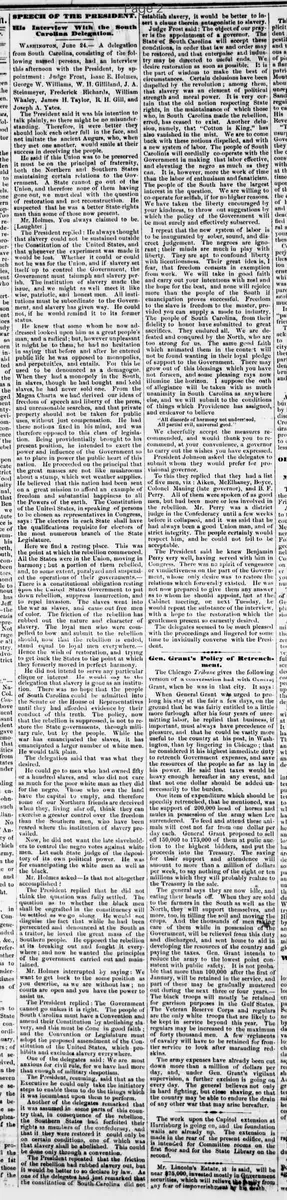
Washington, June 24. - A delegation from South Carolina, consisting of the following named persons, had an interview this afternoon with the President, by appointment: Judge Frost, Isaac E. Holmes, George W. Williams, W. H. Gilliland, J. A. Steinmeyer, Frederick Richards, William Whaley, James H. Taylor, R. H. Gill, and Joseph A. Yates.
The President said it was his intention to talk plainly, so there might be no misunderstanding. Therefore, it were better they should look each other full in the face, and not imitate the ancient Augurs, who, when they met one another, would smile at their success in deceiving the people.
He said if this Union was to be preserved it must be on the principle of fraternity, both the Northern and Southern States maintaining certain relations to the Government. A State cannot go out of the Union, and therefore none of them having gone out, we must deal with the question of restoration and not reconstruction. He suspected that he was a better State-rights man than some of those now present.
Mr. Holmes: You always claimed to be. [Laughter.]
The President replied: He always thought that slavery could not be sustained outside the Constitution of the United States, and that whenever the experiment was made it would be lost. Whether it could or could not be was for the Union, and if slavery set itself up to control the Government, the Government must triumph and slavery perish. The institution of slavery made the issue, and we might as well meet it like wise, patriotic, and honest men. All institutions must be subordinate to the Government, and slavery has given way. He could not, if he would, remind it to its former status.
He knew that some whom he now addressed looked upon him as a great people's man, and a radical; but, however unpleasant it might be to them, he had no hesitation in saying that before and after he entered public life he was opposed to monopolies, and perpetuities, and entails. For this he used to be denounced as a demagogue.
When they had a monopoly in the South, in slaves, though he had bought and held slaves, he had never sold one. From the Magna Charta we had derived our ideas of freedom of speech and liberty of the press, and unreasonable searches, and that private property should not be taken for public uses, without just compensation. He had these notions fixed in his mind, and was therefore opposed to this class of legislation. Being providentially brought to his present position, he intended to exert the power and influence of the Government so as to place in power the public heart of this nation. He proceeded on the principle that the great masses are not like mushrooms about a stump, which wet weather supplies.
He believed that this nation had been sent on a great mission to afford an example of freedom and substantial happiness to all the Powers of the earth. The Constitution of the United States, in speaking of persons to be chosen as representatives in Congress, says: The electors in each State shall have the qualifications requisite for electors of the most numerous branch of the State Legislature.
Here we find a resting place. This was the point at which the rebellion commenced. All the States were in the Union, moving in harmony; but a portion of them rebelled, and, to some extent, paralyzed and suspended the operations of their governments. There is a constitutional obligation resting upon the United States Government to put down rebellion, suppress insurrection, and to repel invasion. The slaves went into the war as slaves, and came out free men of color. The friction of the rebellion has rubbed out the nature and character of slavery. The loyal men who were compelled to bow and submit to the rebellion should, now that the rebellion is ended, stand equal to loyal men everywhere. Hence the wish of restoration, and trying to get back the States to the point at which they formerly moved in perfect harmony.
He did not intend to serve any particular clique or interest. He would say to the delegation that slavery is gone as an institution. There was no hope that the people of South Carolina could be admitted into the Senate or the House of Representatives until they had afforded evidence by their conduct of this truth. The policy, now that the rebellion is suppressed, is not to restore the State governments, through military rule, but by the people. While the war has emancipated the slaves, it has emancipated a larger number of white men. He would talk plain.
The delegation said that was what they desired.
He could go to men who had owned fifty or a hundred slaves, and who did not care as much for the poor white man as they did for the negro. Those who own the land have the capital to employ, and therefore some of our Northern friends are deceived when they, living afar off, think they can exercise a greater control over the freedom than the Southern men, who have been reared where the institution of slavery prevailed.
Now, he did not want the late slaveholders to control the negro votes against white men. Let each State judge of the depository of its own political power. He was for emancipating the white men as well as the black.
Mr. Holmes asked-Is that not altogether accomplished?
The President replied that he did not think the question was fully settled. The question as to whether the black men shall be engrafted in the constituency will be settled as we go along. He would not disguise the fact that while he had been persecuted and denounced at the South as a traitor, he loved the great mass of the Southern people. He opposed the rebellion at its breaking out and fought it everywhere; and now he wanted the principles of the government carried out and maintained.
Mr. Holmes interrupted by saying: We want to get back to the same position as you describe, as we are without law; no courts are open and you have the power to assist us.
The President replied: The Government cannot go unless it is right. The people of South Carolina must have a Convention and amend their Constitution by abolishing slavery, and this must be done in good faith; and the Convention or Legislature must adopt the proposed amendment of the Constitution of the United States, which prohibits and excludes slavery everywhere.
One of the delegates said: We are most anxious for civil rule, for we have had more than enough of military despotism.
The President, resuming, said that as the Executive he could only take the initiatory steps to enable them to do the things which it was incumbent upon them to perform.
Another of the delegates remarked that it was assumed in some parts of this country that, in consequence of the rebellion, the Southern States had forfeited their rights as members of the confederacy, and that if they were restored it could only be on certain conditions, one of which was that slavery shall be abolished. This could be done only through a convention.
The President repeated that the friction of the rebellion had rubbed slavery out, but it would be better to so declare by law. As one of the delegates had just remarked that the constitution of South Carolina did not establish slavery, it would be better to insert a clause therein antagonistic to slavery.
Judge Frost said: The object of our prayer is the appointment of a governor. The State of South Carolina will accept these conditions, in order that law and order may be restored, and that enterprise and industry may be directed to useful ends. We desire restoration as soon as possible. It is the part of wisdom to make the best of circumstances. Certain delusions have been dispelled by the revolution; among them, that slavery was an element of political strength and moral power. It is very certain that the old notion respecting State rights, in the maintenance of which those who, in South Carolina made the rebellion, erred, has ceased to exist. Another delusion, namely, that "Cotton is King," has also vanished in the mist. We are to come back with these notions dispelled, and with a new system of labor. The people of South Carolina will cordially co-operate with the Government in making that labor effective, and elevating the negro as much as they can. It is, however, more the work of time than the labor of enthusiasm and fanaticism.
The people of the South have the largest interest in the question. We are willing to co-operate for selfish, if for no higher reasons. We have taken the liberty encouraged by your kindness, to throw out suggestions by which the policy of the Government will be most surely and effectively subserved.
I repeat that the new system of labor is to be inaugurated by sober, sound, and discreet judgement. The negroes are ignorant; their minds are much in play with liberty. They are apt to confound liberty with licentiousness. Their great idea is, I fear, that freedom consists in exemption from work. We will take in good faith and carry out your intentions with zeal and the hope for the best, and none will rejoice more than the people of the South if emancipation proves successful. Freedom to the slave is freedom to the master, provided you can supply a mode to industry.
The people of South Carolina, from their fidelity to honor have submitted to great sacrifices. They endured all. We are defeated and conquered by the North, who are too strong for us. The same good faith which animated them in the contest will not be found wanting in their loyal pledge of support to the Government. There may grow out of this blessings which you have not foreseen, and some pleasing rays now illumine the horizon. I suppose the oath of allegiance will be taken with as much unanimity in South Carolina as anywhere else, and we will submit to the conditions of things which Providence has assigned, and endeavor to believe
"All discords of harmony not understood,
All partial evil, universal good."
We cheerfully accept the measures recommended, and would thank you to recommend, at your convenience, a governor to carry out the wishes you have expressed.
President Johnson asked the delegates to submit whom they would prefer for provisional governor.
To this they replied that they had a list of five men, viz: Aiken, McElhaney, Boyce, Colonel Manig (late governor), and B. F. Perry. All of them were spoken of as good men, but had been more or less involved in the rebellion. Mr. Perry was a district judge in the Confederacy until a few weeks before it collapsed, and it was said that he had always been a good Union man, and of strict integrity. The people certainly would respect him, and he could not fail to be acceptable.
The President said he knew Benjamin Perry very well, having served with him in Congress. There was no spirit of vengeance or vindictiveness on the part of the Government, whose only desire was to restore the relations which formerly existed. He was not now prepared to give them any answer as to whom he should appoint, but at the Cabinet meeting, or next Tuesday, he would repeat the substance of the interview, with a hope to the restoration which the gentlemen present so earnestly desired.
The delegates seemed to be much pleased with the proceedings and lingered for some time to individually converse with the President.
The President said it was his intention to talk plainly, so there might be no misunderstanding. Therefore, it were better they should look each other full in the face, and not imitate the ancient Augurs, who, when they met one another, would smile at their success in deceiving the people.
He said if this Union was to be preserved it must be on the principle of fraternity, both the Northern and Southern States maintaining certain relations to the Government. A State cannot go out of the Union, and therefore none of them having gone out, we must deal with the question of restoration and not reconstruction. He suspected that he was a better State-rights man than some of those now present.
Mr. Holmes: You always claimed to be. [Laughter.]
The President replied: He always thought that slavery could not be sustained outside the Constitution of the United States, and that whenever the experiment was made it would be lost. Whether it could or could not be was for the Union, and if slavery set itself up to control the Government, the Government must triumph and slavery perish. The institution of slavery made the issue, and we might as well meet it like wise, patriotic, and honest men. All institutions must be subordinate to the Government, and slavery has given way. He could not, if he would, remind it to its former status.
He knew that some whom he now addressed looked upon him as a great people's man, and a radical; but, however unpleasant it might be to them, he had no hesitation in saying that before and after he entered public life he was opposed to monopolies, and perpetuities, and entails. For this he used to be denounced as a demagogue.
When they had a monopoly in the South, in slaves, though he had bought and held slaves, he had never sold one. From the Magna Charta we had derived our ideas of freedom of speech and liberty of the press, and unreasonable searches, and that private property should not be taken for public uses, without just compensation. He had these notions fixed in his mind, and was therefore opposed to this class of legislation. Being providentially brought to his present position, he intended to exert the power and influence of the Government so as to place in power the public heart of this nation. He proceeded on the principle that the great masses are not like mushrooms about a stump, which wet weather supplies.
He believed that this nation had been sent on a great mission to afford an example of freedom and substantial happiness to all the Powers of the earth. The Constitution of the United States, in speaking of persons to be chosen as representatives in Congress, says: The electors in each State shall have the qualifications requisite for electors of the most numerous branch of the State Legislature.
Here we find a resting place. This was the point at which the rebellion commenced. All the States were in the Union, moving in harmony; but a portion of them rebelled, and, to some extent, paralyzed and suspended the operations of their governments. There is a constitutional obligation resting upon the United States Government to put down rebellion, suppress insurrection, and to repel invasion. The slaves went into the war as slaves, and came out free men of color. The friction of the rebellion has rubbed out the nature and character of slavery. The loyal men who were compelled to bow and submit to the rebellion should, now that the rebellion is ended, stand equal to loyal men everywhere. Hence the wish of restoration, and trying to get back the States to the point at which they formerly moved in perfect harmony.
He did not intend to serve any particular clique or interest. He would say to the delegation that slavery is gone as an institution. There was no hope that the people of South Carolina could be admitted into the Senate or the House of Representatives until they had afforded evidence by their conduct of this truth. The policy, now that the rebellion is suppressed, is not to restore the State governments, through military rule, but by the people. While the war has emancipated the slaves, it has emancipated a larger number of white men. He would talk plain.
The delegation said that was what they desired.
He could go to men who had owned fifty or a hundred slaves, and who did not care as much for the poor white man as they did for the negro. Those who own the land have the capital to employ, and therefore some of our Northern friends are deceived when they, living afar off, think they can exercise a greater control over the freedom than the Southern men, who have been reared where the institution of slavery prevailed.
Now, he did not want the late slaveholders to control the negro votes against white men. Let each State judge of the depository of its own political power. He was for emancipating the white men as well as the black.
Mr. Holmes asked-Is that not altogether accomplished?
The President replied that he did not think the question was fully settled. The question as to whether the black men shall be engrafted in the constituency will be settled as we go along. He would not disguise the fact that while he had been persecuted and denounced at the South as a traitor, he loved the great mass of the Southern people. He opposed the rebellion at its breaking out and fought it everywhere; and now he wanted the principles of the government carried out and maintained.
Mr. Holmes interrupted by saying: We want to get back to the same position as you describe, as we are without law; no courts are open and you have the power to assist us.
The President replied: The Government cannot go unless it is right. The people of South Carolina must have a Convention and amend their Constitution by abolishing slavery, and this must be done in good faith; and the Convention or Legislature must adopt the proposed amendment of the Constitution of the United States, which prohibits and excludes slavery everywhere.
One of the delegates said: We are most anxious for civil rule, for we have had more than enough of military despotism.
The President, resuming, said that as the Executive he could only take the initiatory steps to enable them to do the things which it was incumbent upon them to perform.
Another of the delegates remarked that it was assumed in some parts of this country that, in consequence of the rebellion, the Southern States had forfeited their rights as members of the confederacy, and that if they were restored it could only be on certain conditions, one of which was that slavery shall be abolished. This could be done only through a convention.
The President repeated that the friction of the rebellion had rubbed slavery out, but it would be better to so declare by law. As one of the delegates had just remarked that the constitution of South Carolina did not establish slavery, it would be better to insert a clause therein antagonistic to slavery.
Judge Frost said: The object of our prayer is the appointment of a governor. The State of South Carolina will accept these conditions, in order that law and order may be restored, and that enterprise and industry may be directed to useful ends. We desire restoration as soon as possible. It is the part of wisdom to make the best of circumstances. Certain delusions have been dispelled by the revolution; among them, that slavery was an element of political strength and moral power. It is very certain that the old notion respecting State rights, in the maintenance of which those who, in South Carolina made the rebellion, erred, has ceased to exist. Another delusion, namely, that "Cotton is King," has also vanished in the mist. We are to come back with these notions dispelled, and with a new system of labor. The people of South Carolina will cordially co-operate with the Government in making that labor effective, and elevating the negro as much as they can. It is, however, more the work of time than the labor of enthusiasm and fanaticism.
The people of the South have the largest interest in the question. We are willing to co-operate for selfish, if for no higher reasons. We have taken the liberty encouraged by your kindness, to throw out suggestions by which the policy of the Government will be most surely and effectively subserved.
I repeat that the new system of labor is to be inaugurated by sober, sound, and discreet judgement. The negroes are ignorant; their minds are much in play with liberty. They are apt to confound liberty with licentiousness. Their great idea is, I fear, that freedom consists in exemption from work. We will take in good faith and carry out your intentions with zeal and the hope for the best, and none will rejoice more than the people of the South if emancipation proves successful. Freedom to the slave is freedom to the master, provided you can supply a mode to industry.
The people of South Carolina, from their fidelity to honor have submitted to great sacrifices. They endured all. We are defeated and conquered by the North, who are too strong for us. The same good faith which animated them in the contest will not be found wanting in their loyal pledge of support to the Government. There may grow out of this blessings which you have not foreseen, and some pleasing rays now illumine the horizon. I suppose the oath of allegiance will be taken with as much unanimity in South Carolina as anywhere else, and we will submit to the conditions of things which Providence has assigned, and endeavor to believe
"All discords of harmony not understood,
All partial evil, universal good."
We cheerfully accept the measures recommended, and would thank you to recommend, at your convenience, a governor to carry out the wishes you have expressed.
President Johnson asked the delegates to submit whom they would prefer for provisional governor.
To this they replied that they had a list of five men, viz: Aiken, McElhaney, Boyce, Colonel Manig (late governor), and B. F. Perry. All of them were spoken of as good men, but had been more or less involved in the rebellion. Mr. Perry was a district judge in the Confederacy until a few weeks before it collapsed, and it was said that he had always been a good Union man, and of strict integrity. The people certainly would respect him, and he could not fail to be acceptable.
The President said he knew Benjamin Perry very well, having served with him in Congress. There was no spirit of vengeance or vindictiveness on the part of the Government, whose only desire was to restore the relations which formerly existed. He was not now prepared to give them any answer as to whom he should appoint, but at the Cabinet meeting, or next Tuesday, he would repeat the substance of the interview, with a hope to the restoration which the gentlemen present so earnestly desired.
The delegates seemed to be much pleased with the proceedings and lingered for some time to individually converse with the President.
What sub-type of article is it?
Historical Event
What themes does it cover?
Justice
Recovery
Providence Divine
What keywords are associated?
Reconstruction
South Carolina Delegation
President Johnson
Slavery Abolition
Union Restoration
Provisional Governor
Emancipation
Constitutional Amendment
What entities or persons were involved?
President Johnson
Judge Frost
Isaac E. Holmes
George W. Williams
W. H. Gilliland
J. A. Steinmeyer
Frederick Richards
William Whaley
James H. Taylor
R. H. Gill
Joseph A. Yates
B. F. Perry
Aiken
Mcelhaney
Boyce
Colonel Manig
Where did it happen?
Washington
Story Details
Key Persons
President Johnson
Judge Frost
Isaac E. Holmes
George W. Williams
W. H. Gilliland
J. A. Steinmeyer
Frederick Richards
William Whaley
James H. Taylor
R. H. Gill
Joseph A. Yates
B. F. Perry
Aiken
Mcelhaney
Boyce
Colonel Manig
Location
Washington
Event Date
June 24
Story Details
President Johnson discusses with South Carolina delegation the restoration of the Union, abolition of slavery via constitutional amendments, emancipation's implications for white and black Southerners, and potential appointment of a provisional governor such as B.F. Perry to enable civil rule and cooperation.