Thank you for visiting SNEWPapers!
Sign up free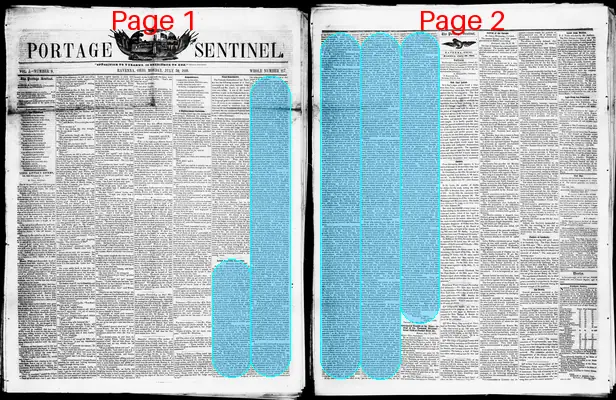
Portage Sentinel
Ravenna, Portage County, Ohio
What is this article about?
In a letter to Thomas Ritchie dated July 10, 1849, from Detroit, Gen. Lewis Cass defends his political consistency against Whig press accusations of inconsistency on internal improvements, protective tariff, and slavery extension to territories ceded by Mexico. He argues the Wilmot Proviso is unconstitutional and unnecessary, as slavery cannot exist there naturally.
Merged-components note: This is a continuation of the letter from Gen. Lewis Cass across pages 1 and 2; the second part was incorrectly labeled as 'story' but belongs to the same letter_to_editor component.
Clippings
1 of 2
OCR Quality
Full Text
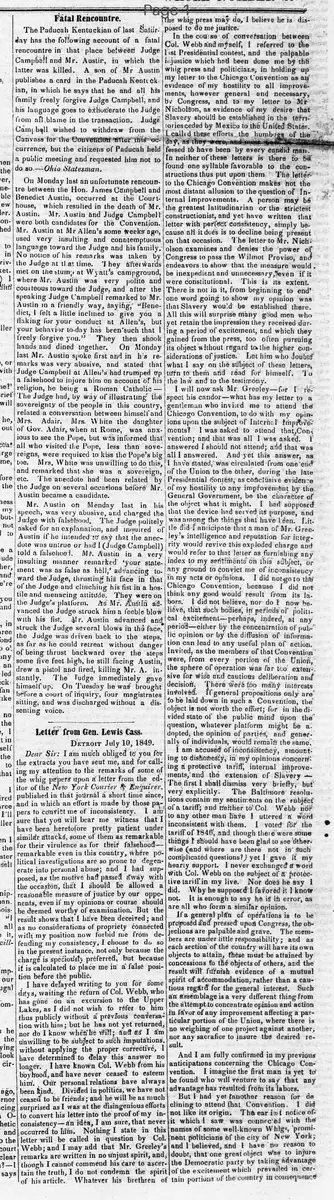
DETROIT July 10, 1849.
Dear Sir: I am much obliged to you for the extracts you have sent me, and for calling my attention to the remarks of some of the whig papers upon a letter from the editor of the New York Courier & Enquirer, published in that journal a short time since. and in which an effort is made by those papers to convict me of inconsistency. I am sure that you will bear me witness that I have been heretofore pretty patient under similar attacks, some of them as remarkable for their virulence as for their falsehood—remarkable even in this country, where political investigations are so prone to degenerate into personal abuse; and I had supposed, as the motive had passed away with the occasion, that I should be allowed a reasonable measure of justice by our opponents, even if my opinions or course should be deemed worthy of examination. But the result shows that I have been deceived; and as no considerations of propriety connected with my position now forbid me from defending my consistency, I choose to do so in the present instance, not only because the charge is speciously preferred, but because it is calculated to place me in a false position before the public.
I have delayed writing to you for some days, waiting the return of Col. Webb, who has gone on an excursion to the Upper Lakes, as I did not wish to refer to him thus publicly without a previous conversation with him; but he has not yet returned, nor do I know when he will; and as I am unwilling to be subject to such imputations without applying the proper corrective, I have determined to delay this answer no longer. I have known Col. Webb from his boyhood, and have never ceased to esteem him. Our personal relations have always been kind. Divided in politics, we have not ceased to be friends; and he will be as much surprised as I was at the disingenuous efforts to convert his letter into the proof of my inconsistency—an idea, I am sure, that never occurred to him. Nothing I state in this letter will be called in question by Col. Webb; and I may add that Mr. Greeley's remarks are written in no unjust spirit, and though I cannot commend his care to ascertain the truth, I do not condemn the spirit of his article. Whatever his brethren of the whig press may do, I believe he is disposed to do me justice.
In the course of conversation between Col. Webb and myself, I referred to the last Presidential contest, and the palpable injustice which had been done me by the whig press and politicians; in holding up my letter to the Chicago Convention as an evidence of my hostility to all improvements, however general and necessary by Congress, and to my letter to Mr. Nicholson, as evidence of my desire that Slavery should be established in the territories ceded by Mexico to the United States.
I called these efforts the humbugs of the day, as they were, and as they have been confessed to have been by every candid man. In neither of these letters is there to be found one syllable favorable to the constructions thus put upon them. The letter to the Chicago Convention makes not the most distant allusion to the question of Internal Improvements. A person may be the greatest latitudinarian or the strictest constructionist, and yet have written that letter with perfect consistency, simply because all it does is to decline being present on that occasion. The letter to Mr. Nicholson examines and denies the power of Congress to pass the Wilmot Proviso, and endeavors to show that the measure would be inexpedient and unnecessary, even if it were constitutional. This is its extent. There is not in it, from beginning to end, one word going to show my opinion was that Slavery would be established there.
All this will surprise many good men who yet retain the impression they received during a period of excitement, and which they gained from the press, too often pursuing its object without regard to the higher considerations of justice. Let him who doubts what I say on the subject of these letters, turn to them and read for himself. To the law and to the testimony.
I will now ask Mr. Greeley—or I respect his candor—what has my letter to a gentleman who invited me to attend the Chicago Convention, to do with my opinions upon the subject of Internal Improvements? I was asked to attend that Convention; and that was all I was asked. I answered I should not attend; and that was all I answered. And yet this answer, as I have stated, was circulated from one end of the Union to the other, during the late Presidential Contest; as conclusive evidence of my hostility to any improvement by the General Government, be the character of the object what it might. I had supposed that the device had served its purpose, and was among the things that have been. Little did I anticipate that a man of Mr. Greeley's intelligence and reputation for integrity would revive this exploded charge and would refer to that letter as furnishing any index to my sentiments on this subject, or any ground to convict me of inconsistency in my acts or opinions. I did not go to the Chicago Convention, because I did not think any good would result from its labors. I did not believe, nor do I now believe, that such bodies, in periods of political excitement—perhaps, indeed, at any period—either by the concentration of public opinion or by the diffusion of information can lead to any useful plan of action.
Invited, as the members of that Convention were, from every portion of the Union, the sphere of operation was too extensive for wise and cautious deliberation and decision. There were too many interests involved. If general propositions only are to be laid down in such a Convention, the object is not worth the effort; or in the divided state of the public mind upon the question, whatever platform might be adopted, the opinion of parties, and generally of individuals, would remain the same.
I am accused of inconsistency, amounting to dishonesty, in my opinions concerning the protective tariff, internal improvements, and the extension of Slavery—
The first I shall dismiss very briefly, but very explicitly. The Baltimore resolutions contain my sentiments on the subject of a tariff; and neither to Col. Webb nor to any other man have I uttered word inconsistent with them. I voted for the tariff of 1846, and though there were some things I should have been glad to see otherwise (and where are there not in such complicated questions?) yet I gave it my hearty support. I never exchanged a word with Col. Webb on the subject of a protective tariff in my life. Nor does he say I did. Why he supposed I favored it I know not. It is enough to say he is in error, as are all who form a similar opinion.
If a general plan of operations is to be proposed and pressed upon Congress, the objections are palpable and grave. The members are under little responsibility; and as each section of the country will have its own objects to attain, these must be attained by concessions to the objects of others, and the result will furnish evidence of a mutual spirit of accommodation, rather than a cautious regard for the general interest. Such an assemblage is a very different thing from the attempt to concentrate opinion and action in favor of any improvement affecting a particular portion of the Union, where there is no weighing of one project against another, nor any sacrifice to insure the desired result.
And I am fully confirmed in my previous anticipations concerning the Chicago Convention. I imagine the first man is yet to be found who will venture to say that any advantage has resulted from its labors.
But I had yet another reason for declining to attend that Convention. I did not like its origin. The earliest notice of it which I saw was connected with the names of some well-known Whigs, 'prominent politicians of the city of New York; and I believed, and I have no reason to doubt, that one great object was to injure the Democratic party by taking advantage of the excitement which prevailed in certain portions of the country in consequence
of the failure of two successive internal improvement bills. And I have since understood, though I cannot vouch for the fact, that such was the actual intention, and that the proceedings of the Convention would have assumed a party character, and been directed to this object, had not the design been frustrated by the firmness of the Democratic members.
Now Mr. Greeley will understand why I did not attend this Convention. But I cannot understand why he seeks my opinion on this question in my letter, which is wholly silent on the subject, and not in my speeches and votes in the Senate of the United States.
Eminent Whig politicians whom I could name but that it would be invidious to do so, were invited to attend the Chicago Convention, but neither answered nor attended. I thought it due to the gentleman who invited me, to acknowledge his attention and did so. And this act of courtesy, which constitutes the only difference between myself and others has been made the text-book whence my opinions are to be deduced and by which my inconsistency is to be proved. On the question of the power of the United States over the subject of internal improvements, my sentiments are in accordance with those of the great Democratic party, and are fully expressed in the resolutions of the Baltimore Convention. In the words of one of these resolutions, I believe "that the Constitution does not confer on the general government the power to commence and carry on a general system of internal improvements," and no man living has the right to gainsay this assertion. But at the same time I have never disputed the right of Congress to improve some of the great harbors and rivers, and lakes of the Union, national in their character, and important to the commerce, and some of them to the defence of our country. While the Democratic party deny the power to devise and carry on a vast system of operations-whose pecuniary extent no man can foresee, and what is still worse, whose corrupting influence as well in the legislature as out of it cannot be viewed but with the most serious apprehension-the great majority of that party, indeed nearly all of it, has advocated particular appropriations justified by the circumstances of position and importance. Almost at the same time that I declared my adhesion to the resolutions of the Baltimore Convention I voted with equal good faith for bills in the Senate providing for the improvement of rivers and harbors and lakes, and advocated their passage in my seat; and this is precisely the reason why I accuse many of the Whig papers and politicians, of disingenuousness, or something worse in asserting that my Chicago letter, which contained not a word on the subject, was proof of my hostility to all the action of Congress, in the very face of my official course and of my publicly declared opinions. And my position was that of most of the prominent men of our party, who while they held to the doctrines of the resolution held likewise to the power of special legislation, and voted for the same bills. I do not know, indeed, that there is a single Senator who denies to Congress all power to legislate over this matter. Certainly Mr. Calhoun does not, who adopts the whole-sale doctrine of strict construction. I am aware it is difficult to draw a practical line at all times between objects that ought and that ought not to engage the attention of Congress; and I think, therefore, looking to the abuse to which the whole object is liable, that the effort should be to narrow and not to enlarge the circle of power; and such I understand to be the views of the Democratic party.
The other proof of insincerity, as I have already stated is drawn from the fact, that in my letter to Mr. Nicholson, I took ground against the Wilmot Proviso, excluding Slavery by law from the Territories, and now believe that Slavery, with or without that restriction, will not be established there. And the wonder is gravely expressed, how I could write that letter, and the letter of three lines to the Chicago Convention, and yet claim to the character of an honest man! It is a much graver wonder to me how intelligent Editors of public papers, whose influence on public opinion is so great, should venture thus to deal, even with a political opponent, in utter disregard of his true position. It will not surprise you, but it will many who have viewed my course only in a party aspect, to be told that in the very letter to Mr. Nicholson I expressly stated my opinion to be, that Slavery would never extend to California or New Mexico; and that "the inhabitants of those regions, whether they depend on their plows or their herds, cannot be Slaveholders." I quoted with full approbation the opinions of Mr. Buchanan and of Mr. Walker, the former of whom says: "it is morally impossible, therefore, that a majority of the emigrants to that portion of the territory south of 36 deg. 30, will ever re-establish Slavery within its limits." Mr. Walker maintains that "beyond the Rio del Norte Slavery will not pass, not only because it is forbidden by law, but because the colored race there preponderates in the ratio of ten to one over the whites, and holding as they do the government and most of the offices in their possession, they will not permit the enslavement of any portion of the colored race, which makes and executes the laws of the country." And to these remarks I add: The question, it will therefore be seen on examination, does not regard the exclusion of Slavery from a region where it now exists, but a prohibition against its introduction where it does not exist, and where, from the feelings of the inhabitants, and the laws of Nature, "it is morally impossible," as Mr. Buchanan says, "that it can ever re-establish itself" I have never uttered to a human being a sentiment in opposition to these views; and subsequent events-the events indeed of every day-confirm their justice, and render it impossible that Slavery should be re-established in the region ceded to us by Mexico. Such is the general opinion in the non-slave holding States among those who are most attached to the compromises of the Constitution and most determined to maintain them; and I do not doubt but that there are many persons in the Southern States who resist the Wilmot Proviso with all their power, as offensive to the feelings, and injurious to the rights of the South, but who still believe it is a question rather of principle than of action, and that circumstances are preparing an exclusion which Congress has no right to pronounce.
In the view here taken, the effort to graft the Wilmot proviso upon an act of Congress, even if Congress had the requisite power, is a useless attempt to direct the legislation of the country to an object which would be just as certainly attained without it. If Congress have not the power, as I believe they have not, in common with a large portion of the people, it becomes worse than useless by becoming unconstitutional. And in addition to this, it is peculiarly offensive to one-half of the States of the Union, who see in it an attempt to circumscribe their rights, and to mortify their pride of character. No man can look at the signs of the times without being satisfied that the prosecution of this question is producing the worst state of feeling; and though I trust that, happen what may, our Southern brethren will still cling to the Union, equally their ark of safety and ours, still there are evils short of a separation which every good citizen should seek to avoid. He should seek to avoid all occasions of unfriendly feelings; to avoid as far as may be the agitation of questions hostile to the sentiments or interests of different sections of the country, and thus tending to array one of them against another. There is enough passing in the Old World-and if there were not, there is enough passing around us-to teach us the inestimable value of our institutions, and that these ought not to be hazarded by internal dissensions, as unnecessary in their origin as they are portentous in their consequences.
So much for the expediency of urging a measure thus advocated and opposed. But beyond this question is a still more important one in a Constitutional Government, and that is the power of Congress to legislate over the subject; and this must be settled affirmatively before the propriety of legislative action can be considered. I am not going over this ground at present. I have already touched upon it in my letter to Mr. Nicholson, and I shall probably have an opportunity of expressing my sentiments more fully at the next session of Congress.
I shall content myself with presenting a few general remarks here, as the subject lies in my way. There is one important consideration which meets us at the very threshold of this inquiry; there is no express power in Congress to legislate over the Territories, to be found in the Constitution; for I believe it is now generally conceded-as indeed it must be-that the power to dispose of, and make needful rules and regulations, for the 'Territory and other property of the United States, contains no grant of political power over persons upon such property, either within or without the respective States. And if it does in the one, it must in the other; or these words are equally applicable to the Territory and other property of the United States, wherever situated. But there are some five or six provisions in the Constitution, whence the power is sought to be deduced-some persons deriving it from one clause, and some from another; while each is more fortunate in showing where it does not than where it does exist. The exercise of a great political power like this by a legislature, deriving its existence from a written instrument, ought not to depend on such loose constructions. Nothing shows the well grounded doubts respecting this power better than the very uncertainty in which we are involved in the endeavor to maintain it by an express constitutional grant. And no wonder that now, when peculiar circumstances bring this question more forcibly than ever before the country the true foundation of the power should be severely investigated.
Those who maintain the right of Congress to pass the Wilmot proviso must maintain not only the right of that body to establish governments, and to provide for the necessities of legislation over the public territory, which is one thing, but also the power to direct all the internal territorial legislation at its pleasure, without regard to the will of the people to be affected by it, which is another and quite a different thing. I shall not enter into any subtleties touching the condition of sovereignty or the rights it brings with it. That subject was a good deal debated at the last session of Congress; but it had been already exhausted in the discussions previously to our Revolutionary struggle. We are sovereign, said the British Government to the Colonies and may legislate over you as we please. You are sovereign, said our fathers, and may establish Governments; but you have no right to interfere, by your legislation in our internal concerns. Such legislation without representation is the very essence of despotism. This dispute divided one empire. Let us take care that a similar assumption of power does not divide another.
Have Congress any power to legislate over the Territories? I said in my letter to Mr. Nicholson, "How far an existing necessity may have operated in producing this legislation, and thus extending, by rather a violent implication powers not directly given, I know not. But certain it is, that the principle of interference should not be carried beyond the necessary implication which produces it."
The ground of necessity is that upon which Mr. Madison placed the action of the old Confederation in passing the Ordinance 1787; and if I do not misunderstand the late Mr. Justice Story, he entertained similar views when he said that acquired territory "must be under dominion and jurisdiction of the Union, or it would be without any government at all." If to avoid this latter consequence Congress exercise a power not otherwise to be defended, that power should be limited by the necessity of the occasion which calls it forth. To preserve the peace of society and to this ground of support we must come at last-there is no more need that Congress should conduct the legislation of the Territories, than that they should conduct the legislation of Virginia or Massachusetts. It is enough that they organize Governments, and then the necessity of their interference ceases. And the result proves this; for the local governments do manage the internal concerns of the territories in most cases, and would as safely in all, if not restrained by Congressional interposition; and if Congress can pass beyond the power to organize Governments, they may rule a territory at their pleasure and prostrate every barrier of freedom. If, as I have heretofore said they can regulate the relation of master and servant, what but their own will is to prevent them from regulating the other relations of life -the relation of husband and wife, and of parent and of child; and, indeed, all the objects which belong to the social state?
There is no man who can show the slightest necessity for this interference on the part of the General Government and there is consequently no man who can show that it has any right to interfere on the ground of its necessary action. The people of the territories are fully competent to conduct their own affairs; and the very first principle of our social system demands that they should be permitted to do so.
Whichever may be the source, says Chief Justice Marshall, speaking doubtfully of the origin of this jurisdiction, "whence this power may be derived, the possession of it is unquestionable." He is speaking of the power of Government; and no doubt it has been possessed; but it becomes very important to ascertain how, and how far Congress has justly possessed it, in order to ascertain to what extent it may be exercised. In almost all-I believe I may say all-the speeches and essays in support of the power of Congress to legislate over Slavery, after endeavoring vaguely to deduce it from some clause or other of the Constitution, the principal reliance is at last upon the authority of the few instances of its exercise to be found in the statute books. Authority and precedent have weight-and ought to have some weight-in doubtful questions; but I trust there are few to be found who are prepared to shut the Constitution, and to seek in the practice of the Government the foundation of its power; and more especially when, as in this case, the early legislative proceedings passed, as we have reason to believe, without objection or inquiry. They commenced by adopting the provision of an ordinance of the old Government to the administration of the new one, and thus impliedly recognizing the exclusion of Slavery, and seem to have gone on silently and unquestioned for years. I have not had time to look back to ascertain the facts precisely, but I believe it will be found that this power has never been exercised where there was a united sectional opposition to it. Precedent may weigh much in the consideration of a doubtful question, where the whole subject has been maturely considered, and many minds have been brought to bear upon its adjustment. But as the foundation of political power, a practice thus introduced is of little value, particularly when it comes to involve grave questions, seriously affecting the Union. We turn then instinctively from what has been done to what ought to be done--from the authority of precedent to the authority of the Constitution. These are times which try such questions. Who can wonder that with the views entertained on this subject by the South, an appeal should be made to the common charter of the country, or that a large portion of our citizens should be satisfied with no answer not derived from it? That what has been must continue to be, is a principle which has done more to perpetuate abuses, than all other causes which have operated upon political institutions.
Those who advocate and those who oppose the Wilmot Proviso occupy very different positions. The former urge its adoption as a matter of expediency, in order to exclude Slavery from the newly acquired territories, where it does not exist and where it cannot be denied that this exclusion is as morally certain without it as with it while the latter all oppose this measure on the ground of its unconstitutionality, and a large portion of the Union on the ground also of its interference with their rights and feelings. The contest to which this subject has given rise, has already been productive of the worst consequences. For two years it has prevented all legislation over most important regions, and has left them without government and in a state of social disorganization, to our own reproach and to the surprise of the world. I do not believe there is another country on the face of the earth which would have permitted such a state of things. And how is it to continue? Is California to become a prey to intestine dissensions in the absence of all law, or is it to be driven to separate from us because we neglect to discharge one of our first duties-a duty of necessity-that of organizing a Government for the people who inhabit it. Those who have heretofore advocated its adoption may well abandon it, convinced, as they must be, that their object will be as well attained without it as with it. It appears to me one of the most barren questions that ever divided a country; barren in useful results, but fertile in difficulties and dangers. I freely confess that I look with amazement upon the zeal and pertinacity displayed in urging this measure under these circumstances, and augur from them the worst consequences.
These are my sentiments They will give offence to many, and will expose me to much obloquy. But I do not hesitate thus openly to avow them; for every public man who is not prepared to take a decided part agreeably to his convictions in times like these, is not prepared to discharge one of the first duties which belongs to his position. To insure domestic tranquility, in the words of the Constitution, was one of the great motives of the people of the United States in the organization of their present government. Measures which may endanger that tranquility should be scrutinized with great caution, and never adopted but in the last necessity, and then with great reluctance.
I am, dear Sir,
With great regard,
Truly yours
LEW. CASS.
Thomas Ritchie, Esq.
What sub-type of article is it?
What themes does it cover?
What keywords are associated?
What entities or persons were involved?
Letter to Editor Details
Author
Lew. Cass
Recipient
Thomas Ritchie, Esq.
Main Argument
lewis cass defends his consistency against charges of inconsistency in his views on internal improvements, protective tariff, and opposition to the wilmot proviso, arguing that congress lacks constitutional power to legislate on slavery in territories and that it is unnecessary as slavery cannot exist there naturally.
Notable Details