Thank you for visiting SNEWPapers!
Sign up free
The National Intelligencer And Washington Advertiser
Washington, District Of Columbia
What is this article about?
In 1806, a Kentucky House committee reports on charges against Judge Benjamin Sebastian for receiving a Spanish pension, based on depositions revealing his role in 1795 commercial negotiations with Spanish officials and later proposals for western independence.
Merged-components note: This is a continuation of the report on the Kentucky legislature's inquiry into charges against Judge Sebastian, split across pages. Relabeled from 'foreign_news' for the second part as it concerns domestic U.S. political proceedings despite Spanish references.
Clippings
1 of 2
OCR Quality
Full Text
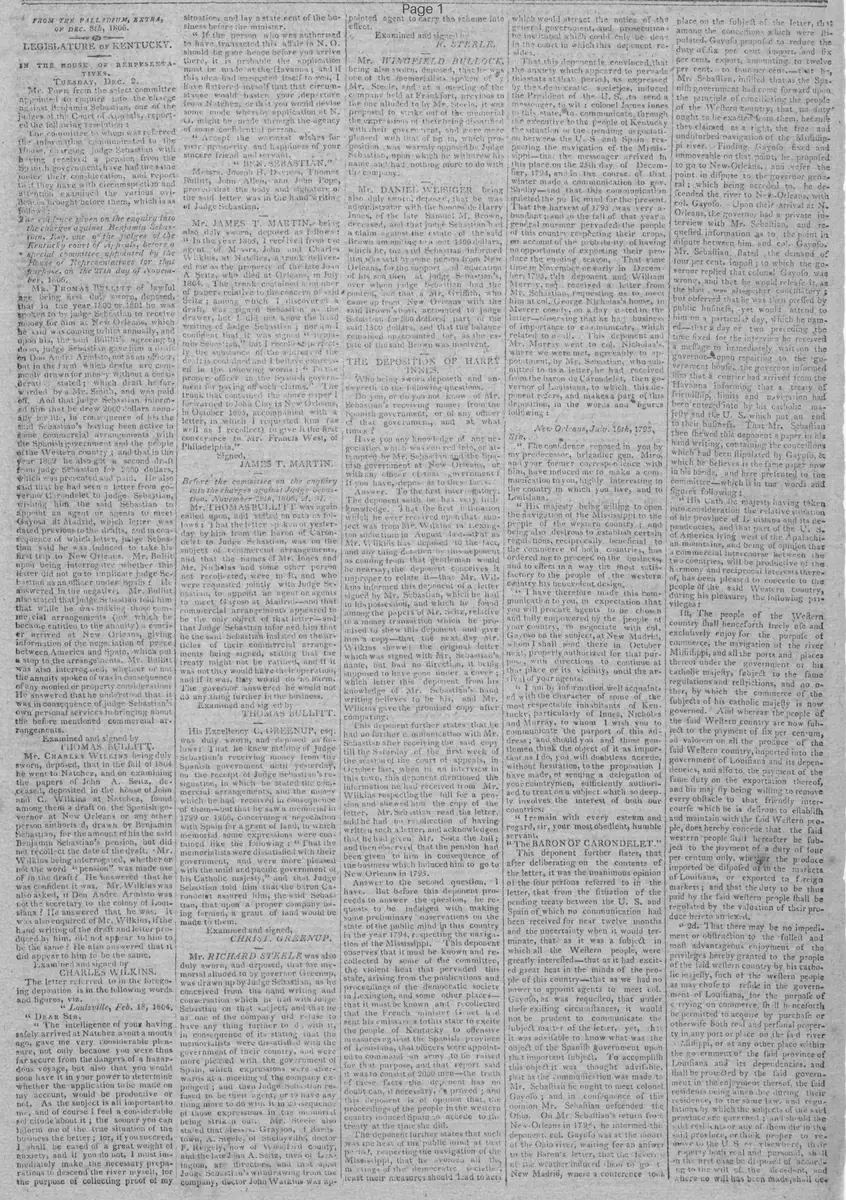
LEGISLATURE OF KENTUCKY
IN THE HOUSE OF REPRESENTATIVES.
TUESDAY, DEC. 2.
Mr. Pope from the select committee appointed to enquire into the charge against Benjamin Sebastian, one of the judges of the Court of Appeals, reported the following resolution:
The committee to whom was referred the information communicated to the House, charging Judge Sebastian with having received a pension from the Spanish government, have had the same under their consideration, and report that they have with circumspection and attention examined the various evidences brought before them, which is as follows:
The evidence given on the enquiry into the charges against Benjamin Sebastian, Esq. one of the judges of the Kentucky court of appeals, before a special committee appointed by the House of Representatives for that purpose, on the 27th day of November, 1806.
MR. THOMAS BULLITT of lawful age being first duly sworn, deposed, that in the year 1800 or 1801 he was spoken to by Judge Sebastian to receive money for him at New Orleans, which he said was coming to him annually, and upon his, the said Bullitt's agreeing to do so, Judge Sebastian gave him a draft on Don Andres Armesto, not as an officer, but in the form which drafts are commonly drawn for money without a consideration stated; which draft he forwarded by a Mr. Smith, and was paid off. And that Judge Sebastian informed him that he drew 200 dollars annually for life, in consequence of his the said Sebastian's having been active in some commercial arrangements with the Spanish government and the people of the Western country; and that in the year 1802 he also got a second draft from Judge Sebastian for 1000 dollars, which was presented and paid. He also said that he had seen a letter from Governor Carondelet to Judge Sebastian, wishing him the said Sebastian to appoint an agent or agents to meet Gayoso at Madrid, which letter was dated previous to the drafts, and in consequence of which letter, Judge Sebastian said he was induced to take his first trip to New Orleans. Mr. Bullitt upon being interrogated whether this letter did not go to implicate Judge Sebastian as an officer under Spain? He answered in the negative, Mr. Bullitt also stated that Judge Sebastian told him that while he was making those commercial arrangements (for which he became entitled to the annuity) a courier arrived at New Orleans, giving information of the negotiation of peace between America and Spain, which put a stop to the arrangements. Mr. Bullitt was also interrogated, whether or not the annuity spoken of was in consequence of any monied or property consideration: He answered that he understood that it was in consequence of Judge Sebastian's own personal services in bringing about the before mentioned commercial arrangements.
Examined and signed by
THOMAS BULLITT.
Mr. CHARLES WILKINS being duly sworn, deposed, that in the fall of 1804 he went to Natchez, and on examining the papers of John A. Seitz, dec'd, deposited in the house of John and C. Wilkins at Natchez, found among them a draft on the Spanish governor at New Orleans or any other person authorised, drawn by Benjamin Sebastian, for the amount of his the said Benjamin Sebastian's pension, but did not recollect the date of the draft. Mr. Wilkins being interrogated, whether or not the word "pension" was made use of in the draft? He answered that he was confident it was. Mr. Wilkins was also asked, If Don Andres Armesto was not the secretary to the colony of Louisiana? He answered that he was. It was also enquired of Mr. Wilkins, if the hand writing of the draft and letter produced by him, did not appear to him to be the same? He also answered that it did appear to him to be the same.
Examined and signed by
CHARLES WILKINS.
The letter referred to in the foregoing deposition is in the following words and figures, viz.
"Louisville, Feb. 18, 1804.
"DEAR SIR,
"The intelligence of your having safely arrived at Natchez about a month ago, gave me very considerable pleasure, not only because you were thus far secure from the dangers of a hazardous voyage, but also that you would soon have it in your power to determine whether the application to be made on my account, would be productive or not. As the subject is all important to me, and of course I feel a considerable solicitude about it; the sooner you can inform me of the true situation of the business the better; for, if you succeed, I shall be eased of a great weight of anxiety, and if you do not, I must immediately make the necessary preparations to descend the river myself, for the purpose of collecting proof of my situation, and lay a statement of the business before the minister.
"If the person who was authorised to have transacted this affair in N. O. should be gone hence before you arrive there, it is probable the application must be made at the Havanna: and if this idea had suggested itself to you, I have flattered myself that that circumstance would hasten your departure from Natchez. or that you would devise some mode whereby application at N. O. might be made through the agency of some confidential person.
"Accept the warmest wishes for your prosperity and happiness of your sincere friend and servant,
"BEN. SEBASTIAN."
Messrs. Joseph H. Davies, Thomas Bullitt, John Allen, and John Pope, proved that the body and signature of the said letter was in the hand writing of Judge Sebastian.
Mr. JAMES T. MARTIN, being also duly sworn, deposed as follows:
"In the year 1805, I received from the agent of Messrs. John and Charles Wilkins, at Natchez, a trunk delivered me as the property of the late John A. Seitz, who died at Orleans, in July 1804. The trunk contained a number of papers relative to the concern of said Seitz; among which I discovered a draft, was signed Sebastian as the drawer, but I did not know the hand writing of Judge Sebastian; nor am I confident that it was signed "Benjamin Sebastian," but I recollect perfectly the substance of the address: of the draft is contained and I believe expressed in the following words: "To the proper officer in the Spanish government for paying off such claims." The trunk that contained the above paper I forwarded to John Clay in New Orleans, in October 1805, accompanied with a letter, in which I requested him (as well as I recollect) to give it the first conveyance to Mr. Francis West, of Philadelphia."
Signed,
JAMES T. MARTIN.
Before the committee on the enquiry into the charges against Judge Sebastian, November 28th, 1806.
Mr. THOMAS BULLITT was again called upon, and stated on oath as follows: That the letter spoken of yesterday by him from the Baron of Carondelet to Judge Sebastian, was on the subject of commercial arrangements, and that the names of Mr. Innes and Mr. Nicholas and some other person not recollected, were in it, and who were requested jointly with Judge Sebastian, to appoint an agent or agents to meet Gayoso at Madrid--and that commercial arrangements appeared to be the only object of that letter--and that Judge Sebastian informed him that he the said Sebastian insisted on the articles of their commercial arrangements being signed, stating that the treaty might not be ratified, and if it was not they would have their operation, and if it was, they would do no harm. The governor answered he would not do any thing further in the business.
Examined and signed by
THOMAS BULLITT.
His Excellency C. GREENUP, Esq. was duly sworn, and deposed as follows: That he knew nothing of Judge Sebastian's receiving money from the Spanish government until yesterday, on the receipt of Judge Sebastian's resignation, in which he stated the commercial arrangements, and the money which he had received in consequence of them--but that he saw a memorial in 1799 or 1800, concerning a negotiation with Spain for a grant of land, in which memorial some expressions were contained like the following: "That the memorialists were dissatisfied with their government, and were more pleased with the mild and pacific government of his Catholic majesty," and that Judge Sebastian told him that the Baron Carondelet assured him, the said Sebastian, that upon a proper company being formed, a grant of land would be made to them.
Examined and signed,
CHRIST. GREENUP,
Mr. RICHARD STEELE was also duly sworn, and deposed, that one memorial alluded to by Governor Greenup, was drawn up by Judge Sebastian, as he conceived from the hand writing and conversation which he had with Judge Sebastian on that subject, and that he as one of the company did refuse to have any thing further to do with it, in consequence of its stating that the memorialists were dissatisfied with the government of their country, and were more pleased with the government of Spain, which expressions were afterwards at a meeting of the company expunged; and then Judge Sebastian refused to be their agent, or to have any thing more to do with it in consequence of those expressions in the memorial being struck out. Mr. Steele also stated that Messrs. Grayson, of Bardstown, A. Steele, of Shelbyville, Doctor F. Ridgely, now of Woodford County, and the late John A. Seitz, then of Lexington, are directors, and upon Judge Sebastian's withdrawing from the company, Doctor John Watkins was appointed agent to carry this scheme into effect.
Examined and signed by
R. STEELE.
Mr. WINFIELD BULLOCK being also sworn, deposed, that he was one of the memorialists spoken of by Mr. Steele. and at a meeting of the company held at Frankfort, previous to the one alluded to by Mr. Steele, it was proposed to strike out of the memorial the expressions of their being dissatisfied with their government, and were more pleased with that of Spain, which proposition was warmly opposed by Judge Sebastian, upon which he withdrew his name and had nothing more to do with the company.
Mr. DANIEL WEISIGER being also duly sworn, deposed, that he was administrator with the honourable Harry Innes, of the late Samuel M. Brown, deceased, and that Judge Sebastian had a claim against the estate of the said Brown amounting to about 1500 dollars, which he, the said Sebastian informed him was sent by some person from New Orleans, for the support and education of his son then at Judge Sebastian's, over whom Judge Sebastian had the control. One that a Mr. Griffith, who came up from New Orleans with the said Brown's boat, accounted to Judge Sebastian for 800 dollars, part of the said 1500 dollars, and that the balance remained unaccounted for, as the estate of the said Brown was insolvent.
THE DEPOSITION OF HARRY INNES.
Who being sworn deposeth and answereth to the following questions.
Do you, or do you not know of Mr. Sebastian's receiving money from the Spanish government, or of any officer of that government and at what times?
Have you any knowledge of any negotiation which was entered into, or attempted by Mr. Sebastian and the Spanish government at New Orleans, or with any officer of that government?
If you have, depose as to the facts.
Answer. To the first interrogatory. The deponent saith he has very little knowledge. that the first information which he ever received upon that subject was from Mr. Wilkins in Lexington some time in August last--that as Mr. Wilkins has deposed to the fact, and any thing detailed by this deponent as coming from that gentleman would be hearsay, the deponent conceives it improper to relate it--that Mr. Wilkins informed this deponent of a letter signed by Mr. Sebastian, which he had in his possession, and which he found among the papers of Mr. Seitz, relative to a money transaction which he promised to shew this deponent and give him a copy--that the next day Mr. Wilkins shewed the original letter which was signed with Mr. Sebastian's name, but had no direction, it being supposed to have gone under a cover; which letter this deponent from his knowledge of Mr. Sebastian's hand writing believes to be his, and Mr. Wilkins gave the promised copy after comparing.
This deponent further states that he had no further communication with Mr. Sebastian after receiving the said copy till the Saturday of the first week of the session of the court of appeals, in October last, when in an interview in this town, this deponent mentioned the information he had received from Mr. Wilkins respecting the bill for a pension and shewed him the copy of the letter. Mr. Sebastian read the letter, said he had no recollection of having written such a letter; and acknowledged that he had given Mr. Seitz the bill: and then observed that the pension had been given to him in consequence of the business which induced him to go to New Orleans in 1795.
Answer to the second question. I have. But before this deponent proceeds to answer the question, he requests to be indulged with making some preliminary observations on the state of the public mind in this country in the year 1794, respecting the navigation of the Mississippi. This deponent observes that it must be known and recollected by some of the committee, the violent heat that pervaded this state, arising from the publications and proceedings of the democratic society in Lexington, and some other places--that it must be known and recollected that the French minister Genet had sent his emissaries to this state to excite the people of Kentucky to offensive measures against the Spanish province of Louisiana, that officers were appointed to command an army to be raised for that purpose, and that report said it was to consist of 2000 men--the truth of these facts the deponent has no doubt can, if necessary, be proved; and this deponent is of opinion that, the proceedings of the people in the western country induced Spain to accede to the treaty at the time she did.
The deponent further states that such was the heat of the public mind at that period, respecting the navigation of the Mississippi, that he avoided all the meetings of the democratic societies lest their measures should lead to acts which would attract the notice of the general government, and prosecutions be instituted which could only be done in the court in which this deponent resides.
That this deponent is convinced that the anxiety which appeared to pervade this state at that period, as expressed by the democratic societies, induced the President of the U. S. to send a messenger, to wit: colonel James Innes to this state, to communicate through the executive to the people of Kentucky the situation of the pending negotiation between the U. S. and Spain respecting the navigation of the Mississippi--that the messenger arrived in this place on the 28th day of December, 1794, and in the course of that winter made a communication to gov. Shelby--and that this communication quieted the public mind for the present.
That the harvest of 1795 was very abundant and in the fall of that year a general murmur pervaded the people of this country respecting their crops, on account of the probability of having no opportunity of exporting their produce the ensuing season. That some time in November or early in December 1795, this deponent and William Murray, Esq. received a letter from Mr. Sebastian, requesting us to meet him at col. George Nicholas's house, in Mercer county, on a day stated in the letter--observing that he had business of importance to communicate, which related to us all. This deponent and Mr. Murray went to col. Nicholas's, where we were met, agreeably to appointment, by Mr. Sebastian, who submitted to us a letter, he had received from the baron de Carondelet, then governor of Louisiana, to which this deponent refers, and makes a part of this deposition, in the words and figures following:
New Orleans, July 16th, 1795.
SIR,
"The confidence, reposed in you by my predecessor, brigadier gen. Miro and your former correspondence with him, have induced me to make a communication to you, highly interesting to the country in which you live, and to Louisiana.
"His majesty being willing to open the navigation of the Mississippi to the people of the western country; and being also desirous to establish certain regulations, reciprocally beneficial to the commerce of both countries, has ordered me to proceed on the business, and to effect in a way the most satisfactory to the people of the western country his benevolent design,
"I have therefore made this communication to you, in expectation that you will procure agents to be chosen and fully empowered by the people of your country, to negotiate with col. Gayoso on the subject, at New Madrid, whom I shall send there in October next, properly authorized for that purpose, with directions to continue at that place or its vicinity, until the arrival of your agents.
"I am by information well acquainted with the character of some of the most respectable inhabitants of Kentucky, particularly of Innes, Nicholas and Murray, to whom I wish you to communicate the purport of this address; and should you and those gentlemen think the object of it as important as I do, you will doubtless accede, without hesitation, to the proposition I have made, of sending a delegation of your countrymen, sufficiently authorized to treat on a subject which so deeply involves the interest of both our countries
"I remain with every esteem and regard, sir, your most obedient, humble servant,
"The BARON OF CARONDELET."
This deponent further states, that after deliberating on the contents of the letter, it was the unanimous opinion of the four persons referred to in the letter, that from the situation of the pending treaty between the U. S. and Spain of which no communication had been received for near twelve months and the uncertainty when it would terminate, that as it was a subject in which all the Western people, were greatly interested--that as it had excited great heat in the minds of the people of this country--that as we had no power to appoint agents to meet col. Gayoso, as was requested, that under these existing circumstances, it would not be prudent to communicate the subject matter of the letter, yet, that it was advisable to know what was the object of the Spanish government upon the all important subject. To accomplish this object it was thought advisable, that as the communication was made to Mr. Sebastian he ought to meet colonel Gayoso; and in consequence of this opinion Mr. Sebastian ascended the Ohio. On Mr. Sebastian's return from New Orleans in 1796. he informed this deponent, col. Gayoso was at the mouth of the Ohio river, waiting for an answer to the Baron's letter, that the inclemency of the weather induced them to go to New Madrid, where a conference took place on the subject of the letter, that among the conditions which were stipulated. Gayoso proposed to reduce the duty of six per cent import, and six per cent. export, amounting to twelve per cent. to four per cent.--that he Mr. Sebastian, insisted that as the Spanish government had come forward upon the principle of conciliating the people of the Western country, that no duty ought to be exacted from them, because they claimed as a right, the free and undisturbed navigation of the Mississippi river. Finding Gayoso fixed and immoveable on that point, he proposed to go to New-Orleans. and refer the point in dispute to the governor general: which being acceded to, he descended the river to New-Orleans. with col. Gayoso. Upon their arrival at N. Orleans, the governor had a private interview with Mr. Sebastian, and requested information as to the point in dispute between him. and col. Gayoso. Mr. Sebastian stated the demand of four per cent. import; to which the governor replied that colonel Gayoso was wrong, and that he would release it, as the plan , was altogether conciliatory; but observed that he was then pressed by public business, yet would attend to him on a particular day, which he named--that a day or two preceding the time fixed for the interview he received a message to immediately wait on the governor--upon repairing to the government house, the governor informed him that a courier had arrived from the Havanna informing that a treaty of friendship, limits and navigation had been entered into by his catholic majesty and the U. S. which put an end to their business. That Mr. Sebastian then shewed this deponent a paper in his hand writing, containing the concessions which had been stipulated by Gayoso, & which he believes is the same paper now in his hands. and here presented to the committee--which is in the words and figures following:
"His Catholic majesty having taken into consideration the relative situation of his province of Louisiana and its dependencies, and that part of the U. S. of America lying west of the Appalachian mountains, and being of opinion that a commercial intercourse between the two countries, will be productive of the harmony and reciprocal interests thereof, has been pleased to concede to the people of the said Western country, during his pleasure, the following privileges:
1st. The people of the Western country shall henceforth freely use and exclusively enjoy for the purpose of commerce, the navigation of the river Mississippi, and all the ports and places thereof under the government of his catholic majesty, subject to the same regulations and restrictions, and no other, by which the commerce of the subjects of his catholic majesty is now governed. And whereas the people of the said Western country are now subject to the payment of six per centum, ad valorem on all the produce of the said Western country, imported into the government of Louisiana and its dependencies, and also to the payment of the same duty on the exportation thereof, and his majesty being willing to remove every obstacle to that friendly intercourse which he is desirous to establish and maintain with the said Western people, does hereby concede that the said western people shall hereafter be subject to the payment of a duty of four per centum only, whether the produce imported be disposed of in the markets of Louisiana, or exported to foreign markets: and that the duty to be thus paid by the said western people shall be regulated by the valuation of their produce heretofore an fixed.
"2d. That there may be no impediment or obstruction to the fullest and most advantageous enjoyment of the privileges hereby granted to the people of the said western country by his catholic majesty, such of the western people as may choose to reside in the government of Louisiana, for the purpose of carrying on commerce, shall henceforth be permitted to acquire by purchase or otherwise both real and personal property in any port or place on the said river Mississippi, or at any other place within the government of the said province of Louisiana and its dependencies, and shall be protected by the said government in the enjoyment thereof, the said residents being amenable during their residence, to the same laws and regulations by which the subjects of the said province are governed; and should the said residents or any of them die in the said province, or think proper to remove to the U.S or elsewhere, their property both real and personal, shall in the first case be disposed of according to the will of the decedent, and where no will has been made, shall cease and be distributed among the legal representatives of the deceased, amenable to the laws of the said province ; and in the last case the removing resident shall have the liberty of disposing of the absolute estate, in the whole or in part of the property which he has either carried to, or acquired in the said province, and to transport the proceeds thereof free from duty to any part of the world.
" 3. His catholic majesty to evince to the said western people his disposition to encourage the commerce of their country, hereby permits them when they cannot get a satisfactory market for their produce in the province of Louisiana or its dependencies, to export the same to the Havanna, or any other port or place, either in the U. S. or Europe ; and the said produce being reexported to the Havanna, or to any of the said ports in the Spanish dominions, has paid the duty in the province of Louisiana, and the proprietor thereof taking from the proper officer in the said province, authentic documents of the payment, shall not again be subject to the payment of any duty in any port or place in the said Spanish dominions, to which the said produce shall be exported, that the same may be disposed of in such port or place under the same rules and regulations which at present govern the disposal of the produce of Louisiana.
" 4th, To prevent any misconstruction or improper use of the privileges hereby granted, it is explicitly declared that the importation of all articles of commerce, of what nature or description soever which are not actually the production of the said western country is absolutely prohibited, and if any person shall hereafter attempt under any pretext whatsoever, to introduce into the province of Louisiana or its dependencies down the Mississippi the products or manufactures of any other country (unless specially permitted by the government) the same are hereby declared to be contraband and liable to seizure.
" 5th. As the commutation of the products of one country in those of another is the foundation of commerce, his majesty in order to establish that reciprocity of interests between his dominions and the said western country, without which no commercial intercourse can be permanent, will cause a preference to be always given in his markets to the products of the said western country and therefore expects that the people of the said western country acting under the influence of the same principle, will in the purchase of such articles of commerce as they may need, whether foreign or domestic, prefer his markets to any other. And as a farther inducement thereto, his majesty contrary to a long established rule of his government, does henceforth permit the people of the said western country to carry out of his dominions whatever money may remain to them after completing their purchases, free from any duty or impost whatever."
This deponent having detailed every thing which occurred within his knowledge respecting Mr. Sebastian's receiving a pension, & the object which had induced him to descend the Mississippi in the latter end of 1795 or beginning of 1796, addressed this committee and stated that he was going to make a communication which was not pertinent to the subject of the testimony he had already given, but had relation to the same matter--that he was induced to do it in consequence of the slanders which had been falsely and lavishly heaped upon him by the publications in the Western World-that he had been charged as a disorganizer of the government that he had been charged in an indirect manner as having improperly received Spanish money, on account of his intimacy with and friendly agency towards general Wilkinson after he joined the army.-To make this communication was a duty he owed to his own character, and to the memory of the late col. Nicholas, whose character has also been attacked by the publications in the Western World-that he made a solemn appeal to the chairman of the committee, to his country and to his God, that the accusations were false-that the communication he was about to make was of a delicate nature as it related to this deponent; because from the circumstances which attended it, much must depend upon his own veracity, as he could only prove the facts by circumstantial evidence, to wit the declaration of Col. Nicholas in his life time on the same subject.
This deponent then proceeded to state that a certain Thomas Power, who this deponent never saw, came from Louisiana in the summer 1797 and made a communication to Mr. Sebastian in writing, which has a reference to the same characters that are named in the letter of Baron de Carondelet, herein before inserted-that Mr. Sebastian came to this deponent's house some short time after receiving the communication and shewed it to him, upon which this deponent observed that it was a dangerous project and ought not to be countenanced, as the western people had now obtained the navigation of the Mississippi by which all their wishes were gratified. Mr. Sebastian concurred in sentiment, but observed that Power wished a written answer, and requested me to see Col. Nicholas saying that whatever we did, he would concur in. I promised to visit the Colonel in two or three days. This deponent never had any communication with Mr. Murray upon the business nor does he know that Mr. Sebastian ever did inform Mr. Murray of it.
This deponent rode to Lexington, and had a conference with Col. Nicholas, respecting the communication from Power, who agreeing with this deponent, that the proposition ought to be rejected; he, colonel Nicholas, instantly wrote an answer, which was copied by this deponent, signed by both of us, and directed by me; that the copy of our answer was taken possession of by me, and has been ever since in my possession, except for a short time that I left it in the hands of Mr. Morrison, in August last, to have copied, as being the executor and friend of colonel Nicholas, he wished to have a copy. Mr. Morrison having previously informed me that colonel Nicholas, in his life time, had related all the circumstances to him, and that he had communicated it to James Ross, esq. of Pennsylvania, when in this country, in I believe 1798, who was then a senator in the congress of the U. S.
This deponent since making this communication, recollects that Mr. Sebastian informed him, when he gave up the original paper to be submitted to colonel Nicholas, Mr. Power requested it to be returned to him with our answer, which was done, but not until this deponent took a copy, which with the answer are as follows;
" His Excellency the Baron de Carondelet, commander in chief and governor of his Catholic majesty's provinces of West Florida and Louisiana, having communications of importance, embracing the interests of said provinces, and at the same time deeply affecting those of Kentucky and the western country in general, to make its inhabitants, through the medium of the influential characters in this country, and judging it in the present uncertain and critical attitude of politics, highly imprudent and dangerous to lay them on paper, has expressly commissioned and authorised me to submit the following proposals to the consideration of Messrs. S. N. I. and M. and also of such other gentlemen as may be pointed out by them, and to receive from them their sentiments and determination on the subject.
"1st. The abovementioned gentlemen are immediately to exert all their influence in impressing on the minds of the inhabitants of the western Country a conviction of the necessity of their withdrawing and separating themselves from the federal union, and forming an independent government wholly unconnected with that of the Atlantic states —to prepare and dispose the people for such an event, it will be necessary that the most popular and eloquent writers in this state, should in well timed publications expose in the most striking point of view, the inconveniences and disadvantages that a longer connection with, and dependence on the Atlantic states must inevitably draw upon them, and the great and innumerable difficulties in which they will probably be entangled if they do not speedily recede from the union-the benefits they will certainly reap from a secession ought to be pointed out in the most forcible and powerful manner, and the danger of permitting the federal troops to take possession of the posts on the Mississippi, and thus forming a cordon of fortified places round them, must be particularly expatiated upon. In consideration of gentlemen devoting their time & talents to this object, his excellency the Baron de Carondelet will appropriate the sum of one hundred thousand dollars to their use, which shall be paid in drafts on the royal treasury at New Orleans, or if more convenient shall be conveyed at the expence of his catholic majesty into this country, and held at their disposal. Moreover should such persons as shall be instrumental in promoting the views of his catholic majesty hold any public employment and in consequence of taking an active part in endeavoring to effect a secession, shall lose their employments, a compensation equal at least to the emoluments of their office, shall be made to them by his catholic majesty, let their efforts be crowned with success or terminate in disappointment.
"2d. Immediately after the declaration of independence, fort Massac should be taken possession of by the troops of the new government, which shall be furnished by his catholic majesty without loss of time, with twenty field pieces with their carriages, and every necessary appendage, including powder, balls, &c. together with a number of small arms and ammunition, sufficient to equip the troops that shall be judged expedient to raise. The whole to be transported at his expence to the already mentioned fort Massac. His majesty will further supply the sum of one hundred thousand dollars for the raising and maintaining the said troops, which sum shall also be conveyed to and delivered at fort Massac.
" 3d. The northern boundary of his Catholic majesty's provinces of East and West Florida, shall be designated by a line commencing on the Mississippi, at the mouth of the river Yazoo, extending due east to the river Confederation, or Tombigbee : Provided however, that all his Catholic majesty's forts, posts and settlements on the Confederation or Tombigbee, are included on the south of such a line, but should any of his majesty's forts, posts or settlements fall to the north of said line, then the northern boundary of his majesty's provinces of East and West Florida, shall be designated by a line beginning at the same point on the Mississippi, and drawn in such a direction as to meet the river Confederation or Tombigbee, six miles to the north of the most northern Spanish fort, post or settlement on the said river. All the lands to the north of that line, shall be considered as constituting a part of the territory of the new government, having that small tract of land at Chickasaw Bluffs on the eastern bank of the Mississippi, ceded to his majesty by the Chickasaw nation in a formal treaty concluded on the spot in the year 1795 between his excellency Gov. Don Manuel Gayoso De Lemos, governor of Natchez and Chickasaw Bluffs and some other Chickasaw chiefs ; which tract of land his majesty reserves for himself. The eastern boundary of the Floridas shall be hereafter regulated.
" 4th, His Catholic Majesty will in case the Indian nations south of the Ohio, should declare war or commit hostilities against the new government, not only join and assist in repelling its enemies, but if said government shall at any future period deem it necessary to reduce said Indian nations, extend its dominion over them and compel them to submit themselves to its constitution and laws, his majesty will heartily concur and co-operate with the new government in the most effectual manner in attaining this desirable end
" 5th, His catholic majesty will not either directly or indirectly interfere in the framing of the constitution or laws which the new government shall think fit to adopt, nor will he at any time by any means whatever attempt to lessen the independence of the said government, or endeavor to acquire any undue influence in it. but will in the manner that shall hereafter be stipulated by treaty, defend and support it in the preserving its independence.
The preceding proposals are the outlines of a provisional treaty, which his excellency the Baron de Carondelet is desirous of entering into with the inhabitants of the western country, the moment they shall be in a situation to treat for themselves. Should they not meet entirely with your approbation, and should you wish to make any alterations in, or additions to them, I shall on my return if you think proper to communicate them to me, lay them before his excellency, who is animated with a sincere and ardent desire to foster this promising and rising infant country, and at the same time promote and fortify the interest of his beneficent royal master, in securing by a generous and disinterested conduct the gratitude and affections of a just, sensible and enlightened people.
"The important and unexpected events that have taken place in Europe since the ratification of the treaty concluded on the 27th of October 1795, between his catholic majesty and the United States of America having convulsed the general system of politics in that quarter of the globe and wherever its influence is extended, causing a collision of interests between nations formerly living in the most perfect union and harmony, and directing the political views of some states towards objects the most remote from their former pursuits. but none being so completely unbalanced, and disjointed as the cabinet of Spain, it may be confidently averred, without incurring the reproach of presumption, that his catholic majesty will not carry the above mentioned treaty into execution; nevertheless the thorough knowledge I have of the disposition of the Spanish government justifies me in saying that so far from its being his majesty's wish to exclude the inhabitants of this western country from the free navigation of the Mississippi, or withhold from them any of the benefits stipulated for them by the treaty, it is positively his intention, as soon as they shall put it in his power to treat with them, by declaring themselves independent of the federal government and establishing one of their own, to grant them privileges far more extensive, give them a decided preference over the Atlantic states in his commercial connections with them and place them in a situation infinitely more advantageous, in every point of view than that which they would find themselves in, were the treaty to be carried into effect "
(Signed)
THOMAS POWER.
Louisville, 19th July, 1797.
What sub-type of article is it?
What keywords are associated?
What entities or persons were involved?
Where did it happen?
Domestic News Details
Primary Location
Kentucky
Event Date
December 2, 1806
Key Persons
Outcome
committee reports evidence of sebastian receiving spanish pension for commercial services and rejecting independence proposal; sebastian resigns.
Event Details
Kentucky House select committee examines charges against Judge Sebastian for Spanish pension, presenting sworn depositions from witnesses detailing drafts, letters, and negotiations from 1795-1804 involving Mississippi navigation, commercial arrangements, and a rejected 1797 proposal for western secession from the U.S.