Thank you for visiting SNEWPapers!
Sign up free
Editorial
March 18, 1799
The Gazette
Portland, Cumberland County, Maine
What is this article about?
This final essay critiques Thomas Jefferson's 1796 Mazzei letter, accusing him and the Republican party of excessive pro-French allegiance, dependence on French influence, opposition to the British treaty, and subversion of the federal constitution, particularly through Virginia's actions challenging union authority.
Clipping
OCR Quality
98%
Excellent
Full Text
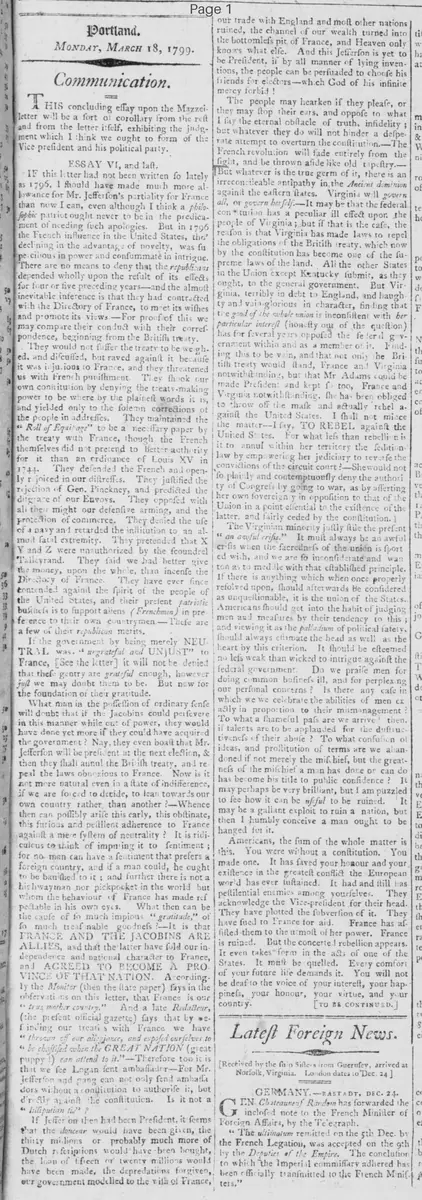
Communication.
This concluding essay upon the Mazzei letter will be a sort of corollary from the rest and from the letter itself, exhibiting the judgment which I think we ought to form of the Vice President and his political party.
ESSAY VI, and last.
If this letter had not been written so lately as 1796, I should have made much more allowance for Mr. Jefferson's partiality for France than now I can, even although I think a philosophic patriot ought never to be in the predicament of needing such apologies. But in 1796 the French influence in the United States, though declining in the advantage of novelty, was so capricious in power and consummate in intrigue. There are no means to deny that the republicans depended wholly upon the result of its effects for four or five preceding years—and the almost inevitable inference is that they had contracted with the Directory of France, to meet its wishes and promote its views—For proof of this we may compare their conduct with their correspondence, beginning from the British treaty. They would not suffer the treaty to be weighed and discussed, but raved against it because it was injurious to France, and they threatened us with French punishment. They shook our own constitution by denying the treaty-making power to be where by the plainest words it is, and yielded only to the solemn corrections of the people in addresses. They maintained the 'Right of Equipage' to be a necessary paper by the treaty with France, though the French themselves did not pretend to better authority for it than an ordinance of Louis XV in 1744. They defended the French and openly rejoiced in our distresses. They justified the rejection of Gen. Pinckney, and predicted the outrage of our Envoys. They opposed with all their might our defensive arming, and the protection of commerce. They denied the use of a navy and retarded the institution to an almost fatal extremity. They pretended that X Y and Z were unauthorized by the scoundrel Talleyrand. They said we had better give the money, upon the whole, than incense the Directory of France. They have ever since contended against the spirit of the people of the United States, and their present Patriotic business is to support aliens (Frenchmen) in preference to their own countrymen—These are a few of their republican merits.
If the government by being merely NEUTRAL was 'ungrateful and UNJUST' to France, [See the letter] it will not be denied that these gentry are grateful enough, however just we may doubt them to be. But now for the foundation of their gratitude.
What man in the possession of ordinary sense will doubt that if the Jacobins could persevere in this manner while out of power, they would have done yet more if they could have acquired the government? Nay, they even boast that Mr. Jefferson will be president at the next election, & then they shall annul the British treaty, and repeal the laws obnoxious to France. Now is it not more natural even in a state of indifference, if we are so forced to decide, to lean towards our own country rather than another?—Whence then can possibly arise this early, this obstinate, this furious and pestilent adherence to France against a mere system of neutrality? It is ridiculous to think of imputing it to sentiment; for no man can have a sentiment that prefers a foreign country, and if a man could, he ought to be banished to it: and further there is not a highwayman nor pickpocket in the world but whom the behaviour of France has made respectable in his own eyes. What then can be the cause of so much impious 'gratitude,' of so much treasonable goodness?—It is that FRANCE AND THE JACOBINS ARE ALLIES, and that the latter have sold our independence and national character to France, and AGREED TO BECOME A PROVINCE OF THAT NATION. Accordingly the Monitor (then the state paper) says in the observations on this letter, that France is our 'true mother country.' And a late Redacteur, (the present official gazette) says that by enforcing our treaties with France we have 'thrown off our allegiance, and exposed ourselves to be chastised when the GREAT NATION (great puppy!) can attend to it.'—Therefore too it is that we see Logan sent ambassador—For Mr. Jefferson and company can not only send ambassadors without a constitution to authorize it, but directly against the constitution. Is it not a 'Lilliputian lie'?
If Jefferson then had been President, it seems that the douceur would have been given, the thirty millions or probably much more of Dutch subscriptions would have been bought, the loan of fifteen or twenty millions would have been made, the depredations forgiven, our government modelled to the wish of France, our trade with England and most other nations ruined, the channel of our wealth turned into the bottomless pit of France, and Heaven only knows what else. And this Jefferson is yet to be President, if by all manner of lying inventions, the people can be persuaded to choose his friends for electors—which God of his infinite mercy forbid!
The people may hearken if they please, or they may stop their ears, and oppose to what I say the eternal obstacle of truth, infidelity; but whatever they do will not hinder a desperate attempt to overturn the constitution.—The French revolution will fade entirely from the sight, and be thrown aside like old tapestry.—But whatever is the true germ of it, there is an irreconcilable antipathy in the Ancient dominion against the eastern states. Virginia will govern all, or govern herself.—It may be that the federal constitution has a peculiar ill effect upon the people of Virginia; but if that is the case, the reason is that Virginia has made laws to repel the obligations of the British treaty, which now by the constitution has become one of the supreme laws of the land. All the other States in the Union except Kentucky submit, as they ought, to the general government. But Virginia, terribly in debt to England, and haughty and vainglorious in character, finding that the good of the whole union is inconsistent with her particular interest (honesty out of the question) has for several years opposed the federal government within and as a member of it. Finding this to be vain, and that not only the British treaty would stand, France and Virginia notwithstanding, but that Mr. Adams could be made President and kept so, France and Virginia notwithstanding, she has been obliged to throw off the mask and actually rebel against the United States. I shall not mince the matter—I say, TO REBEL against the United States. For what less than rebellion is it to annul within her territory the sedition law by empowering her judiciary to reverse the convictions of the circuit court?—She would not so plainly and contemptuously deny the authority of Congress by going to war, as by asserting her own sovereignty in opposition to that of the Union in a point essential to the existence of the latter, and fairly ceded by the constitution.)
The Virginian minority justly style the present 'an awful crisis.' It must always be an awful crisis when the sacredness of the union is sported with, and we are so inconsiderate and wanton as to meddle with that established principle. If there is anything which when once properly resolved upon, should afterwards be considered as unquestionable, it is the union of the States. Americans should get into the habit of judging men and measures by their tendency to this; and viewing it as the palladium of political safety, should always estimate the head as well as the heart by this criterion. It should be esteemed no less weak than wicked to intrigue against the federal government. Do we praise men for doing common business ill, and for perplexing our personal concerns? Is there any case in which we celebrate the abilities of men especially in proportion to their mismanagement? To what a shameful pass are we arrived then, if talents are to be applauded for the destructiveness of their abuse? To what confusion of ideas, and prostitution of terms are we abandoned if not merely the mischief, but the greatness of the mischief a man has done or can do has become his title to public confidence? It may perhaps be very brilliant, but I am puzzled to see how it can be useful to be ruined. It may be a gallant exploit to ruin a nation, but then I humbly conceive a man ought to be hanged for it.
Americans, the sum of the whole matter is this. You were without a constitution. You made one. It has saved your honour and your existence in the greatest conflict the European world has ever sustained. It had and still has pestilential enemies among yourselves. They acknowledge the Vice-president for their head. They have plotted the subversion of it. They have used to France for aid. France has assisted them to the utmost of her power. France is ruined. But the concerted rebellion appears. It even takes form in the acts of one of the States. It must be quelled. Every comfort of your future life demands it. You will not be deaf to the voice of your interest, your happiness, your honour, your virtue, and your country.
TO BE CONTINUED.
This concluding essay upon the Mazzei letter will be a sort of corollary from the rest and from the letter itself, exhibiting the judgment which I think we ought to form of the Vice President and his political party.
ESSAY VI, and last.
If this letter had not been written so lately as 1796, I should have made much more allowance for Mr. Jefferson's partiality for France than now I can, even although I think a philosophic patriot ought never to be in the predicament of needing such apologies. But in 1796 the French influence in the United States, though declining in the advantage of novelty, was so capricious in power and consummate in intrigue. There are no means to deny that the republicans depended wholly upon the result of its effects for four or five preceding years—and the almost inevitable inference is that they had contracted with the Directory of France, to meet its wishes and promote its views—For proof of this we may compare their conduct with their correspondence, beginning from the British treaty. They would not suffer the treaty to be weighed and discussed, but raved against it because it was injurious to France, and they threatened us with French punishment. They shook our own constitution by denying the treaty-making power to be where by the plainest words it is, and yielded only to the solemn corrections of the people in addresses. They maintained the 'Right of Equipage' to be a necessary paper by the treaty with France, though the French themselves did not pretend to better authority for it than an ordinance of Louis XV in 1744. They defended the French and openly rejoiced in our distresses. They justified the rejection of Gen. Pinckney, and predicted the outrage of our Envoys. They opposed with all their might our defensive arming, and the protection of commerce. They denied the use of a navy and retarded the institution to an almost fatal extremity. They pretended that X Y and Z were unauthorized by the scoundrel Talleyrand. They said we had better give the money, upon the whole, than incense the Directory of France. They have ever since contended against the spirit of the people of the United States, and their present Patriotic business is to support aliens (Frenchmen) in preference to their own countrymen—These are a few of their republican merits.
If the government by being merely NEUTRAL was 'ungrateful and UNJUST' to France, [See the letter] it will not be denied that these gentry are grateful enough, however just we may doubt them to be. But now for the foundation of their gratitude.
What man in the possession of ordinary sense will doubt that if the Jacobins could persevere in this manner while out of power, they would have done yet more if they could have acquired the government? Nay, they even boast that Mr. Jefferson will be president at the next election, & then they shall annul the British treaty, and repeal the laws obnoxious to France. Now is it not more natural even in a state of indifference, if we are so forced to decide, to lean towards our own country rather than another?—Whence then can possibly arise this early, this obstinate, this furious and pestilent adherence to France against a mere system of neutrality? It is ridiculous to think of imputing it to sentiment; for no man can have a sentiment that prefers a foreign country, and if a man could, he ought to be banished to it: and further there is not a highwayman nor pickpocket in the world but whom the behaviour of France has made respectable in his own eyes. What then can be the cause of so much impious 'gratitude,' of so much treasonable goodness?—It is that FRANCE AND THE JACOBINS ARE ALLIES, and that the latter have sold our independence and national character to France, and AGREED TO BECOME A PROVINCE OF THAT NATION. Accordingly the Monitor (then the state paper) says in the observations on this letter, that France is our 'true mother country.' And a late Redacteur, (the present official gazette) says that by enforcing our treaties with France we have 'thrown off our allegiance, and exposed ourselves to be chastised when the GREAT NATION (great puppy!) can attend to it.'—Therefore too it is that we see Logan sent ambassador—For Mr. Jefferson and company can not only send ambassadors without a constitution to authorize it, but directly against the constitution. Is it not a 'Lilliputian lie'?
If Jefferson then had been President, it seems that the douceur would have been given, the thirty millions or probably much more of Dutch subscriptions would have been bought, the loan of fifteen or twenty millions would have been made, the depredations forgiven, our government modelled to the wish of France, our trade with England and most other nations ruined, the channel of our wealth turned into the bottomless pit of France, and Heaven only knows what else. And this Jefferson is yet to be President, if by all manner of lying inventions, the people can be persuaded to choose his friends for electors—which God of his infinite mercy forbid!
The people may hearken if they please, or they may stop their ears, and oppose to what I say the eternal obstacle of truth, infidelity; but whatever they do will not hinder a desperate attempt to overturn the constitution.—The French revolution will fade entirely from the sight, and be thrown aside like old tapestry.—But whatever is the true germ of it, there is an irreconcilable antipathy in the Ancient dominion against the eastern states. Virginia will govern all, or govern herself.—It may be that the federal constitution has a peculiar ill effect upon the people of Virginia; but if that is the case, the reason is that Virginia has made laws to repel the obligations of the British treaty, which now by the constitution has become one of the supreme laws of the land. All the other States in the Union except Kentucky submit, as they ought, to the general government. But Virginia, terribly in debt to England, and haughty and vainglorious in character, finding that the good of the whole union is inconsistent with her particular interest (honesty out of the question) has for several years opposed the federal government within and as a member of it. Finding this to be vain, and that not only the British treaty would stand, France and Virginia notwithstanding, but that Mr. Adams could be made President and kept so, France and Virginia notwithstanding, she has been obliged to throw off the mask and actually rebel against the United States. I shall not mince the matter—I say, TO REBEL against the United States. For what less than rebellion is it to annul within her territory the sedition law by empowering her judiciary to reverse the convictions of the circuit court?—She would not so plainly and contemptuously deny the authority of Congress by going to war, as by asserting her own sovereignty in opposition to that of the Union in a point essential to the existence of the latter, and fairly ceded by the constitution.)
The Virginian minority justly style the present 'an awful crisis.' It must always be an awful crisis when the sacredness of the union is sported with, and we are so inconsiderate and wanton as to meddle with that established principle. If there is anything which when once properly resolved upon, should afterwards be considered as unquestionable, it is the union of the States. Americans should get into the habit of judging men and measures by their tendency to this; and viewing it as the palladium of political safety, should always estimate the head as well as the heart by this criterion. It should be esteemed no less weak than wicked to intrigue against the federal government. Do we praise men for doing common business ill, and for perplexing our personal concerns? Is there any case in which we celebrate the abilities of men especially in proportion to their mismanagement? To what a shameful pass are we arrived then, if talents are to be applauded for the destructiveness of their abuse? To what confusion of ideas, and prostitution of terms are we abandoned if not merely the mischief, but the greatness of the mischief a man has done or can do has become his title to public confidence? It may perhaps be very brilliant, but I am puzzled to see how it can be useful to be ruined. It may be a gallant exploit to ruin a nation, but then I humbly conceive a man ought to be hanged for it.
Americans, the sum of the whole matter is this. You were without a constitution. You made one. It has saved your honour and your existence in the greatest conflict the European world has ever sustained. It had and still has pestilential enemies among yourselves. They acknowledge the Vice-president for their head. They have plotted the subversion of it. They have used to France for aid. France has assisted them to the utmost of her power. France is ruined. But the concerted rebellion appears. It even takes form in the acts of one of the States. It must be quelled. Every comfort of your future life demands it. You will not be deaf to the voice of your interest, your happiness, your honour, your virtue, and your country.
TO BE CONTINUED.
What sub-type of article is it?
Partisan Politics
Constitutional
Foreign Affairs
What keywords are associated?
Mazzei Letter
Jefferson Criticism
French Influence
Republican Merits
British Treaty
Federal Constitution
Virginia Rebellion
Partisan Politics
Union Preservation
What entities or persons were involved?
Jefferson
Vice President
Republicans
France
Directory
Virginia
Adams
Pinckney
Talleyrand
Logan
Editorial Details
Primary Topic
Critique Of Jefferson's Mazzei Letter And Republican Pro French Allegiance Threatening Federal Union
Stance / Tone
Strongly Anti Republican And Pro Federalist, Warning Against French Influence And Virginia's Rebellion
Key Figures
Jefferson
Vice President
Republicans
France
Directory
Virginia
Adams
Pinckney
Talleyrand
Logan
Key Arguments
Republicans Depended On French Influence For Years
Opposed British Treaty As Injurious To France
Denied Constitutional Treaty Making Power
Justified French Actions And Predicted Outrages
Opposed Defensive Arming And Navy
Alleged Alliance With France To Subvert Independence
Virginia Rebelling By Nullifying Federal Laws
Urges Quelling The Rebellion To Preserve Union