Thank you for visiting SNEWPapers!
Sign up free
Editorial
June 11, 1921
The Public Ledger
Maysville, Mason County, Kentucky
What is this article about?
Editorial expresses faith in President Harding to resist pressures from Secretaries Hughes and Hoover to resubmit the Treaty of Versailles for ratification with reservations nullifying the League of Nations. It warns of domestic political fallout and reaffirms opposition to the treaty, supporting Senator Lodge's stance against it.
Clipping
OCR Quality
99%
Excellent
Full Text
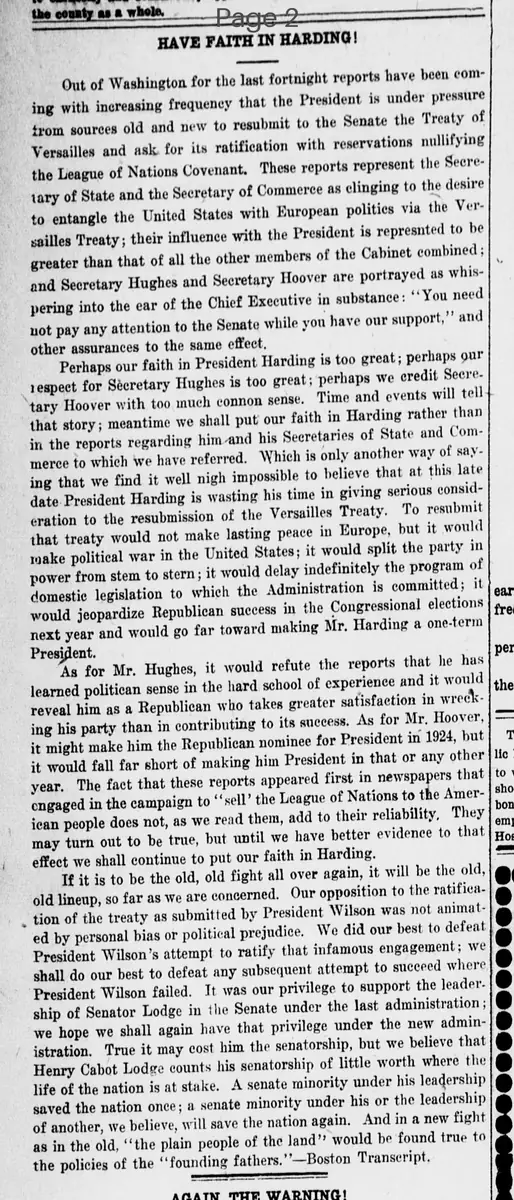
HAVE FAITH IN HARDING!
Out of Washington for the last fortnight reports have been coming with increasing frequency that the President is under pressure from sources old and new to resubmit to the Senate the Treaty of Versailles and ask for its ratification with reservations nullifying the League of Nations Covenant. These reports represent the Secretary of State and the Secretary of Commerce as clinging to the desire to entangle the United States with European politics via the Versailles Treaty; their influence with the President is represented to be greater than that of all the other members of the Cabinet combined: Secretary Hughes and Secretary Hoover are portrayed as whispering into the ear of the Chief Executive in substance: "You need not pay any attention to the Senate while you have our support," and other assurances to the same effect.
Perhaps our faith in President Harding is too great; perhaps our respect for Secretary Hughes is too great; perhaps we credit Secretary Hoover with too much common sense. Time and events will tell in the reports regarding him and his Secretaries of State and Commerce to which we have referred. Which is only another way of saying that we find it well nigh impossible to believe that at this late date President Harding is wasting his time in giving serious consideration to the resubmission of the Versailles Treaty. To resubmit that treaty would not make lasting peace in Europe, but it would make political war in the United States; it would split the party in power from stem to stern; it would delay indefinitely the program of domestic legislation to which the Administration is committed; it would jeopardize Republican success in the Congressional elections next year and would go far toward making Mr. Harding a one-term President.
As for Mr. Hughes, it would refute the reports that he has learned politician sense in the hard school of experience and it would reveal him as a Republican who takes greater satisfaction in wrecking his party than in contributing to its success. As for Mr. Hoover it might make him the Republican nominee for President in 1924, but it would fall far short of making him President in that or any other year. The fact that these reports appeared first in newspapers that were engaged in the campaign to "sell" the League of Nations to the American people does not, as we read them, add to their reliability. They may turn out to be true, but until we have better evidence to that effect we shall continue to put our faith in Harding.
If it is to be the old, old fight all over again, it will be the old lineup, so far as we are concerned. Our opposition to the ratification of the treaty as submitted by President Wilson was not animated by personal bias or political prejudice. We did our best to defeat President Wilson's attempt to ratify that infamous engagement; we shall do our best to defeat any subsequent attempt to succeed where President Wilson failed. It was our privilege to support the leadership of Senator Lodge in the Senate under the last administration; we hope we shall again have that privilege under the new administration. True it may cost him the senatorship, but we believe that Henry Cabot Lodge counts his senatorship of little worth where the life of the nation is at stake. A senate minority under his leadership saved the nation once; a senate minority under his or the leadership of another, we believe, will save the nation again. And in a new fight as in the old, "the plain people of the land" would be found true to the policies of the "founding fathers."—Boston Transcript.
Out of Washington for the last fortnight reports have been coming with increasing frequency that the President is under pressure from sources old and new to resubmit to the Senate the Treaty of Versailles and ask for its ratification with reservations nullifying the League of Nations Covenant. These reports represent the Secretary of State and the Secretary of Commerce as clinging to the desire to entangle the United States with European politics via the Versailles Treaty; their influence with the President is represented to be greater than that of all the other members of the Cabinet combined: Secretary Hughes and Secretary Hoover are portrayed as whispering into the ear of the Chief Executive in substance: "You need not pay any attention to the Senate while you have our support," and other assurances to the same effect.
Perhaps our faith in President Harding is too great; perhaps our respect for Secretary Hughes is too great; perhaps we credit Secretary Hoover with too much common sense. Time and events will tell in the reports regarding him and his Secretaries of State and Commerce to which we have referred. Which is only another way of saying that we find it well nigh impossible to believe that at this late date President Harding is wasting his time in giving serious consideration to the resubmission of the Versailles Treaty. To resubmit that treaty would not make lasting peace in Europe, but it would make political war in the United States; it would split the party in power from stem to stern; it would delay indefinitely the program of domestic legislation to which the Administration is committed; it would jeopardize Republican success in the Congressional elections next year and would go far toward making Mr. Harding a one-term President.
As for Mr. Hughes, it would refute the reports that he has learned politician sense in the hard school of experience and it would reveal him as a Republican who takes greater satisfaction in wrecking his party than in contributing to its success. As for Mr. Hoover it might make him the Republican nominee for President in 1924, but it would fall far short of making him President in that or any other year. The fact that these reports appeared first in newspapers that were engaged in the campaign to "sell" the League of Nations to the American people does not, as we read them, add to their reliability. They may turn out to be true, but until we have better evidence to that effect we shall continue to put our faith in Harding.
If it is to be the old, old fight all over again, it will be the old lineup, so far as we are concerned. Our opposition to the ratification of the treaty as submitted by President Wilson was not animated by personal bias or political prejudice. We did our best to defeat President Wilson's attempt to ratify that infamous engagement; we shall do our best to defeat any subsequent attempt to succeed where President Wilson failed. It was our privilege to support the leadership of Senator Lodge in the Senate under the last administration; we hope we shall again have that privilege under the new administration. True it may cost him the senatorship, but we believe that Henry Cabot Lodge counts his senatorship of little worth where the life of the nation is at stake. A senate minority under his leadership saved the nation once; a senate minority under his or the leadership of another, we believe, will save the nation again. And in a new fight as in the old, "the plain people of the land" would be found true to the policies of the "founding fathers."—Boston Transcript.
What sub-type of article is it?
Foreign Affairs
Partisan Politics
War Or Peace
What keywords are associated?
Versailles Treaty
League Of Nations
President Harding
Senator Lodge
Republican Party
Foreign Entanglement
Treaty Ratification
What entities or persons were involved?
President Harding
Secretary Hughes
Secretary Hoover
Senator Lodge
President Wilson
Editorial Details
Primary Topic
Faith In Harding Against Resubmitting Versailles Treaty
Stance / Tone
Supportive Of Harding And Anti League Of Nations Ratification
Key Figures
President Harding
Secretary Hughes
Secretary Hoover
Senator Lodge
President Wilson
Key Arguments
Reports Of Pressure To Resubmit Versailles Treaty Are Unreliable And From Pro League Sources
Resubmission Would Cause Political Division In Us And Split Republican Party
It Would Delay Domestic Legislation And Jeopardize Republican Elections
Opposition To Wilson's Ratification Was Principled, Not Biased
Support For Lodge's Leadership To Block The Treaty