Thank you for visiting SNEWPapers!
Sign up free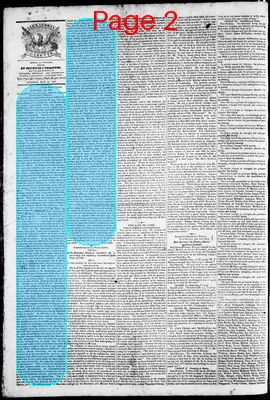
Editorial
May 28, 1827
Phenix Gazette
Alexandria, Virginia
What is this article about?
In a letter to Senator Louis McLane, 'Bayard' criticizes supporters of General Jackson for the presidency, portraying them as minions of power drawn to military leaders. He highlights discrepancies in Jackson's sworn statements and official praises regarding Louisiana's loyalty during the 1815 New Orleans defense, arguing Jackson's proclamation of martial law stemmed from a domineering spirit rather than necessity, questioning his fitness for office.
Clipping
OCR Quality
92%
Excellent
Full Text
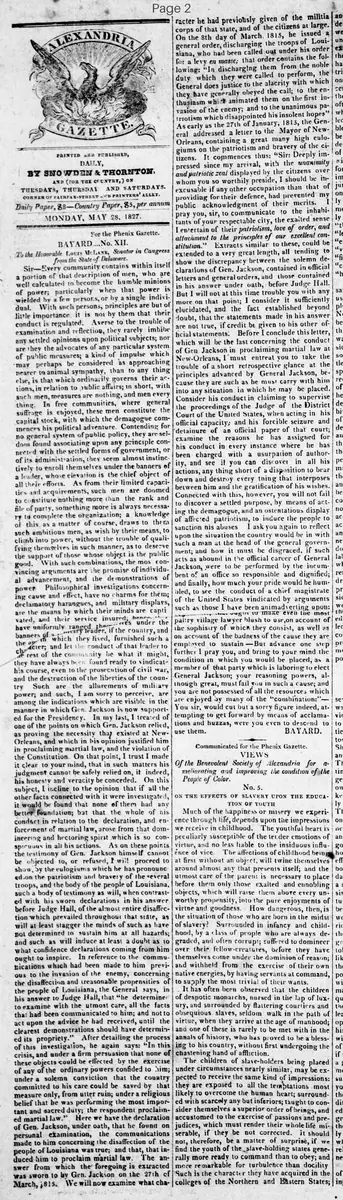
For the Phenix Gazette:
BAYARD...NO. XII.
To the Honorable Louis McLane, Senator in Congress from the State of Delaware:
Sir—Every community contains within itself a portion of that description of men, who are well calculated to become the humble minions of power; particularly when that power is wielded by a few persons, or by a single individual. With such persons, principles are but of little importance, it is not by them that their conduct is regulated. Averse to the trouble of examination and reflection, they rarely imbibe any settled opinions upon political subjects; nor are they the advocates of any particular system of public measures; a kind of impulse which may perhaps be considered as approaching nearer to animal sympathy, than to any thing else, is that which ordinarily governs their actions in relation to public affairs; in short, with such men, measures are nothing, and men every thing. In free communities, where general suffrage is enjoyed, these men constitute the capital stock, with which the demagogue commences his political adventure. Contending for no general system of public policy, they are seldom found associating upon any principle connected with the settled forms of government, or of its administration, they seem almost instinctively to enroll themselves under the banners of a leader, whose elevation is the chief object of all their efforts. As from their limited capacities and acquirements, such men are doomed to constitute nothing more than the rank and file of party, something more is always necessary to complete the organization; a knowledge of this, as a matter of course, draws to them such ambitious men, as wish by their means, to climb into power, without the trouble of qualifying themselves in such manner, as to deserve the support of those whose object is the public good. With such combinations, the most convincing arguments are the promise of individual advancement, and the demonstrations of power. Philosophical investigations concerning cause and effect, have no charms for them; declamatory harangues, and military displays, are the means by which their minds are captivated, and their service insured; hence the age in which they lived, furnished such a military leader, and have uniformly ranged themselves under the banners of a military leader.
Such are the allurements of military power; and such, I am sorry to perceive, are among the indications which are visible in the manner in which Gen. Jackson is now supported for the Presidency. In my last, I treated of one of the points on which Gen. Jackson relied, as proving the necessity that existed at New Orleans, and which in his opinion justified him in proclaiming martial law, and the violation of the Constitution. On that point, I trust I made it clear to your mind, that in such matters his judgment cannot be safely relied on, if indeed, his honesty and veracity be conceded. On this subject, I incline to the opinion that if all the other facts connected with it were investigated, it would be found that none of them had any better foundation; but that the whole of his conduct in relation to the declaration, and enforcement of martial law, arose from that domineering and hectoring spirit which is so conspicuous in all his actions. As on these points the testimony of Gen. Jackson himself cannot be objected to, or refused, I will proceed to show, by the eulogiums which he has pronounced on the patriotism and bravery of the several troops, and the body of the people of Louisiana, such a body of testimony as will, when contrasted with his sworn declarations in his answer before Judge Hall, of the almost entire disaffection which prevailed throughout that state, as will at least stagger the minds of such as have not determined to sustain him at all hazards; and such as will induce at least a doubt as to what confidence declarations coming from him ought to inspire. In reference to the communications which had been made to him previous to the invasion of the enemy, concerning the disaffection and treasonable propensities of the people of Louisiana, the General says, in his answer to Judge Hall, that "he determined to examine with the utmost care, all the facts that had been communicated to him; and not to act upon the advice he had received, until the clearest demonstrations should have determined its propriety." After detailing the process of this investigation, he again says: "In this crisis, and under a firm persuasion that none of these objects could be effected by the exercise of any of the ordinary powers confided to him; under a solemn conviction that the country committed to his care could be saved by that measure only, from utter ruin; under a religious belief that he was performing the most important and sacred duty; the respondent proclaimed martial law." Here we have the declaration of Gen. Jackson, under oath, that he found on personal examination, the communications made to him concerning the disaffection of the people of Louisiana was true; and that, that induced him to proclaim martial law. The answer from which the foregoing is extracted was sworn to by Gen. Jackson on the 27th of March, 1815. We will now examine what character he had previously given of the militia corps of that state, and of the citizens at large.
On the 8th day of March, 1815, he issued a general order, discharging the troops of Louisiana, who had been called out under his order for a levy en masse; that order contains the following: "In discharging them from the noble duty which they were called to perform, the General does justice to the alacrity with which they have generally obeyed the call; to the enthusiasm which animated them on the first invasion of the enemy; and to the unanimous patriotism which disappointed his insolent hopes."
As early as the 27th of January, 1815, the General addressed a letter to the Mayor of New Orleans, containing a great many high eulogiums on the patriotism and bravery of the citizens. It commences thus: "Sir: Deeply impressed since my arrival, with the unanimity and patriotic zeal displayed by the citizens over whom you so worthily preside, I should be inexcusable if any other occupation than that of providing for their defence, had prevented my public acknowledgment of their merits. I pray you, sir, to communicate to the inhabitants of your respectable city, the exalted sense I entertain of their patriotism, love of order, and attachment to the principles of our excellent constitution."
Extracts similar to these, could be extended to a very great length, all tending to show the discrepancy between the solemn declarations of Gen. Jackson, contained in official letters and general orders, and those contained in his answer under oath, before Judge Hall. But I will not at this time trouble you with any more on that point; I consider it sufficiently elucidated, and the fact established beyond doubt, that the statements made in his answer are not true, if credit be given to his other official statements. Before I conclude this letter, which will be the last concerning the conduct of Gen Jackson in proclaiming martial law at New-Orleans, I must entreat you to take the trouble of a short retrospective glance at the principles advanced by General Jackson, because they are such as he must carry with him into any situation in which he may be placed. Consider his conduct in claiming to supervise the proceedings of the Judge of the District Court of the United States, when acting in his official capacity; and his forcible seizure and detainment of an official paper of that court; examine the reasons he has assigned for his conduct in every instance where he has been charged with a usurpation of authority, and see if you can discover in all his actions, any thing short of a disposition to bear down and destroy every thing that interposes between him and the gratification of his wishes. Connected with this, however, you will not fail to discover a settled purpose, by means of acting the demagogue, and an ostentatious display of affected patriotism, to induce the people to sanction his abuses. I ask you again to reflect upon the situation the country would be in with such a man at the head of the general government; and how it must be disgraced, if such acts as abound in the official career of General Jackson, were to be performed by the incumbent of an office so responsible and dignified; and finally, how much your pride would be humbled, to see the conduct of a chief magistrate of the United States vindicated by arguments such as those I have been animadverting upon: make even the most paitry village lawyer blush to use, on account of the sophistry of which they consist, as well as on account of the badness of the cause they are employed to sustain. But advance one step further I pray you, and bring to your mind the condition in which you would be placed, as a member of that party which is laboring to elect General Jackson; your reasoning powers, although great, must fail you in such a cause; and you are not possessed of all the resources which are enjoyed by many of the "combination:"— You sir, would cut but a sorry figure indeed, attempting to get forward by means of acclamations and huzzas, were you even to descend to use them.
BAYARD.
BAYARD...NO. XII.
To the Honorable Louis McLane, Senator in Congress from the State of Delaware:
Sir—Every community contains within itself a portion of that description of men, who are well calculated to become the humble minions of power; particularly when that power is wielded by a few persons, or by a single individual. With such persons, principles are but of little importance, it is not by them that their conduct is regulated. Averse to the trouble of examination and reflection, they rarely imbibe any settled opinions upon political subjects; nor are they the advocates of any particular system of public measures; a kind of impulse which may perhaps be considered as approaching nearer to animal sympathy, than to any thing else, is that which ordinarily governs their actions in relation to public affairs; in short, with such men, measures are nothing, and men every thing. In free communities, where general suffrage is enjoyed, these men constitute the capital stock, with which the demagogue commences his political adventure. Contending for no general system of public policy, they are seldom found associating upon any principle connected with the settled forms of government, or of its administration, they seem almost instinctively to enroll themselves under the banners of a leader, whose elevation is the chief object of all their efforts. As from their limited capacities and acquirements, such men are doomed to constitute nothing more than the rank and file of party, something more is always necessary to complete the organization; a knowledge of this, as a matter of course, draws to them such ambitious men, as wish by their means, to climb into power, without the trouble of qualifying themselves in such manner, as to deserve the support of those whose object is the public good. With such combinations, the most convincing arguments are the promise of individual advancement, and the demonstrations of power. Philosophical investigations concerning cause and effect, have no charms for them; declamatory harangues, and military displays, are the means by which their minds are captivated, and their service insured; hence the age in which they lived, furnished such a military leader, and have uniformly ranged themselves under the banners of a military leader.
Such are the allurements of military power; and such, I am sorry to perceive, are among the indications which are visible in the manner in which Gen. Jackson is now supported for the Presidency. In my last, I treated of one of the points on which Gen. Jackson relied, as proving the necessity that existed at New Orleans, and which in his opinion justified him in proclaiming martial law, and the violation of the Constitution. On that point, I trust I made it clear to your mind, that in such matters his judgment cannot be safely relied on, if indeed, his honesty and veracity be conceded. On this subject, I incline to the opinion that if all the other facts connected with it were investigated, it would be found that none of them had any better foundation; but that the whole of his conduct in relation to the declaration, and enforcement of martial law, arose from that domineering and hectoring spirit which is so conspicuous in all his actions. As on these points the testimony of Gen. Jackson himself cannot be objected to, or refused, I will proceed to show, by the eulogiums which he has pronounced on the patriotism and bravery of the several troops, and the body of the people of Louisiana, such a body of testimony as will, when contrasted with his sworn declarations in his answer before Judge Hall, of the almost entire disaffection which prevailed throughout that state, as will at least stagger the minds of such as have not determined to sustain him at all hazards; and such as will induce at least a doubt as to what confidence declarations coming from him ought to inspire. In reference to the communications which had been made to him previous to the invasion of the enemy, concerning the disaffection and treasonable propensities of the people of Louisiana, the General says, in his answer to Judge Hall, that "he determined to examine with the utmost care, all the facts that had been communicated to him; and not to act upon the advice he had received, until the clearest demonstrations should have determined its propriety." After detailing the process of this investigation, he again says: "In this crisis, and under a firm persuasion that none of these objects could be effected by the exercise of any of the ordinary powers confided to him; under a solemn conviction that the country committed to his care could be saved by that measure only, from utter ruin; under a religious belief that he was performing the most important and sacred duty; the respondent proclaimed martial law." Here we have the declaration of Gen. Jackson, under oath, that he found on personal examination, the communications made to him concerning the disaffection of the people of Louisiana was true; and that, that induced him to proclaim martial law. The answer from which the foregoing is extracted was sworn to by Gen. Jackson on the 27th of March, 1815. We will now examine what character he had previously given of the militia corps of that state, and of the citizens at large.
On the 8th day of March, 1815, he issued a general order, discharging the troops of Louisiana, who had been called out under his order for a levy en masse; that order contains the following: "In discharging them from the noble duty which they were called to perform, the General does justice to the alacrity with which they have generally obeyed the call; to the enthusiasm which animated them on the first invasion of the enemy; and to the unanimous patriotism which disappointed his insolent hopes."
As early as the 27th of January, 1815, the General addressed a letter to the Mayor of New Orleans, containing a great many high eulogiums on the patriotism and bravery of the citizens. It commences thus: "Sir: Deeply impressed since my arrival, with the unanimity and patriotic zeal displayed by the citizens over whom you so worthily preside, I should be inexcusable if any other occupation than that of providing for their defence, had prevented my public acknowledgment of their merits. I pray you, sir, to communicate to the inhabitants of your respectable city, the exalted sense I entertain of their patriotism, love of order, and attachment to the principles of our excellent constitution."
Extracts similar to these, could be extended to a very great length, all tending to show the discrepancy between the solemn declarations of Gen. Jackson, contained in official letters and general orders, and those contained in his answer under oath, before Judge Hall. But I will not at this time trouble you with any more on that point; I consider it sufficiently elucidated, and the fact established beyond doubt, that the statements made in his answer are not true, if credit be given to his other official statements. Before I conclude this letter, which will be the last concerning the conduct of Gen Jackson in proclaiming martial law at New-Orleans, I must entreat you to take the trouble of a short retrospective glance at the principles advanced by General Jackson, because they are such as he must carry with him into any situation in which he may be placed. Consider his conduct in claiming to supervise the proceedings of the Judge of the District Court of the United States, when acting in his official capacity; and his forcible seizure and detainment of an official paper of that court; examine the reasons he has assigned for his conduct in every instance where he has been charged with a usurpation of authority, and see if you can discover in all his actions, any thing short of a disposition to bear down and destroy every thing that interposes between him and the gratification of his wishes. Connected with this, however, you will not fail to discover a settled purpose, by means of acting the demagogue, and an ostentatious display of affected patriotism, to induce the people to sanction his abuses. I ask you again to reflect upon the situation the country would be in with such a man at the head of the general government; and how it must be disgraced, if such acts as abound in the official career of General Jackson, were to be performed by the incumbent of an office so responsible and dignified; and finally, how much your pride would be humbled, to see the conduct of a chief magistrate of the United States vindicated by arguments such as those I have been animadverting upon: make even the most paitry village lawyer blush to use, on account of the sophistry of which they consist, as well as on account of the badness of the cause they are employed to sustain. But advance one step further I pray you, and bring to your mind the condition in which you would be placed, as a member of that party which is laboring to elect General Jackson; your reasoning powers, although great, must fail you in such a cause; and you are not possessed of all the resources which are enjoyed by many of the "combination:"— You sir, would cut but a sorry figure indeed, attempting to get forward by means of acclamations and huzzas, were you even to descend to use them.
BAYARD.
What sub-type of article is it?
Partisan Politics
Military Affairs
Constitutional
What keywords are associated?
Jackson Presidency
Martial Law
New Orleans
Louisiana Disaffection
Military Leader
Constitutional Violation
Partisan Support
Demagogue
What entities or persons were involved?
Gen. Jackson
Louis Mclane
Judge Hall
People Of Louisiana
Mayor Of New Orleans
Editorial Details
Primary Topic
Criticism Of General Jackson's Martial Law Proclamation In New Orleans And His Presidential Candidacy
Stance / Tone
Strongly Anti Jackson, Portraying Him As Domineering And Dishonest
Key Figures
Gen. Jackson
Louis Mclane
Judge Hall
People Of Louisiana
Mayor Of New Orleans
Key Arguments
Supporters Of Jackson Are Minions Drawn To Military Power Rather Than Principles
Jackson's Sworn Statements Claim Disaffection In Louisiana Justified Martial Law
Contradictory Official Praises Depict Louisiana Troops And Citizens As Patriotic And Unanimous
Discrepancies Indicate Jackson's Statements Are Untrue
Jackson's Domineering Spirit Led To Constitutional Violations
Election Of Jackson Would Disgrace The Presidency And Enable Abuses
Jackson Acts As A Demagogue Using Affected Patriotism To Gain Support