Thank you for visiting SNEWPapers!
Sign up free
The Daily Journal
East Saint Louis, Saint Clair County, Illinois
What is this article about?
Mrs. Grace E. Hager criticizes the Journal's reprint of a Chicago News article condemning the execution of nurse Edith Cavell by Germans in WWI Belgium. She argues Cavell was a profit-motivated professional nurse involved in aiding Allied escapes, defends the execution as just, but highlights class bias in pardoning titled accomplices while executing the poor nurse.
Clipping
OCR Quality
Full Text
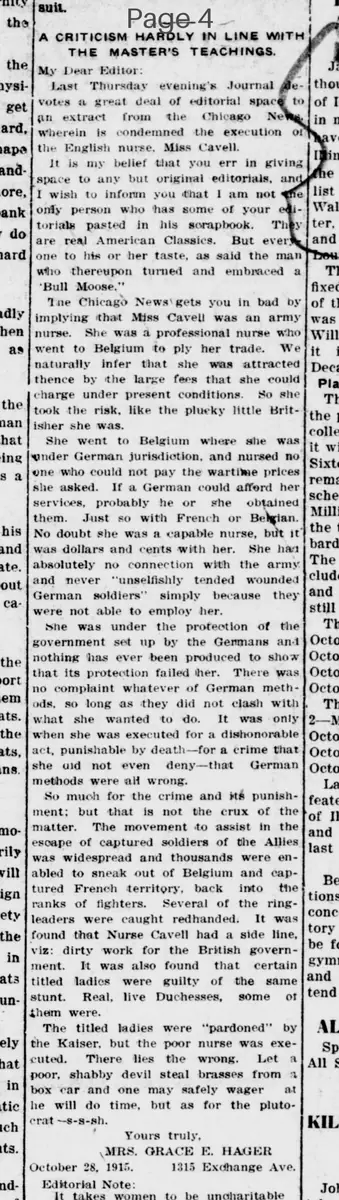
My Dear Editor:
Last Thursday evening's Journal devotes a great deal of editorial space to an extract from the Chicago News wherein is condemned the execution of the English nurse, Miss Cavell.
It is my belief that you err in giving space to any but original editorials, and I wish to inform you that I am not the only person who has some of your editorials pasted in his scrapbook.
They are real American Classics. But every one to his or her taste, as said the man who thereupon turned and embraced a "Bull Moose."
The Chicago News gets you in bad by implying that Miss Cavell was an army nurse. She was a professional nurse who went to Belgium to ply her trade. We naturally infer that she was attracted thence by the large fees that she could charge under present conditions. So she took the risk, like the plucky little Britisher she was.
She went to Belgium where she was under German jurisdiction, and nursed no one who could not pay the wartime prices she asked. If a German could afford her services, probably he or she obtained them. Just so with French or Belgian.
No doubt she was a capable nurse, but it was dollars and cents with her. She had absolutely no connection with the army and never "unselfishly tended wounded German soldiers" simply because they were not able to employ her.
She was under the protection of the government set up by the Germans and nothing has ever been produced to show that its protection failed her. There was no complaint whatever of German methods, so long as they did not clash with what she wanted to do. It was only when she was executed for a dishonorable act, punishable by death—for a crime that she did not even deny—that German methods were all wrong.
So much for the crime and its punishment; but that is not the crux of the matter. The movement to assist in the escape of captured soldiers of the Allies was widespread and thousands were enabled to sneak out of Belgium and captured French territory back into the ranks of fighters.
Several of the ring-leaders were caught redhanded. It was found that Nurse Cavell had a side line, viz: dirty work for the British government. It was also found that certain titled ladies were guilty of the same stunt. Real, live Duchesses, some of them were.
The titled ladies were "pardoned" by the Kaiser, but the poor nurse was executed. There lies the wrong. Let a poor, shabby devil steal brasses from a box car and one may safely wager he will do time, but as for the plutocrat—s-s-sh.
Yours truly,
MRS. GRACE E. HAGER
October 28, 1915.
1315 Exchange Ave.
What sub-type of article is it?
What themes does it cover?
What keywords are associated?
What entities or persons were involved?
Letter to Editor Details
Author
Mrs. Grace E. Hager
Recipient
Editor
Main Argument
the execution of edith cavell was justified as punishment for aiding allied escapes, but the real injustice lies in the kaiser pardoning titled accomplices while executing the poor nurse, highlighting class bias in justice.
Notable Details