Thank you for visiting SNEWPapers!
Sign up free
West Jersey Pioneer
Bridgeton, Cumberland County, New Jersey
What is this article about?
In a January 1, 1855, letter to his parents, C.D.M. from Yuka, CA, recounts moving from Wood's Bar due to rising violence among miners. He details half-ownership in farms in Shasta and Scott Valleys for dairy, vegetables, and grain; lists produce prices; notes improving society and health; and describes building profitable grist and saw mills amid scarce money.
Clipping
OCR Quality
Full Text
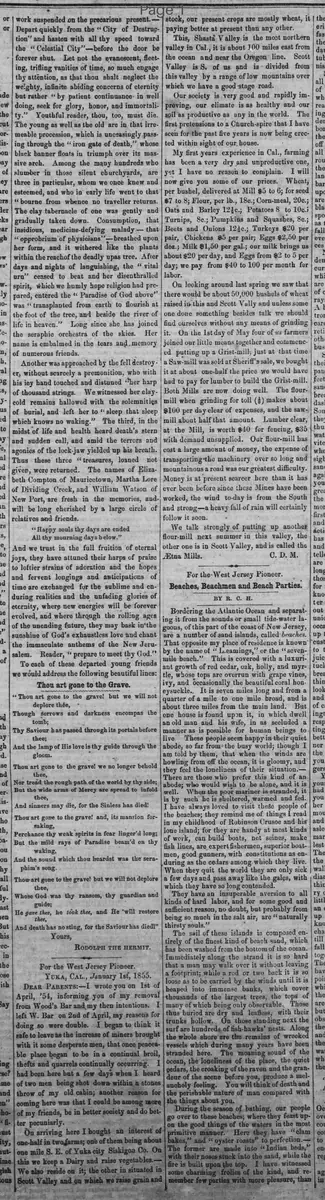
YUKA, CAL., January 1st, 1855.
Dear Parents: I wrote you on 1st of April, '54, informing you of my removal from Wood's Bar and my then intentions. I left W. Bar on 2nd of April, my reasons for doing so were double. I began to think it safe to leave as the increase of miners brought with it some desperate men, that once peaceable place began to be in a continual broil, thefts and quarrels continually occurring. I had been here but a few days when I heard of two men being shot down within a stone's throw of my old cabin; another reason for coming here was that I could be among more of my friends, be in better society and do better pecuniarily.
On arriving here I bought an interest of one-half in two farms; one of them being about one mile S. E. of Yuka city Siskiyou Co. On this we keep a Dairy and raise vegetables. We also reside on it; the other is situated in Scott Valley and on which we raise grain and stock, our present crops are mostly wheat, it paying better at present than any other.
This, Shasta Valley is the most northern valley in Cal. it is about 100 miles east from the ocean and near the Oregon line. Scott Valley is S. of us and is divided from this valley by a range of low mountains over which we have a good stage road.
Our society is very good and rapidly improving, our climate is as healthy and our soil as productive as any in the world. The first pretensions to a Church-spire that I have seen for the past five years is now being erected within sight of our house.
My first year's experience in Cal., farming has been a very dry and unproductive one, yet I have no reason to complain. I will now give you some of our prices. Wheat, per bushel, delivered at Mill $5 to 6; for seed $7 to 8; Flour, per lb., 18c.; Corn-meal, 20c.; Oats and Barley 12c.; Potatoes 8 to 10c.; Turnips, 5c.; Pumpkins and Squashes, 8c.; Beets and Onions 12c.; Turkeys $20 per pair, Chickens $5 per pair; Eggs $2.50 per doz.; Milk $1.50 per gal.; our milk brings us about $20 per day, and Eggs from 2 to 5 per day; we pay from $40 to 100 per month for labor.
On looking around last spring we saw that there would be about 50,000 bushels of wheat raised in this and Scott Valley and unless some one done something besides talk we should find ourselves without any means of grinding it. On the 1st day of May four of us farmers joined our little means together and commenced putting up a Grist-mill; just at that time a Saw-mill was sold at Sheriff's sale, we bought it at about one-half the price we would have had to pay for lumber to build the Grist-mill.
Both Mills are now doing well. The flour-mill when grinding for toll makes about $100 per day clear of expenses, and the saw-mill about half that amount. Lumber clear at the Mill, is worth $40 for fencing, $35 with demand unsupplied. Our flour-mill has cost a large amount of money, the expense of transporting the machinery over so long and mountainous a road was our greatest difficulty.
Money is at present scarcer here than it has ever been before since these Mines have been worked, the wind to-day is from the South and strong—a heavy fall of rain will certainly follow it soon.
We talk strongly of putting up another flour-mill next summer in this valley, the other one is in Scott Valley, and is called the Atna Mills.
C. D. M.
What sub-type of article is it?
What themes does it cover?
What keywords are associated?
What entities or persons were involved?
Letter to Editor Details
Author
C. D. M.
Recipient
Dear Parents
Main Argument
the writer describes his relocation from wood's bar to yuka for safety and better prospects, details his farming operations in shasta and scott valleys including dairy, vegetables, and grain, reports on local prices and society, and explains the joint construction of grist and saw mills to process local wheat production.
Notable Details