Thank you for visiting SNEWPapers!
Sign up free
The Hood River Glacier
Hood River, Hood River County, Oregon
What is this article about?
Reports of serious winter injury to peach, pear, and cherry trees in central Willamette Valley orchards prompt advice from Agricultural College horticulture experts. Growers urged to inspect trees, apply bridge-grafting or protective measures, and report conditions for tailored treatment.
Clipping
OCR Quality
Full Text
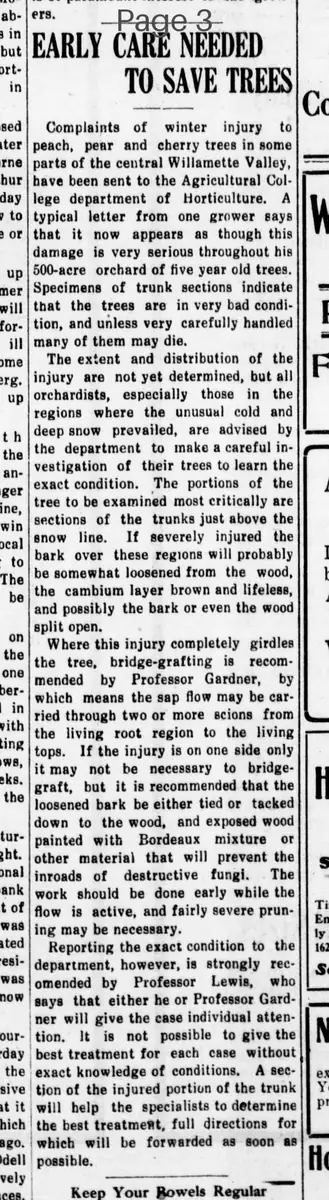
Complaints of winter injury to peach, pear and cherry trees in some parts of the central Willamette Valley, have been sent to the Agricultural College department of Horticulture. A typical letter from one grower says that it now appears as though this damage is very serious throughout his 500-acre orchard of five year old trees. Specimens of trunk sections indicate that the trees are in very bad condition, and unless very carefully handled many of them may die.
The extent and distribution of the injury are not yet determined, but all orchardists, especially those in the regions where the unusual cold and deep snow prevailed, are advised by the department to make a careful investigation of their trees to learn the exact condition. The portions of the tree to be examined most critically are sections of the trunks just above the snow line. If severely injured the bark over these regions will probably be somewhat loosened from the wood, the cambium layer brown and lifeless, and possibly the bark or even the wood split open.
Where this injury completely girdles the tree, bridge-grafting is recommended by Professor Gardner, by which means the sap flow may be carried through two or more scions from the living root region to the living tops. If the injury is on one side only it may not be necessary to bridge-graft, but it is recommended that the loosened bark be either tied or tacked down to the wood, and exposed wood painted with Bordeaux mixture or other material that will prevent the inroads of destructive fungi. The work should be done early while the flow is active, and fairly severe pruning may be necessary.
Reporting the exact condition to the department, however, is strongly recommended by Professor Lewis, who says that either he or Professor Gardner will give the case individual attention. It is not possible to give the best treatment for each case without exact knowledge of conditions. A section of the injured portion of the trunk will help the specialists to determine the best treatment, full directions for which will be forwarded as soon as possible.
What sub-type of article is it?
What keywords are associated?
What entities or persons were involved?
Where did it happen?
Domestic News Details
Primary Location
Central Willamette Valley
Key Persons
Outcome
serious damage to peach, pear, and cherry trees; potential death of many trees if not treated; recommendations for bridge-grafting, bark securing, painting with bordeaux mixture, and pruning.
Event Details
Complaints of winter injury from cold and deep snow to orchards in central Willamette Valley reported to Agricultural College Horticulture department. Growers advised to inspect trunks above snow line for loosened bark, brown cambium, and splits. Bridge-grafting recommended for girdled trees; secure and paint partial injuries. Report conditions and send trunk sections for expert advice.