Thank you for visiting SNEWPapers!
Sign up free
Bisbee Daily Review
Bisbee, Cochise County, Arizona
What is this article about?
In Washington on Oct. 21, the national industrial conference rejected collective bargaining resolutions and labor's steel strike intervention proposal, resulting in deadlock. Separately, Secretary Wilson mediated a four-hour meeting between coal miners led by John L. Lewis and operators led by Thomas T. Brewster, but no agreement was reached, with the miners' strike set for November 1 looming amid government intervention considerations.
Merged-components note: Merging overlapping and continued components of the national industrial conference and coal strike story across page 1 (reading orders 8 and 21) and page 2 (reading order 26). Content is coherent on the same topic of US labor disputes.
Clippings
1 of 2
OCR Quality
Full Text
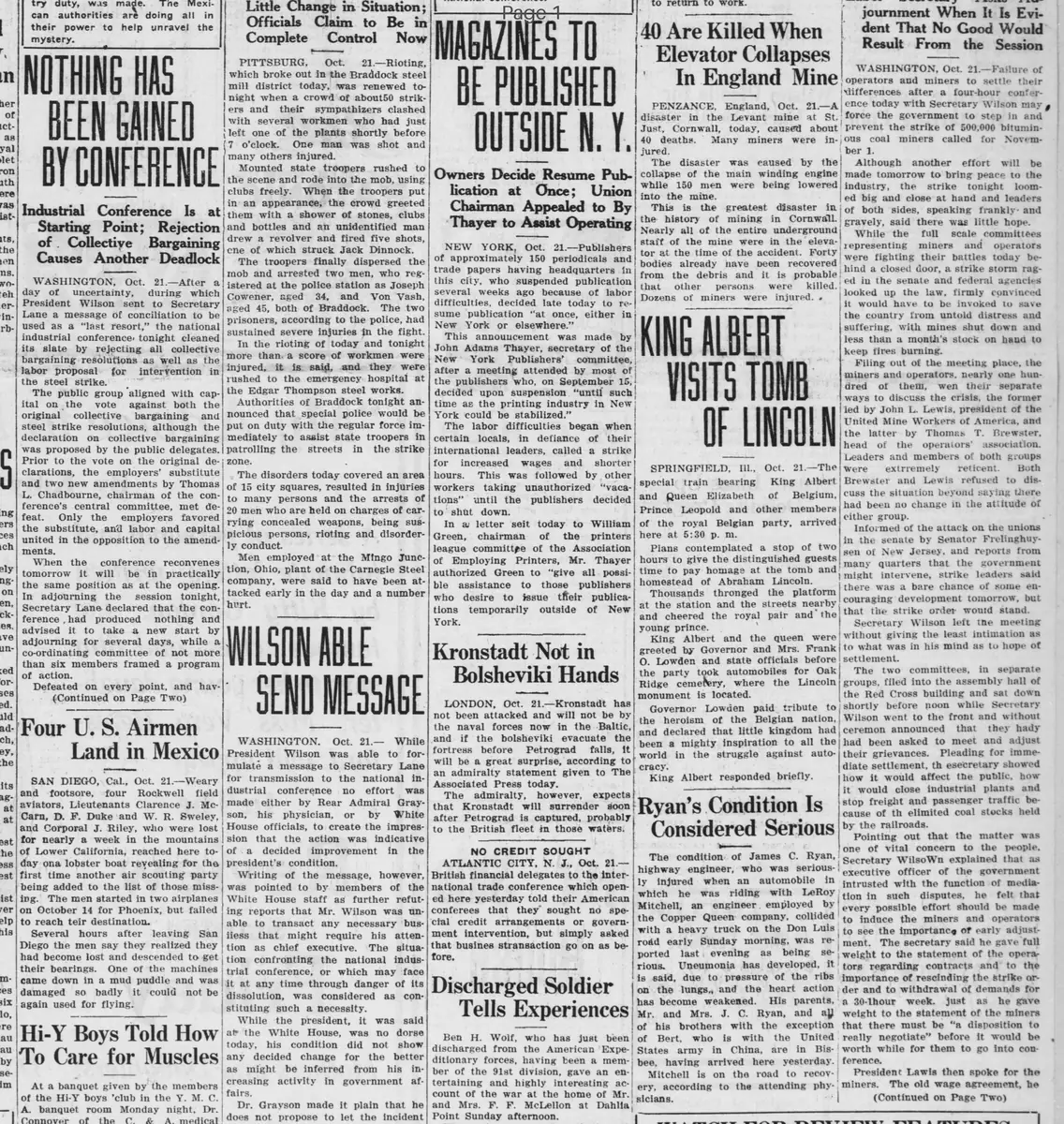
Industrial Conference Is at Starting Point; Rejection of Collective Bargaining Causes Another Deadlock
WASHINGTON, Oct. 21.—After a day of uncertainty, during which President Wilson sent to Secretary Lane a message of conciliation to be used as a "last resort," the national industrial conference, tonight cleared its slate by rejecting all collective bargaining resolutions as well as the labor proposal for intervention in the steel strike.
The public group aligned with capital on the vote against both the original collective bargaining and steel strike resolutions, although the declaration on collective bargaining was proposed by the public delegates.
Prior to the vote on the original declarations, the employers' substitute and two new amendments by Thomas L. Chadbourne, chairman of the conference's central committee, met defeat. Only the employers favored the substitute, and labor and capital united in the opposition to the amendments.
When the conference reconvenes tomorrow it will be in practically the same position as at the opening. In adjourning the session tonight, Secretary Lane declared that the conference had produced nothing and advised it to take a new start by adjourning for several days, while a co-ordinating committee of not more than six members framed a program of action.
Defeated on every point, and having looked up the law, firmly convinced it would have to be invoked to save the country from untold distress and suffering, with mines shut down and less than a month's stock on hand to keep fires burning, filing out of the meeting place, the miners and operators, nearly one hundred of them, went their separate ways to discuss the crisis, the former led by John L. Lewis, president of the United Mine Workers of America, and the latter by Thomas T. Brewster, head of the operators' association.
Leaders and members of both groups were extremely reticent. Both Brewster and Lewis refused to discuss the situation beyond saying there had been no change in the attitude of either group.
Informed of the attack on the unions in the senate by Senator Frelinghuysen of New Jersey, and reports from many quarters that the government might intervene, strike leaders said there was a bare chance of some encouraging development tomorrow, but that the strike order would stand.
Secretary Wilson left the meeting without giving the least intimation as to what was in his mind as to hope of settlement.
The two committees, in separate groups, filed into the assembly hall of the Red Cross building and sat down shortly before noon while Secretary Wilson went to the front and without ceremon announced that they had been asked to meet and adjust their grievances. Pleading for immediate settlement, the secretary showed how it would affect the public, how it would close industrial plants and stop freight and passenger traffic because of the limited coal stocks held by the railroads.
Pointing out that the matter was one of vital concern to the people, Secretary Wilson explained that as executive officer of the government intrusted with the function of mediation in such disputes, he felt that every possible effort should be made to induce the miners and operators to see the importance of early adjustment. The secretary said he gave full weight to the statement of the operators regarding contracts and to the importance of rescinding the strike order and withdrawal of demands for a 30-hour week, just as he gave weight to the statement of the miners that there must be "a disposition to really negotiate" before it would be worth while for them to go into conference.
President Lewis then spoke for the miners. The old wage agreement, he said,
(Continued on Page Two)
Operators and Miners Emerge From Four-Hour Conference, No Agreement; Little Hope for Settlement
WASHINGTON, Oct. 21.—Failure of operators and miners to settle their differences after a four-hour conference today with Secretary Wilson may force the government to step in and prevent the strike of 500,000 bituminous coal miners called for November 1.
Although another effort will be made tomorrow to bring peace to the industry, the strike tonight loomed big and close at hand and leaders of both sides, speaking frankly and gravely, said there was little hope.
While the full-scale committees representing miners and operators were fighting their battles today behind a closed door, a strike storm raged in the senate and federal agencies looked up the law, firmly convinced it would have to be invoked to save the country from untold distress and suffering, with mines shut down and less than a month's stock on hand to keep fires burning.
Filing out of the meeting place, the miners and operators, nearly one hundred of them, went their separate ways to discuss the crisis, the former led by John L. Lewis, president of the United Mine Workers of America, and the latter by Thomas T. Brewster, head of the operators' association.
Leaders and members of both groups were extremely reticent. Both Brewster and Lewis refused to discuss the situation beyond saying there had been no change in the attitude of either group.
Informed of the attack on the unions in the senate by Senator Frelinghuysen of New Jersey, and reports from many quarters that the government might intervene, strike leaders said there was a bare chance of some encouraging development tomorrow, but that the strike order would stand.
Secretary Wilson left the meeting without giving the least intimation as to what was in his mind as to hope of settlement.
The two committees, in separate groups, filed into the assembly hall of the Red Cross building and sat down shortly before noon while Secretary Wilson went to the front and without ceremony announced that they had been asked to meet and adjust their grievances. Pleading for immediate settlement, the secretary showed how it would affect the public, how it would close industrial plants and stop freight and passenger traffic because of the limited coal stocks held by the railroads.
Pointing out that the matter was one of vital concern to the people, Secretary Wilson explained that as executive officer of the government intrusted with the function of mediation in such disputes, he felt that every possible effort should be made to induce the miners and operators to see the importance of early adjustment. The secretary said he gave full weight to the statement of the operators regarding contracts and to the importance of rescinding the strike order and withdrawal of demands for a 30-hour week, just as he gave weight to the statement of the miners that there must be "a disposition to really negotiate" before it would be worth while for them to go into conference.
President Lewis then spoke for the miners. The old wage agreement, he said,
(Continued on Page Two)
Labor Secretary Asks Adjournment When It Is Evident That No Good Would Result From the Session
Wilson Pleads for Early Settlement
Conference Again At Starting Point
(Continued From Page One)
Having lost the support of the public group, which heretofore has been on the side of the workers, the labor delegates left the conference hall tonight disheartened and feeling, as some of them said, that little could be gained by further meetings. However, a meeting of the group has been called for 9 o'clock tomorrow morning and individual members will be bound by action taken at that time.
Should labor show a disposition to bolt the conference, Chairman Lane ultimately will use the president's letter in an effort to avert the crisis. Reading of the letter was said to be entirely discretionary with the chairman, who declared that he would not produce it unless the situation became acute.
Although labor may force the disclosure of its contents, it was generally predicted tonight that the workers would not withdraw. The president's message, it was understood, restates the purpose for which the conference was convened, emphasizes the urgency of the need for allaying industrial unrest, and makes a plea for further work on the part of the conferees.
The morning session of the conference lasted only a few minutes, and the afternoon meeting during which quick action was obtained, was not convened until five o'clock. The entire day was devoted to group meetings in an attempt to devise another declaration on collective bargaining, satisfactory to all elements.
After more than three days of almost continuous sessions, the employers were unable to agree upon another statement, and fell back on the Wheeler substitute.
Members of the public group attempted to effect a compromise by the substitution of the words "associations of their own choosing" for "trade and labor unions" in the clause of the group's resolution guaranteeing workers the right to organize, and the five labor representatives on the general committee of fifteen spent two hours in joint meeting with the public explaining labor's objection to the change. This statement was introduced by Mr. Chadbourne, but the public group alone voted favorably.
When the original Russell-Endicott resolution came up for discussion in the conference, Samuel Gompers, president of the American Federation of Labor, declared that the withdrawal of the support of the public group was due to an interpretation of the words "trade and labor unions" by one member of the group, who is allied with organized labor, and that the phrase excludes all but American Federation of Labor organizations. It was said that the reference was to J. J. Forrester, alternate for P. M. Jewell, acting president of the Railway Employes' department of the federation.
The right to organize for the purpose of collective bargaining, Mr. Gompers continued, is the one question in controversy--the one thing the working people of the United States are going to achieve.
A hush fell over the crowded auditorium as the labor leader, squarely facing the employers' wing and shaking his finger toward that group, exclaimed to the representatives of American capital:
Wilson Pleads for Early Settlement
(Continued From Page One)
Declared, had expired and the operators, he charged, had refused to consider a new one.
The side of the operators was presented by P. H. Penna, of Terre Haute, Ind., who charged that the miners had violated their agreement, that the operators had adhered to the principles and practices of collective bargaining and that the unions were at fault. Then without consulting the leaders, Secretary Wilson suggested an adjournment until tomorrow, as casually as if the conference had planned to run for a week.
There was no objection, neither side desiring to appear in the attitude of blocking peaceful efforts by a voluntary mediator, but miners and operators were surprised. The general feeling seemed to be that the thing would be fought over and settled today. The secretary, it was said, indicated a desire to present the views of the government after each side had been given a full hearing.
What sub-type of article is it?
What keywords are associated?
What entities or persons were involved?
Where did it happen?
Domestic News Details
Primary Location
Washington
Event Date
Oct. 21
Key Persons
Outcome
deadlock in industrial conference with rejection of collective bargaining resolutions and steel strike intervention; no agreement in coal miners-operators mediation, strike of 500,000 miners set for november 1 looms, potential government intervention.
Event Details
The national industrial conference rejected all collective bargaining resolutions and labor's proposal for steel strike intervention, aligning public group with capital, leading to deadlock and suggestion for adjournment to reframe program. Concurrently, Secretary Wilson mediated a four-hour meeting between coal miners led by John L. Lewis and operators led by Thomas T. Brewster in the Red Cross building, pleading for settlement to avoid public distress from coal shortage, but no agreement reached as miners demanded real negotiation and operators cited contract issues; adjournment suggested with little hope for resolution.