Thank you for visiting SNEWPapers!
Sign up free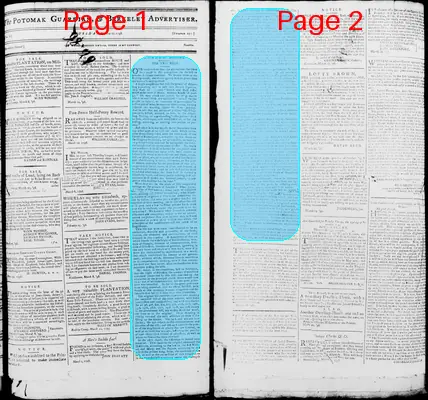
The Patowmac Guardian, And Berkeley Advertiser
Martinsburg, Shepherdstown, Berkeley County, Jefferson County, West Virginia
What is this article about?
Critique of UK Parliament's amended bill on seditious meetings, retaining harsh powers for magistrates including death penalties and home intrusions; omits exemptions; public protests in York, Glasgow, Northumberland petition King to block it. Fears for civil liberties and press freedom. (248 characters)
Merged-components note: Continuation of the article on the Two Bills from London across pages 1 and 2, based on sequential reading order and coherent text topic.
Clippings
1 of 2
OCR Quality
Full Text
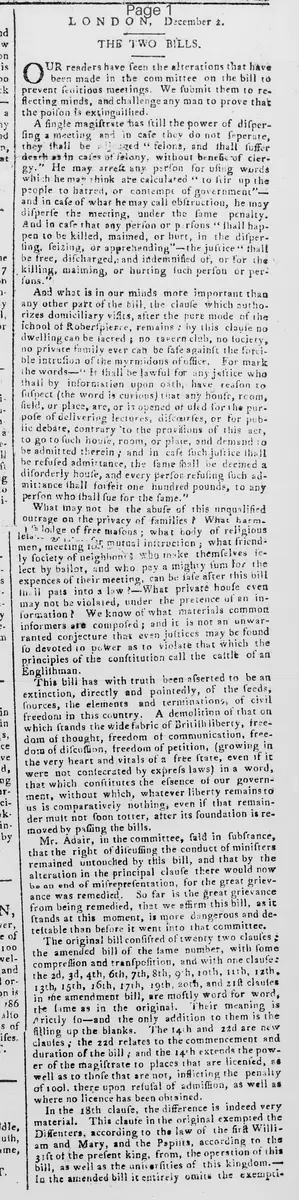
THE TWO BILLS.
Our readers have seen the alterations that have been made in the committee on the bill to prevent seditious meetings. We submit them to reflecting minds, and challenge any man to prove that the poison is extinguished.
A single magistrate has still the power of dispersing a meeting and in case they do not separate, they shall be judged felons, and shall suffer death as in cases of felony, without benefit of clergy. He may arrest any person for using words which he may think are calculated to stir up the people to hatred, or contempt of government and in case of what he may call obstruction, he may disperse the meeting, under the same penalty.
And in case that any person or persons shall happen to be killed, maimed, or hurt, in the dispersing, seizing, or apprehending—the justice shall be free, discharged, and indemnified of, or for the killing, maiming, or hurting such person or persons.
And what is in our minds more important than any other part of the bill, the clause which authorizes domiciliary visits, after the pure mode of the school of Robespierre, remains: by this clause no dwelling can be sacred: no tavern club, no society, no private family ever can be safe against the forcible intrusion of the myrmidons of office. For mark the words—'It shall be lawful for any justice who shall by information upon oath, have reason to suspect (the word is curious) that any house, room, field, or place, are, or is opened or used for the purpose of delivering lectures, discourses, or for public debate, contrary to the provisions of this act, to go to such house, room, or place, and demand to be admitted therein: and in case such justice shall be refused admittance, the same shall be deemed a disorderly house, and every person refusing such admittance shall forfeit one hundred pounds, to any person who shall sue for the same.'
What may not be the abuse of this unqualified outrage on the privacy of families? What harm? A lodge of free masons: what body of religious men, meeting for mutual instruction; what friendly society of neighbours who make themselves jealous by ballot, and who pay a trifling sum for the expenses of their meeting, can be safe after this bill shall pass into a law? What private house even may not be violated, under the pretence of an information? We know of what materials common informers are composed: and it is not an unwarranted conjecture that even justices may be found so devoted to power as to violate that which the principles of the constitution call the castle of an Englishman.
This bill has with truth been asserted to be an extinction, directly and pointedly, of the seeds; sources, the elements and terminations, of civil freedom in this country. A demolition of that on which stands the wide fabric of British liberty, freedom of thought, freedom of communication, freedom of discussion, freedom of petition, (growing in the very heart and vitals of a free state, even if it were not consecrated by express laws) in a word, that which constitutes the essence of our government, without which, whatever liberty remains to us is comparatively nothing; even if that remainder must not soon totter, after its foundation is removed by passing the bills.
Mr. Adair, in the committee, said in substance, that the right of discussing the conduct of ministers remained untouched by this bill, and that by the alteration in the principal clause there would now be an end of misrepresentation, for the great grievance was remedied. So far is the great grievance from being remedied, that we affirm this bill, as it stands at this moment, is more dangerous and detestable than before it went into that committee.
The original bill consisted of twenty two clauses: the amended bill of the same number, with some compression and transposition, and with one clause: the 2d, 3d, 4th, 6th, 7th, 8th, 9th, 10th, 11th, 12th, 13th, 15th, 16th, 17th, 19th, 20th, and 21st clauses in the amendment bill, are mostly word for word the same as in the original. Their meaning is strictly so—and the only addition to them is the filling up the blanks. The 14th and 22d are new clauses: the 22d relates to the commencement and duration of the bill: and the 14th extends the power of the magistrate to places that are licensed, as well as to those that are not, inflicting the penalty of 100l. thereon refusal of admission, as well as where no licence has been obtained.
In the 18th clause, the difference is indeed very material. This clause in the original exempted the Quakers, according to the law of the first William, as well as the universities of this kingdom.— But of the present king, from the operation of this bill, as well as the Dissenters, according to the law of the first William, and the Papists, and the Arm and Mary.
In the amended bill it entirely omits the exemptions.
Nothing in favour of both these Dissenters and Papists, and only protects the diversities.
The first clauses take our after the bill a greater description of meetings than were excepted in the beginning, and to far the amended copy is better than the original: but as they do not extend beyond meetings called by aldermen, head officers of districts, or grand juries, the males of the people are left to the inconvenience of this bill in assembling together, in direct violation of the 6th article of the bill of rights: this breaking where, if it be observed, was made for the joy and power, not ti rich and great. But this inconvenience looks into nothing before the other clauses of this act, for where the greater malady is used, the fever is fancied. An inconvenience in the mode of meeting is a trifle, light as air in comparison to the speedy convenience, which the body ceded delay and by has notified over the hours of the people of England.
A meeting of more than 50 persons can be held otherwise than under this act. At all meetings, whether convened according to the provisions of this act, or in neglect of them, any magistrate has the right to arrest any speaker at his discretion. He has a right to cry fire in meeting, and if persons remain one hour after the proclamation, he has right to order one fifth to be lit, and is indemnified, together with all his assistants, military and civil, from any consequence.
If any person arrested by the justice should in any way resist, the penalty is death.
If any person who is in any way aid the speaker forced, the penalty is death.
If more than 12 persons remain one hour after the injunction order the meeting to disperse, the penalty is death.
If any person or persons should oppose the magistrate, with arms or without, in the words of the act itself, it should be hold in any manner that hinders, hurts the justice or his aides, the penalty is death! death! death!
From such a law may the Almighty God defend our country and posterity!!
Do not the promoters of these bills forget them selves to an arrangement for high treason, for endeavouring to procure laws, than in the application for the royal assent may fairly be construed into acts tending to induce his Majesty to violate his coronation oath, by which he is swore to maintain inviolate certain articles of the Bill of Rights, the gift of the late, that it is the right of the subjects to petition the king, and that all commitments and prosecutions for such petitioning are illegal, one of the conditions by which the house of Brunswick held the crown of these kingdoms?
These bills we are informed, are to be followed by a bill which will at once blot out from our system the freedom of the press, by obliging every man to sign his name to every article he writes.
The country has still one mode left to prevent these bills from passing into laws, but no time is to be lost. New meetings should be called, and humble petitions sent to his majesty, praying him to use his level prerogative in withholding his royal assent, should these bills pass in the two houses of parliament.
The inhabitants of the royal city of York, at a public meeting summoned by the Lord Mayor, came to thirteen spirited resolutions against the bills now passing parliament. To-morrow there is to be a public meeting of the freeholders of that great county, when similar resolutions are expected to be carried.
The large and populous city of Glasgow too have come forward in a spirited manner against the bills.
The county of Northumberland has petitioned against the bills, as well as many other respectable bodies.
What sub-type of article is it?
What keywords are associated?
What entities or persons were involved?
Where did it happen?
Foreign News Details
Primary Location
London
Event Date
December
Key Persons
Outcome
bills under debate in parliament with severe penalties including death for non-compliance; exemptions omitted in amended bill; public meetings and petitions in york, glasgow, northumberland against the bills.
Event Details
The article criticizes amendments to the bill preventing seditious meetings, arguing it retains powers for magistrates to disperse meetings, arrest individuals, conduct domiciliary visits, and impose death penalties. It discusses unchanged clauses, new additions, omission of exemptions for Quakers, Dissenters, Papists. Highlights threats to freedoms of thought, communication, discussion, petition. Mentions Mr. Adair's defense. Reports public opposition in York, Glasgow, Northumberland via resolutions and petitions urging the King to withhold assent. Warns of upcoming bill on press freedom.