Thank you for visiting SNEWPapers!
Sign up free
Story
August 3, 1928
The Weekly Gazette
East Hartford, Hartford County, Connecticut
What is this article about?
Dr. C. H. Eckles of University of Minnesota provides advice on preparing dairy cows for winter, emphasizing feed planning with silage, hay, grains, and proteins, and early housing to protect from cold weather.
Clipping
OCR Quality
98%
Excellent
Full Text
DAIRY FACTS
PREPARING DAIRY FOR COLD WINTER
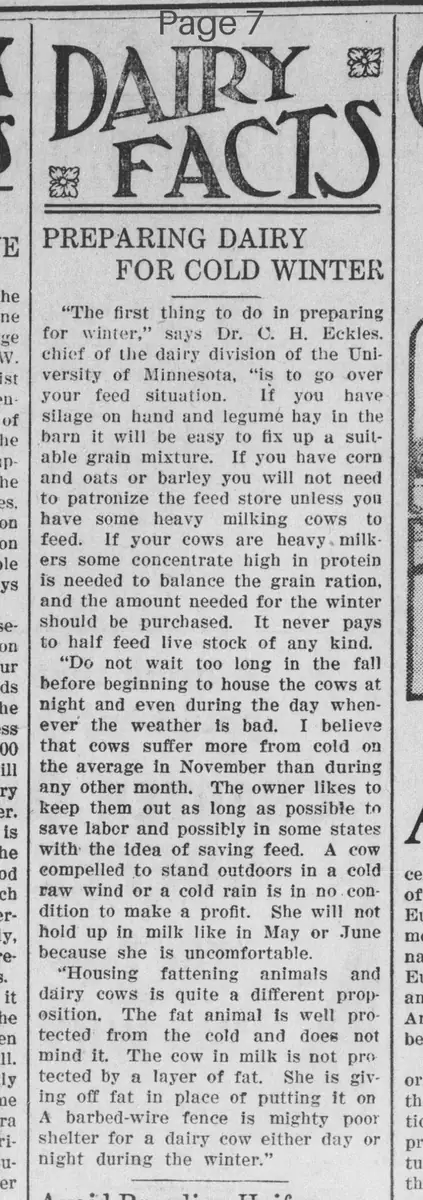
"The first thing to do in preparing for winter," says Dr. C. H. Eckles, chief of the dairy division of the University of Minnesota, "is to go over your feed situation. If you have silage on hand and legume hay in the barn it will be easy to fix up a suitable grain mixture. If you have corn and oats or barley you will not need to patronize the feed store unless you have some heavy milking cows to feed. If your cows are heavy milkers some concentrate high in protein is needed to balance the grain ration, and the amount needed for the winter should be purchased. It never pays to half feed live stock of any kind.
"Do not wait too long in the fall before beginning to house the cows at night and even during the day whenever the weather is bad. I believe that cows suffer more from cold on the average in November than during any other month. The owner likes to keep them out as long as possible to save labor and possibly in some states with the idea of saving feed. A cow compelled to stand outdoors in a cold raw wind or a cold rain is in no condition to make a profit. She will not hold up in milk like in May or June because she is uncomfortable.
"Housing fattening animals and dairy cows is quite a different proposition. The fat animal is well protected from the cold and does not mind it. The cow in milk is not protected by a layer of fat. She is giving off fat in place of putting it on. A barbed-wire fence is mighty poor shelter for a dairy cow either day or night during the winter."
PREPARING DAIRY FOR COLD WINTER
"The first thing to do in preparing for winter," says Dr. C. H. Eckles, chief of the dairy division of the University of Minnesota, "is to go over your feed situation. If you have silage on hand and legume hay in the barn it will be easy to fix up a suitable grain mixture. If you have corn and oats or barley you will not need to patronize the feed store unless you have some heavy milking cows to feed. If your cows are heavy milkers some concentrate high in protein is needed to balance the grain ration, and the amount needed for the winter should be purchased. It never pays to half feed live stock of any kind.
"Do not wait too long in the fall before beginning to house the cows at night and even during the day whenever the weather is bad. I believe that cows suffer more from cold on the average in November than during any other month. The owner likes to keep them out as long as possible to save labor and possibly in some states with the idea of saving feed. A cow compelled to stand outdoors in a cold raw wind or a cold rain is in no condition to make a profit. She will not hold up in milk like in May or June because she is uncomfortable.
"Housing fattening animals and dairy cows is quite a different proposition. The fat animal is well protected from the cold and does not mind it. The cow in milk is not protected by a layer of fat. She is giving off fat in place of putting it on. A barbed-wire fence is mighty poor shelter for a dairy cow either day or night during the winter."
What sub-type of article is it?
Agricultural Advice
Farming Guide
What keywords are associated?
Dairy Facts
Winter Preparation
Cow Housing
Feed Ration
Silage
Legume Hay
Protein Concentrate
What entities or persons were involved?
Dr. C. H. Eckles
Story Details
Key Persons
Dr. C. H. Eckles
Story Details
Dr. C. H. Eckles advises on preparing dairy cows for winter: check feed situation including silage, legume hay, corn, oats, barley, and protein concentrates for heavy milkers; house cows early to protect from cold, especially in November; notes differences between fattening animals and milking cows regarding cold protection.