Thank you for visiting SNEWPapers!
Sign up free
National Gazette
Philadelphia, Philadelphia County, Pennsylvania
What is this article about?
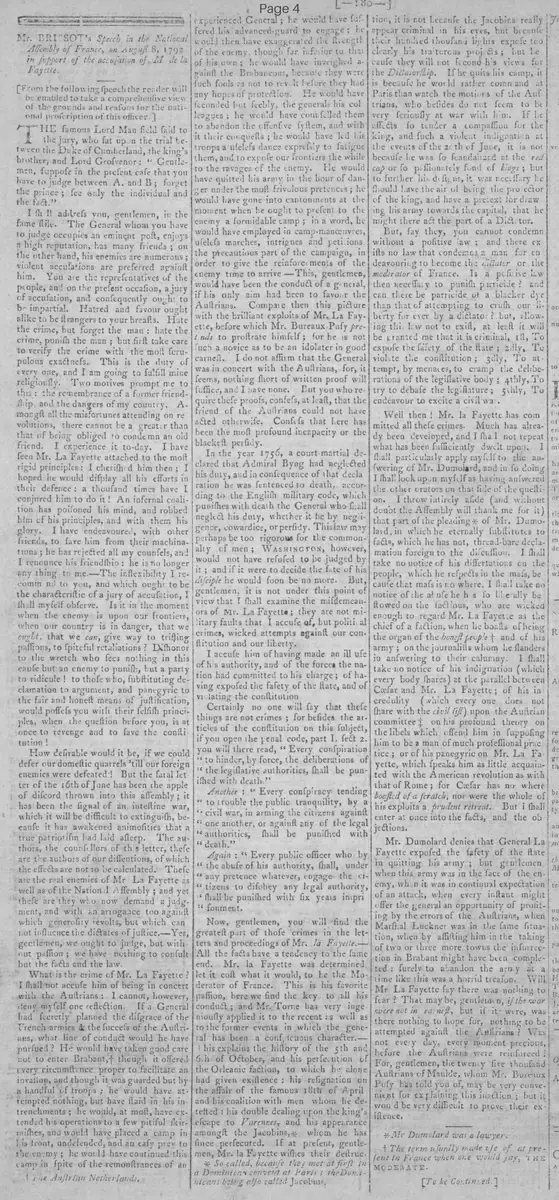
Jacques-Pierre Brissot's speech in the French National Assembly on August 8, 1792, accuses General Lafayette of political crimes, abuse of authority, and actions undermining the constitution and state safety during the revolution and war with Austria.
Clipping
OCR Quality
Full Text
From the following speech the reader will be enabled to take a comprehensive view of the grounds and reasons for the national proscription of this officer.
THE famous Lord Mansfield said to the jury, who sat upon the trial between the Duke of Cumberland, the king's brother, and Lord Grosvenor: "Gentlemen, suppose in the present case that you have to judge between A. and B; forget the prince; see only the individual and the fact."
I shall address you, gentlemen, in the same style. The General whom you have to judge occupies an eminent post, enjoys a high reputation, has many friends; on the other hand, his enemies are numerous; violent accusations are preferred against him. You are the representatives of the people, and on the present occasion, a jury of accusation, and consequently ought to be impartial. Hatred and favour ought alike to be strangers to your breasts. Hate the crime, but forget the man: hate the crime, punish the man; but first take care to verify the crime with the most scrupulous exactness. This is the duty of every one, and I am going to fulfill mine religiously. Two motives prompt me to this: the remembrance of a former friendship, and the dangers of my country. Amongst all the misfortunes attending on revolutions, there cannot be a greater than that of being obliged to condemn an old friend. I experience it to-day. I have seen Mr. La Fayette attached to the most rigid principles: I cherished him then; I hoped he would display all his efforts in their defence: a thousand times have I conjured him to do it! An infernal coalition has poisoned his mind, and robbed him of his principles, and with them his glory. I have endeavoured, with other friends, to save him from their machinations; he has rejected all my counsels, and I renounce his friendship: he is no longer any thing to me. - The inflexibility I recommend to you, and which ought to be the characteristic of a jury of accusation, I shall myself observe. Is it in the moment when the enemy is upon our frontiers, when our country is in danger, that we ought, that we can, give way to trifling passions, to pitiful retaliations? Dishonor to the wretch who sees nothing in this cause but an enemy to punish, but a party to ridicule! to those who, substituting declamation to argument, and panegyric to the fair and honest means of justification, would possess you with their selfish principles, when the question before you, is at once to revenge and to save the constitution!
How desirable would it be, if we could defer our domestic quarrels 'till our foreign enemies were defeated! But the fatal letter of the 16th of June has been the apple of discord thrown into this assembly; it has been the signal of an intestine war, which it will be difficult to extinguish, because it has awakened animosities that a true patriotism had laid asleep. The authors, the counsellors of this letter, these are the authors of our dissensions, of which the effects are not to be calculated. These are the real enemies of Mr. La Fayette as well as of the National Assembly; and yet these are they who now demand a judgment, and with an arrogance too against which generosity revolts, but which can not influence the dictates of justice. - Yes, gentlemen, we ought to judge, but without passion; we have nothing to consult but the facts and the law.
What is the crime of Mr. La Fayette? I shall not accuse him of being in concert with the Austrians: I cannot, however, deny myself one reflection. If a General had secretly planned the disgrace of the French armies & the success of the Austrians, what line of conduct would he have pursued? He would have taken good care not to enter Brabant, though it offered every circumstance proper to facilitate an invasion, and though it was guarded but by a handful of troops; he would have attempted nothing, but have staid in his intrenchments; he would, at most, have extended his operations to a few pitiful skirmishes, and would have placed a camp in his front, undefended, and an easy prey to the enemy; he would have continued this camp in spite of the remonstrances of an experienced General; he would have suffered his advanced-guard to engage; he would then have exaggerated the strength of the enemy, though far inferior to that of his own; he would have inveighed against the Brabancons, because they were such fools as not to revolt before they had any hopes of protection. He would have seconded but feebly, the generals his colleagues: he would have counselled them to abandon the offensive system, and watch their conquests: he would have led his troops a useless dance expressly to fatigue them, and to expose our frontiers the while to the ravages of the enemy. He would have quitted his army in the hour of danger under the most frivolous pretences; he would have gone into cantonments at the moment when he ought to present to the enemy a formidable camp; in a word, he would have employed in camp-manoeuvres, useless marches, intrigues and petitions the precious part of the campaign, in order to give the reinforcements of the enemy time to arrive. - This, gentlemen, would have been the conduct of a general, if his only aim had been to favour the Austrians. Compare then this picture with the brilliant exploits of Mr. La Fayette, before which Mr. Bureaux-Pusy pretends to prostrate himself; for he is not such a novice as to be an idolater in good earnest. I do not affirm that the General was in concert with the Austrians, for, it seems, nothing short of written proof will suffice, and I have none. But you who require these proofs, confess, at least, that the friend of the Austrians could not have acted otherwise. Confess that there has been the most profound incapacity or the blackest perfidy.
In the year 1756, a court-martial declared that Admiral Byng had neglected his duty, and in consequence of that declaration he was sentenced to death, according to the English military code, which punishes with death the General who shall neglect his duty, whether it be by negligence, cowardice, or perfidy. This law may perhaps be too rigorous for the commonalty of men; WASHINGTON, however, would not have refused to be judged by it; and if it were to decide the fate of his disciple he would soon be no more. But, gentlemen, it is not under this point of view that I shall examine the misdemeanors of Mr. La Fayette; they are not military faults that I accuse of, but political crimes, wicked attempts against our constitution and our liberty.
I accuse him of having made an ill use of his authority, and of the force the nation had committed to his charge; of having exposed the safety of the state, and of violating the constitution.
Certainly no one will say that these things are not crimes; for besides the articles of the constitution on this subject, if you open the penal code, part I. sect. 2. you will there read, "Every conspiracy to hinder, by force, the deliberations of the legislative authorities, shall be punished with death."
Another: "Every conspiracy tending to trouble the public tranquility, by a civil war, in arming the citizens against one another, or against any of the legal authorities, shall be punished with death."
Again: "Every public officer who by the abuse of his authority, shall, under any pretence whatever, engage the citizens to disobey any legal authority, shall be punished with six years imprisonment."
Now, gentlemen, you will find the greatest part of these crimes in the letters and proceedings of Mr. La Fayette. - All the facts have a tendency to the same end. Mr. La Fayette was determined let it cost what it would, to be the Moderator of France. This is his favorite passion, here we find the key to all his conduct; and Mr. Torné has very judiciously applied it to the recent as well as to the former events in which the general has been a conspicuous character. - This explains the history of the 5th and 6th of October, and his persecution of the Orleanist faction, to which he alone had given existence: his resignation on the affair of the famous 18th of April and his coalition with men whom he detested: his double dealing upon the king's escape to Varennes, and his appearance amongst the Jacobins,* whom he has since persecuted. If at present, gentlemen, Mr. La Fayette wishes their destruction, it is not because the Jacobins really appear criminal in his eyes, but because their hundred thousand lights expose too clearly his traitorous projects; but because they will not second his views for the Dictatorship. If he quits his camp, it is because he would rather command at Paris than watch the motions of the Austrians, who besides do not seem to be very seriously at war with him. If he affects so tender a compassion for the king, and such a violent indignation at the events of the 20th of June, it is not because he was so scandalized at the red cap or so passionately fond of kings; but to further his designs. it was necessary he should have the air of being the protector of the king, and have a pretext for drawing his army towards the capital, that he might there act the part of a Dictator.
But, say they, you cannot condemn without a positive law; and there exists no law that condemns a man for endeavouring to become the dictator or the moderator of France. Is a positive law then necessary to punish parricide? and can there be parricide of a blacker dye than that of attempting to crush our liberty for ever by a dictator? but, allowing this law not to exist, at least it will be granted me that it is criminal, 1st, To expose the safety of the state; 2dly, To violate the constitution: 3dly, To attempt, by menaces, to cramp the deliberations of the legislative body; 4thly, To try to debase the legislature; 5thly, To endeavour to excite a civil war.
Well then! Mr. La Fayette has committed all these crimes. Much has already been developed, and I shall not repeat what has been sufficiently dwelt upon. I shall particularly apply myself to the answering of Mr. Dumolard, and in so doing I shall look upon myself as having answered the other orators on that side of the question. I throw entirely aside (and without doubt the Assembly will thank me for it) that part of the pleading * of Mr. Dumolard, in which he eternally substitutes to facts, which he has not, thread-bare declamation foreign to the discussion. I shall take no notice of his dissertations on the people, which he respects in the mass, because that mass is no where. I shall take no notice of the abuse he has so sillily bestowed on the factious, who are wicked enough to regard Mr. La Fayette as the chief of a faction, when he boasts of being the organ of the honest people and of his army; on the journalists whom he slanders in answering to their calumny. I shall take no notice of his indignation (which every body shares) at the parallel between Caesar and Mr. La Fayette; of his incredulity (which every one does not share with the civil list) upon the Austrian committee on his profound theory on the libels which offend him in supposing him to be a man of much professional practice; or of his panegyric on Mr. La Fayette, which speaks him as little acquainted with the American revolution as with that of Rome: for Caesar has no where boasted of a scratch, nor were the whole of his exploits a prudent retreat. But I shall enter at once into the facts, and the objections.
Mr. Dumolard denies that General La Fayette exposed the safety of the state in quitting his army; but gentlemen when this army was in the face of the enemy, when it was in continual expectation of an attack, when every instant might offer the general an opportunity of profiting by the errors of the Austrians, when Marshal Luckner was in the same situation, when by assisting him in the taking of two or three more towns the insurrection in Brabant might have been completed: surely to abandon the army at a time like this was a horrid treason. Will Mr. La Fayette say there was nothing to fear? That may be, gentlemen, if the war were not in earnest, but if it were, was there nothing to hope for, nothing to be attempted against the Austrians? Was not every day, every moment precious, before the Austrians were reinforced? For, gentlemen, the twenty five thousand Austrians of Maubuge, whom Mr. Bureaux Pusy has told you of, may be very convenient for explaining this inaction; but it would be very difficult to prove their existence.
* Mr. Dumolard was a lawyer.
† The term usually made use of at present in France when one would say, THE MODERATE.
[To be Continued.]
What sub-type of article is it?
What keywords are associated?
What entities or persons were involved?
Where did it happen?
Foreign News Details
Primary Location
France
Event Date
Aug. 8, 1792
Key Persons
Outcome
accusation of political crimes including abuse of authority, exposing state safety, and violating the constitution; potential proscription of lafayette.
Event Details
Brissot delivers a speech accusing Lafayette of political crimes and military misconduct, including abandoning his army, aiming for dictatorship, and actions favoring Austrian enemies; references past events like October 5-6, April 18, Varennes flight, and June 20; critiques defenses by Dumolard and others.