Thank you for visiting SNEWPapers!
Sign up free
Literary
December 9, 1836
The Hillsborough Recorder
Hillsboro, Orange County, North Carolina
What is this article about?
In this short story, the Hartley family hosts Emily Somerton, whose expected inheritance from India is lost at sea, shifting family attitudes. Mrs. Hartley schemes to marry her daughter to wealthy Bachelor Smith, but Smith reveals he bought the estate for Emily with her actual recovered fortune. Edward Hartley proposes to Emily, leading to their marriage.
Clipping
OCR Quality
98%
Excellent
Full Text
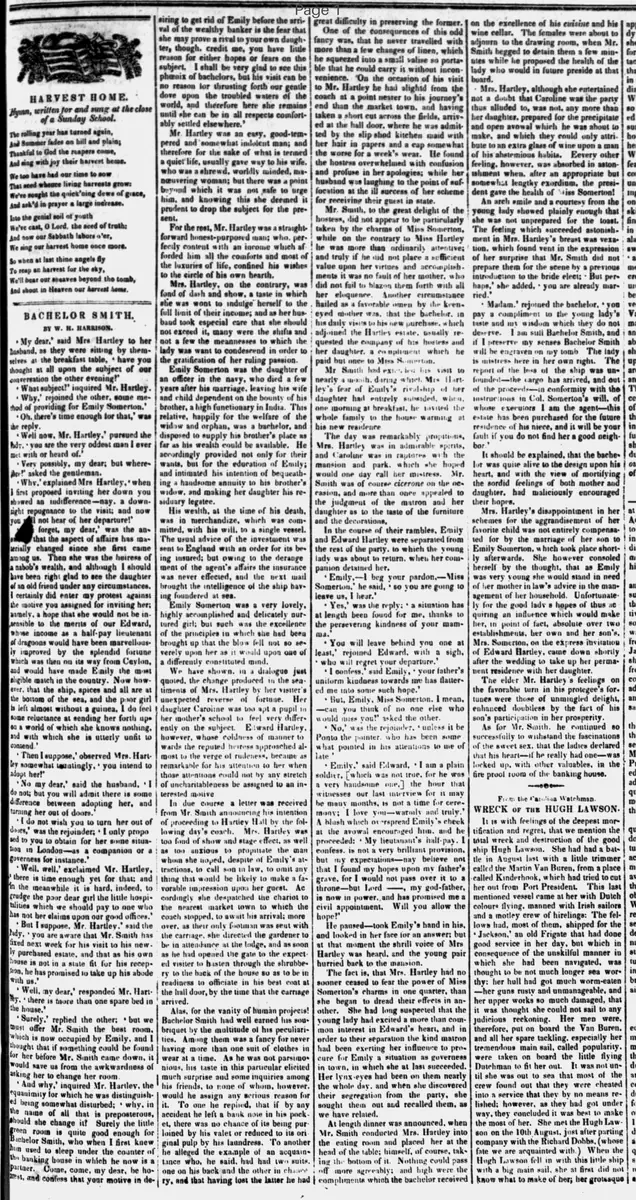
BACHELOR SMITH.
By W. H. HARRISON.
"My dear," said Mrs. Hartley to her husband, as they were sitting by themselves at the breakfast table, "have you thought at all upon the subject of our conversation the other evening?"
"What subject?" inquired Mr. Hartley.
"Why," rejoined the other, "some method of providing for Emily Somerton."
"Oh, there's time enough for that," was the reply.
"Well now, Mr. Hartley," pursued the lady, "you are the very oddest man I ever met with or heard of."
"Very possibly, my dear; but wherefore?" asked the gentleman.
"Why," explained Mrs. Hartley, "when I first proposed inviting her down you showed an indifference—nay, a downright repugnance to the visit; and now that the aspect of affairs has materially changed since she first came among us. Then she was the heiress of a nabob's wealth, and although I should have been right glad to see the daughter of an old friend under any circumstances, I certainly did enter my protest against the motive you assigned for inviting her: namely, a hope that she would not be insensible to the merits of our Edward, whose income as a half-pay lieutenant of dragoons would have been marvellously improved by the splendid fortune which was then on its way from Ceylon, and would have made Emily the most eligible match in the country. Now, however, that the ship, spices and all are at the bottom of the sea, and the poor girl is left almost without a guinea, I do feel some reluctance at sending her forth upon a world of which she knows nothing, and with which she is utterly unfit to contend."
"Then I suppose," observed Mrs. Hartley somewhat tauntingly, "you intend to adopt her!"
"No, my dear," said the husband, "I do not; but you will admit there is some difference between adopting her, and turning her out of doors."
"I do not wish you to turn her out of doors," was the rejoinder; "I only proposed to you to obtain for her some situation in London—as a companion or a governess for instance."
"Well, well," exclaimed Mr. Hartley, "there is time enough yet for that; and in the meanwhile it is hard, indeed, to grudge the poor dear girl the little hospitalities which we should pay to one who has not her claims upon our good offices."
"But I suppose, Mr. Hartley," said the lady, "you are aware that Mr. Smith has fixed next week for his visit to his newly purchased estate, and that as his own house is not in a state fit for his reception, he has promised to take up his abode with us."
"Well, my dear," responded Mr. Hartley, "there is more than one spare bed in the house."
"Surely," replied the other; "but we must offer Mr. Smith the best room, which is now occupied by Emily, and I thought that if something could be found for her before Mr. Smith came down, it would save us from the awkwardness of asking her to change her room."
"And why," inquired Mr. Hartley, the equanimity for which he was distinguished being somewhat disturbed; "why, in the name of all that is preposterous, should she change it? Surely the little green room is quite good enough for Bachelor Smith, who when I first knew him used to sleep under the counter of the banking house in which he now is a partner. Come, come, my dear, be honest, and confess that your motive in desiring to get rid of Emily before the arrival of the wealthy banker is the fear that she may prove a rival to your own daughter, though, credit me, you have little reason for either hopes or fears on the subject. I shall be very glad to see this phoenix of bachelors, but his visit can be no reason for thrusting forth our gentle dove upon the troubled waters of the world, and therefore here she remains until she can be in all respects comfortably settled elsewhere."
Mr. Hartley was an easy, good-tempered and somewhat indolent man; and therefore for the sake of what is termed a 'quiet' life, usually gave way to his wife, who was a shrewd, worldly minded, manœuvering woman; but there was a point beyond which it was not safe to urge him, and knowing this she deemed it prudent to drop the subject for the present.
For the rest, Mr. Hartley was a straightforward honest-purposed man; who, perfectly content with an income which afforded him all the comforts and most of the luxuries of life, confined his wishes to the circle of his own hearth.
Mrs. Hartley, on the contrary, was fond of dash and show, a taste in which she was wont to indulge herself to the full limit of their income; and as her husband took especial care that she should not exceed it, many were the shifts and not a few the meannesses to which the lady was wont to condescend in order to the gratification of her ruling passion.
Emily Somerton was the daughter of an officer in the navy, who died a few years after his marriage, leaving his wife and child dependent on the bounty of his brother, a high functionary in India. This relative, happily for the welfare of the widow and orphan, was a bachelor, and disposed to supply his brother's place as far as his wealth could be available. He accordingly provided not only for their wants, but for the education of Emily; and intimated his intention of bequeathing a handsome annuity to his brother's widow, and making her daughter his residuary legatee.
His wealth, at the time of his death, was in merchandize, which was committed, with his will, to a single vessel. The usual advice of the investment was sent to England with an order for its being insured; but owing to the derangement of the agent's affairs the insurance was never effected, and the next mail brought the intelligence of the ship having foundered at sea.
Emily Somerton was a very lovely, highly accomplished and delicately nurtured girl: but such was the excellence of the principles in which she had been brought up that the blow fell not so severely upon her as it would upon one of a differently constituted mind.
We have shown, in a dialogue just quoted, the change produced in the sentiments of Mrs. Hartley by her visitor's unexpected reverse of fortune. Her daughter Caroline was too apt a pupil in her mother's school to feel very differently on the subject. Edward Hartley, however, whose coldness of manner towards the reputed heiress approached almost to the verge of rudeness, became as remarkable for his attention to her when those attentions could not by any stretch of uncharitableness be assigned to an interested motive.
In due course a letter was received from Mr. Smith announcing his intention of proceeding to Hartley Hall by the following day's coach. Mrs. Hartley was too fond of show and stage effect, as well as too anxious to propitiate the man whom she hoped, despite of Emily's attractions, to call son in law, to omit anything that would be likely to make a favorable impression upon her guest. Accordingly she despatched the chariot to the nearest market town to which the coach stopped, to await his arrival; moreover, as their only footman was sent with the carriage, she directed the gardener to be in attendance at the lodge, and as soon as he had opened the gate to the expected visitor to hasten through the shrubbery to the back of the house so as to be in readiness to officiate in his best coat at the hall door, by the time that the carriage arrived.
Alas, for the vanity of human projects! Bachelor Smith had well earned his soubriquet by the multitude of his peculiarities. Among them was a fancy for never having more than one suit of clothes in wear at a time. As he was not parsimonious, his taste in this particular elicited much surprise and some inquiries among his friends, to none of whom, however, would he assign any serious reason for it. To one he replied, that if by any accident he left a bank note in his pocket, there was no chance of its being purloined by his valet or reduced to its original pulp by his laundress. To another he alleged the example of an acquaintance who, he said, had had two suits, one on his back and the other in chancery, and that having lost the latter he had great difficulty in preserving the former.
One of the consequences of this odd fancy was, that he never travelled with more than a few changes of linen, which he squeezed into a small valise so portable that he could carry it without inconvenience. On the occasion of his visit to Mr. Hartley he had alighted from the coach at a point nearer to his journey's end than the market town, and having taken a short cut across the fields, arrived at the hall door, where he was admitted by the slip-shod kitchen maid with her hair in papers and a cap somewhat the worse for a week's wear. He found the hostess overwhelmed with confusion and profuse in her apologies; while her husband was laughing to the point of suffocation at the ill-success of her scheme for receiving their guest in state.
Mr. Smith, to the great delight of the hostess, did not appear to be particularly taken by the charms of Miss Somerton, while on the contrary to Miss Hartley he was more than ordinarily attentive; and truly if he did not place a sufficient value upon her virtues and accomplishments it was no fault of her mother, who did not fail to blazon them forth with all her eloquence. Another circumstance hailed as a favorable omen by the keen-eyed mother was, that the bachelor, in his daily visits to his new purchase, which adjoined the Hartley estate, usually requested the company of his hostess and her daughter, a compliment which he paid but once to Miss Somerton.
Mr. Smith had extended his visit to nearly a month, during which Mrs. Hartley's fear of Emily's rivalry of her daughter had entirely subsided, when, one morning at breakfast, he invited the whole family to the house-warming at his new residence.
The day was remarkably propitious. Mrs. Hartley was in admirable spirits, and Caroline was in raptures with the mansion and park, which she hoped would one day call her mistress. Mr. Smith was of course cicerone on the occasion, and more than once appealed to the judgment of the matron and her daughter as to the taste of the furniture and the decorations.
In the course of their rambles, Emily and Edward Hartley were separated from the rest of the party, to which the young lady was about to return, when her companion detained her.
"Emily—I beg your pardon—Miss Somerton," he said, "so you are going to leave us, I hear."
"Yes," was the reply; "a situation has at length been found for me, thanks to the persevering kindness of your mama."
"You will leave behind you one at least," rejoined Edward, with a sigh, "who will regret your departure."
"I confess," said Emily, "your father's uniform kindness towards me has flattered me into some such hope."
"But, Emily—Miss Somerton, I mean—can you think of no one else who would miss you?" asked the other.
"No," was the rejoinder, "unless it be Ponto the pointer, who has been somewhat pointed in his attentions to me of late."
"Emily," said Edward, "I am a plain soldier, which was not true, for he was a very handsome one. The hour that witnesses our last interview—for it may be many months—is not a time for ceremony: I love you—warmly and truly."
A blush which overspread Emily's cheek at the avowal encouraged him, and he proceeded: "My lieutenant's half-pay, I confess, is not a very brilliant provision, but my expectations—nay believe not that I found my hopes upon my father's grave, for I would not pass over it to a throne—but Lord—, my god-father, is now in power, and has promised me a civil appointment. Will you allow the hope?"
He paused—took Emily's hand in his, and looked in her face for an answer; but at that moment the shrill voice of Mrs. Hartley was heard, and the young pair hurried back to the mansion.
The fact is, that Mrs. Hartley had no sooner ceased to fear the power of Miss Somerton's charms in one quarter, than she began to dread their effects in another. She had long suspected that the young lady had excited a more than common interest in Edward's heart, and in order to their separation the kind matron had been exerting her influence to procure for Emily a situation as governess in town, in which she at last succeeded.
Her lynx-eyes had been on them nearly the whole day, and when she discovered their segregation from the party, she sought them out and recalled them, as we have related.
At length dinner was announced, when Mr. Smith conducted Mrs. Hartley into the eating room and placed her at the head of the table: himself, of course, taking the bottom of it. Nothing could pass off more agreeably: and high were the compliments which the bachelor received on the excellence of his cuisine and his wine cellar. The females were about to adjourn to the drawing room, when Mr. Smith begged to detain them a few minutes while he proposed the health of the lady who would in future preside at that board.
Mrs. Hartley, although she entertained not a doubt that Caroline was the party thus alluded to, was not, any more than her daughter, prepared for the precipitate and open avowal which he was about to make, and which they could only attribute to an extra glass of wine upon a man of his abstemious habits. Every other feeling, however, was absorbed in astonishment when, after an appropriate but somewhat lengthy exordium, the president gave the health of Miss Somerton!
An arch smile and a courtesy from the young lady showed plainly enough that she was not unprepared for the toast.
The feeling which succeeded astonishment in Mrs. Hartley's breast was vexation, which found vent in the expression of her surprise that Mr. Smith did not prepare them for the scene by a previous introduction to the bride elect; "But perhaps," she added, "you are already married."
"Madam," rejoined the bachelor, "you pay a compliment to the young lady's taste and my wisdom which they do not deserve. I am still Bachelor Smith, and if I preserve my senses Bachelor Smith will be engraven on my tomb. The lady is mistress here in her own right. The report of the loss of the ship was unfounded—the cargo has arrived, and out of the proceeds—in conformity with the instructions in Col. Somerton's will, of whose executors I am the agent—this estate has been purchased for the future residence of his niece, and it will be your fault if you do not find her a good neighbor."
It should be explained, that the bachelor was quite alive to the design upon his heart, and with the view of mortifying the sordid feelings of both mother and daughter, had maliciously encouraged their hopes.
Mrs. Hartley's disappointment in her schemes for the aggrandisement of her favorite child was not entirely compensated for by the marriage of her son to Emily Somerton, which took place shortly afterwards. She however consoled herself by the thought, that as Emily was very young she would stand in need of her mother-in-law's advice in the management of her household. Unfortunately for the good lady's hopes of thus acquiring an influence which would make her, in point of fact, absolute over two establishments, her own and her son's, Mrs. Somerton, on the express invitation of Edward Hartley, came down shortly after the wedding to take up her permanent residence with her daughter.
The elder Mr. Hartley's feelings on the favorable turn in his protegée's fortunes were those of unmingled delight, enhanced doubtless by the fact of his son's participation in her prosperity.
As for Mr. Smith, he continued so successfully to withstand the fascinations of the sweet sex, that the ladies declared that his heart—if he really had one—was locked up, with other valuables, in the fire-proof room of the banking house.
By W. H. HARRISON.
"My dear," said Mrs. Hartley to her husband, as they were sitting by themselves at the breakfast table, "have you thought at all upon the subject of our conversation the other evening?"
"What subject?" inquired Mr. Hartley.
"Why," rejoined the other, "some method of providing for Emily Somerton."
"Oh, there's time enough for that," was the reply.
"Well now, Mr. Hartley," pursued the lady, "you are the very oddest man I ever met with or heard of."
"Very possibly, my dear; but wherefore?" asked the gentleman.
"Why," explained Mrs. Hartley, "when I first proposed inviting her down you showed an indifference—nay, a downright repugnance to the visit; and now that the aspect of affairs has materially changed since she first came among us. Then she was the heiress of a nabob's wealth, and although I should have been right glad to see the daughter of an old friend under any circumstances, I certainly did enter my protest against the motive you assigned for inviting her: namely, a hope that she would not be insensible to the merits of our Edward, whose income as a half-pay lieutenant of dragoons would have been marvellously improved by the splendid fortune which was then on its way from Ceylon, and would have made Emily the most eligible match in the country. Now, however, that the ship, spices and all are at the bottom of the sea, and the poor girl is left almost without a guinea, I do feel some reluctance at sending her forth upon a world of which she knows nothing, and with which she is utterly unfit to contend."
"Then I suppose," observed Mrs. Hartley somewhat tauntingly, "you intend to adopt her!"
"No, my dear," said the husband, "I do not; but you will admit there is some difference between adopting her, and turning her out of doors."
"I do not wish you to turn her out of doors," was the rejoinder; "I only proposed to you to obtain for her some situation in London—as a companion or a governess for instance."
"Well, well," exclaimed Mr. Hartley, "there is time enough yet for that; and in the meanwhile it is hard, indeed, to grudge the poor dear girl the little hospitalities which we should pay to one who has not her claims upon our good offices."
"But I suppose, Mr. Hartley," said the lady, "you are aware that Mr. Smith has fixed next week for his visit to his newly purchased estate, and that as his own house is not in a state fit for his reception, he has promised to take up his abode with us."
"Well, my dear," responded Mr. Hartley, "there is more than one spare bed in the house."
"Surely," replied the other; "but we must offer Mr. Smith the best room, which is now occupied by Emily, and I thought that if something could be found for her before Mr. Smith came down, it would save us from the awkwardness of asking her to change her room."
"And why," inquired Mr. Hartley, the equanimity for which he was distinguished being somewhat disturbed; "why, in the name of all that is preposterous, should she change it? Surely the little green room is quite good enough for Bachelor Smith, who when I first knew him used to sleep under the counter of the banking house in which he now is a partner. Come, come, my dear, be honest, and confess that your motive in desiring to get rid of Emily before the arrival of the wealthy banker is the fear that she may prove a rival to your own daughter, though, credit me, you have little reason for either hopes or fears on the subject. I shall be very glad to see this phoenix of bachelors, but his visit can be no reason for thrusting forth our gentle dove upon the troubled waters of the world, and therefore here she remains until she can be in all respects comfortably settled elsewhere."
Mr. Hartley was an easy, good-tempered and somewhat indolent man; and therefore for the sake of what is termed a 'quiet' life, usually gave way to his wife, who was a shrewd, worldly minded, manœuvering woman; but there was a point beyond which it was not safe to urge him, and knowing this she deemed it prudent to drop the subject for the present.
For the rest, Mr. Hartley was a straightforward honest-purposed man; who, perfectly content with an income which afforded him all the comforts and most of the luxuries of life, confined his wishes to the circle of his own hearth.
Mrs. Hartley, on the contrary, was fond of dash and show, a taste in which she was wont to indulge herself to the full limit of their income; and as her husband took especial care that she should not exceed it, many were the shifts and not a few the meannesses to which the lady was wont to condescend in order to the gratification of her ruling passion.
Emily Somerton was the daughter of an officer in the navy, who died a few years after his marriage, leaving his wife and child dependent on the bounty of his brother, a high functionary in India. This relative, happily for the welfare of the widow and orphan, was a bachelor, and disposed to supply his brother's place as far as his wealth could be available. He accordingly provided not only for their wants, but for the education of Emily; and intimated his intention of bequeathing a handsome annuity to his brother's widow, and making her daughter his residuary legatee.
His wealth, at the time of his death, was in merchandize, which was committed, with his will, to a single vessel. The usual advice of the investment was sent to England with an order for its being insured; but owing to the derangement of the agent's affairs the insurance was never effected, and the next mail brought the intelligence of the ship having foundered at sea.
Emily Somerton was a very lovely, highly accomplished and delicately nurtured girl: but such was the excellence of the principles in which she had been brought up that the blow fell not so severely upon her as it would upon one of a differently constituted mind.
We have shown, in a dialogue just quoted, the change produced in the sentiments of Mrs. Hartley by her visitor's unexpected reverse of fortune. Her daughter Caroline was too apt a pupil in her mother's school to feel very differently on the subject. Edward Hartley, however, whose coldness of manner towards the reputed heiress approached almost to the verge of rudeness, became as remarkable for his attention to her when those attentions could not by any stretch of uncharitableness be assigned to an interested motive.
In due course a letter was received from Mr. Smith announcing his intention of proceeding to Hartley Hall by the following day's coach. Mrs. Hartley was too fond of show and stage effect, as well as too anxious to propitiate the man whom she hoped, despite of Emily's attractions, to call son in law, to omit anything that would be likely to make a favorable impression upon her guest. Accordingly she despatched the chariot to the nearest market town to which the coach stopped, to await his arrival; moreover, as their only footman was sent with the carriage, she directed the gardener to be in attendance at the lodge, and as soon as he had opened the gate to the expected visitor to hasten through the shrubbery to the back of the house so as to be in readiness to officiate in his best coat at the hall door, by the time that the carriage arrived.
Alas, for the vanity of human projects! Bachelor Smith had well earned his soubriquet by the multitude of his peculiarities. Among them was a fancy for never having more than one suit of clothes in wear at a time. As he was not parsimonious, his taste in this particular elicited much surprise and some inquiries among his friends, to none of whom, however, would he assign any serious reason for it. To one he replied, that if by any accident he left a bank note in his pocket, there was no chance of its being purloined by his valet or reduced to its original pulp by his laundress. To another he alleged the example of an acquaintance who, he said, had had two suits, one on his back and the other in chancery, and that having lost the latter he had great difficulty in preserving the former.
One of the consequences of this odd fancy was, that he never travelled with more than a few changes of linen, which he squeezed into a small valise so portable that he could carry it without inconvenience. On the occasion of his visit to Mr. Hartley he had alighted from the coach at a point nearer to his journey's end than the market town, and having taken a short cut across the fields, arrived at the hall door, where he was admitted by the slip-shod kitchen maid with her hair in papers and a cap somewhat the worse for a week's wear. He found the hostess overwhelmed with confusion and profuse in her apologies; while her husband was laughing to the point of suffocation at the ill-success of her scheme for receiving their guest in state.
Mr. Smith, to the great delight of the hostess, did not appear to be particularly taken by the charms of Miss Somerton, while on the contrary to Miss Hartley he was more than ordinarily attentive; and truly if he did not place a sufficient value upon her virtues and accomplishments it was no fault of her mother, who did not fail to blazon them forth with all her eloquence. Another circumstance hailed as a favorable omen by the keen-eyed mother was, that the bachelor, in his daily visits to his new purchase, which adjoined the Hartley estate, usually requested the company of his hostess and her daughter, a compliment which he paid but once to Miss Somerton.
Mr. Smith had extended his visit to nearly a month, during which Mrs. Hartley's fear of Emily's rivalry of her daughter had entirely subsided, when, one morning at breakfast, he invited the whole family to the house-warming at his new residence.
The day was remarkably propitious. Mrs. Hartley was in admirable spirits, and Caroline was in raptures with the mansion and park, which she hoped would one day call her mistress. Mr. Smith was of course cicerone on the occasion, and more than once appealed to the judgment of the matron and her daughter as to the taste of the furniture and the decorations.
In the course of their rambles, Emily and Edward Hartley were separated from the rest of the party, to which the young lady was about to return, when her companion detained her.
"Emily—I beg your pardon—Miss Somerton," he said, "so you are going to leave us, I hear."
"Yes," was the reply; "a situation has at length been found for me, thanks to the persevering kindness of your mama."
"You will leave behind you one at least," rejoined Edward, with a sigh, "who will regret your departure."
"I confess," said Emily, "your father's uniform kindness towards me has flattered me into some such hope."
"But, Emily—Miss Somerton, I mean—can you think of no one else who would miss you?" asked the other.
"No," was the rejoinder, "unless it be Ponto the pointer, who has been somewhat pointed in his attentions to me of late."
"Emily," said Edward, "I am a plain soldier, which was not true, for he was a very handsome one. The hour that witnesses our last interview—for it may be many months—is not a time for ceremony: I love you—warmly and truly."
A blush which overspread Emily's cheek at the avowal encouraged him, and he proceeded: "My lieutenant's half-pay, I confess, is not a very brilliant provision, but my expectations—nay believe not that I found my hopes upon my father's grave, for I would not pass over it to a throne—but Lord—, my god-father, is now in power, and has promised me a civil appointment. Will you allow the hope?"
He paused—took Emily's hand in his, and looked in her face for an answer; but at that moment the shrill voice of Mrs. Hartley was heard, and the young pair hurried back to the mansion.
The fact is, that Mrs. Hartley had no sooner ceased to fear the power of Miss Somerton's charms in one quarter, than she began to dread their effects in another. She had long suspected that the young lady had excited a more than common interest in Edward's heart, and in order to their separation the kind matron had been exerting her influence to procure for Emily a situation as governess in town, in which she at last succeeded.
Her lynx-eyes had been on them nearly the whole day, and when she discovered their segregation from the party, she sought them out and recalled them, as we have related.
At length dinner was announced, when Mr. Smith conducted Mrs. Hartley into the eating room and placed her at the head of the table: himself, of course, taking the bottom of it. Nothing could pass off more agreeably: and high were the compliments which the bachelor received on the excellence of his cuisine and his wine cellar. The females were about to adjourn to the drawing room, when Mr. Smith begged to detain them a few minutes while he proposed the health of the lady who would in future preside at that board.
Mrs. Hartley, although she entertained not a doubt that Caroline was the party thus alluded to, was not, any more than her daughter, prepared for the precipitate and open avowal which he was about to make, and which they could only attribute to an extra glass of wine upon a man of his abstemious habits. Every other feeling, however, was absorbed in astonishment when, after an appropriate but somewhat lengthy exordium, the president gave the health of Miss Somerton!
An arch smile and a courtesy from the young lady showed plainly enough that she was not unprepared for the toast.
The feeling which succeeded astonishment in Mrs. Hartley's breast was vexation, which found vent in the expression of her surprise that Mr. Smith did not prepare them for the scene by a previous introduction to the bride elect; "But perhaps," she added, "you are already married."
"Madam," rejoined the bachelor, "you pay a compliment to the young lady's taste and my wisdom which they do not deserve. I am still Bachelor Smith, and if I preserve my senses Bachelor Smith will be engraven on my tomb. The lady is mistress here in her own right. The report of the loss of the ship was unfounded—the cargo has arrived, and out of the proceeds—in conformity with the instructions in Col. Somerton's will, of whose executors I am the agent—this estate has been purchased for the future residence of his niece, and it will be your fault if you do not find her a good neighbor."
It should be explained, that the bachelor was quite alive to the design upon his heart, and with the view of mortifying the sordid feelings of both mother and daughter, had maliciously encouraged their hopes.
Mrs. Hartley's disappointment in her schemes for the aggrandisement of her favorite child was not entirely compensated for by the marriage of her son to Emily Somerton, which took place shortly afterwards. She however consoled herself by the thought, that as Emily was very young she would stand in need of her mother-in-law's advice in the management of her household. Unfortunately for the good lady's hopes of thus acquiring an influence which would make her, in point of fact, absolute over two establishments, her own and her son's, Mrs. Somerton, on the express invitation of Edward Hartley, came down shortly after the wedding to take up her permanent residence with her daughter.
The elder Mr. Hartley's feelings on the favorable turn in his protegée's fortunes were those of unmingled delight, enhanced doubtless by the fact of his son's participation in her prosperity.
As for Mr. Smith, he continued so successfully to withstand the fascinations of the sweet sex, that the ladies declared that his heart—if he really had one—was locked up, with other valuables, in the fire-proof room of the banking house.
What sub-type of article is it?
Prose Fiction
Satire
What themes does it cover?
Social Manners
Love Romance
Commerce Trade
What keywords are associated?
Short Story
Social Satire
Marriage Prospects
Lost Fortune
Family Intrigue
Bachelor Eccentricities
What entities or persons were involved?
By W. H. Harrison.
Literary Details
Title
Bachelor Smith.
Author
By W. H. Harrison.
Key Lines
"I Am Still Bachelor Smith, And If I Preserve My Senses Bachelor Smith Will Be Engraven On My Tomb. The Lady Is Mistress Here In Her Own Right."
"Emily," Said Edward, "I Am A Plain Soldier... I Love You—Warmly And Truly."