Thank you for visiting SNEWPapers!
Sign up free
The National Republican And Ohio Political Register
Cincinnati, Hamilton County, Ohio
What is this article about?
Report from Ayacucho on December 10, 1824, details the Spanish capitulation after their defeat by the Liberating Army led by Antonio Jose de Sucre. The treaty, signed on December 9, surrenders Peruvian territories, forces, and guarantees safe passage for Spanish troops, marking Peru's independence.
Clipping
OCR Quality
Full Text
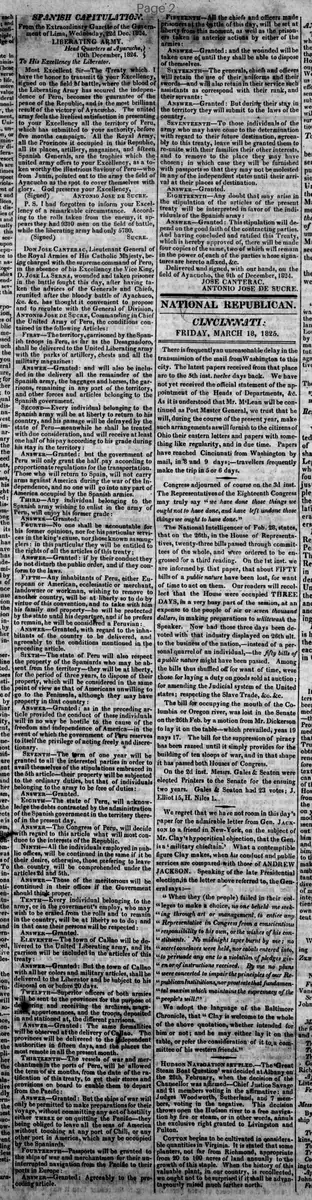
From the Extraordinary Gazette of the Government of Lima, Wednesday, 22d Dec. 1824,
LIBERATING ARMY.
Head Quarters at Ayacucho,
10th December, 1824.
To His Excellency the Liberator.
Most Excellent Sir—The Treaty which I have the honor to transmit to your Excellency, signed on the field of battle, where the blood of the Liberating Army has secured the independence of Peru, becomes the guarantee of the peace of the Republic, and is the most brilliant result of the victory of Ayacucho. The united army feels the liveliest satisfaction in presenting to your Excellency all the territory of Peru, which has submitted to your authority, before six months campaign. All the Royal Army, all the Provinces it occupied in this Republic, all its places, artillery, magazines, and fifteen Spanish Generals, are the trophies which the united army offers to your Excellency, as a token worthy the illustrious Saviour of Peru—who from Junin, pointed out to the army the field of Ayacucho as the spot to cover themselves with glory. God preserve your Excellency,
(Signed)
Antonio Jose De Sucre
P. S. I had forgotten to inform your Excellency of a remarkable circumstance. According to the rolls taken from the enemy, it appears they had 9810 men on the field of battle, while the liberating army had only 5780.
(Signed)
SUCRE.
Don Jose Canterac, Lieutenant General of the Royal Armies of His Catholic Majesty, being charged with the supreme command of Peru, in the absence of his Excellency the Vice King, D. Jose La Serna, wounded and taken prisoner in the battle fought this day, after having taken the advices of the Generals and Chiefs, reunited after the bloody battle of Ayacucho, &c. &c. has thought it convenient to propose and to regulate with the General of Division, Antonio Jose de Sucre, Commanding in Chief the United Army of Peru, the conditions contained in the following Articles:
First—The territory, garrisoned by the Spanish troops in Peru, as far as the Desaguadero, shall be delivered to the United Liberating army with the parks of artillery, chests and all the military magazines:
Answer—Granted: and will also be included in the delivery all the remainder of the Spanish army, the baggages and horses, the garrisons, remaining in any part of the territory, and other forces and articles belonging to the Spanish government.
Second—Every individual belonging to the Spanish army will be at liberty to return to his country, and his passage will be defrayed by the state of Peru—meanwhile he shall be treated with due consideration, and will receive at least one half of his pay according to his grade during his stay in the territory:
Answer—Granted: but the government of Peru will only grant the half pay according to proportionate regulations for the transportation. Those who will return to Spain, will not carry arms against America during the war of the Independence, and no one will go into any part of America occupied by the Spanish armies.
Third—Any individual belonging to the Spanish army wishing to enlist in the army of Peru, will enjoy his former grade:
Answer—Granted.
Fourth—No one shall be accountable for his former opinions, nor for his particular services in the king's cause, nor those known as smugglers: in this particular they will be entitled to the rights of all the articles of this treaty;
Answer—Granted: if by their conduct they do not disturb the public order, and if they conform to the laws.
Fifth—Any inhabitants of Peru, either European or American, ecclesiastic or merchant, landowner or workman, wishing to remove to another country, will be at liberty so to do by virtue of this convention, and to take with him his family and property—he will be protected by the state until his departure, and if he prefers to remain, he will be considered a Peruvian:
Answer—Granted, with regard to the inhabitants of the country to be delivered, and agreeably to the conditions mentioned in the preceding article,
Sixth—The state of Peru will also respect the property of the Spaniards who may be absent from the territory—they will be at liberty, for the period of three years, to dispose of their property, which will be considered in the same point of view as that of Americans unwilling to go to the Peninsula, although they may have property in that country:
Answer—Granted: as in the preceding article provided the conduct of these individuals will in no way be hostile to the cause of the freedom and independence of America—in the event of which the government of Peru reserves to itself the privilege of acting freely and discretionally.
Seventh—The term of one year will be granted to all the interested parties in order to avail themselves of the stipulations embraced in the 5th article—their property will be subjected to the ordinary duties, but that of individuals belonging to the army to be free of duties:
Answer—Granted.
Eighth—The state of Peru, will acknowledge the debts contracted by the administration of the Spanish government in the territory thereof in the present day.
Answer—The Congress of Peru, will decide with regard to this article what will most conduce to the interests of the Republic.
Ninth—All the individuals employed in public offices, will be continued in the same if it be their desire, otherwise, those preferring to leave the country, will be comprehended under the articles 2d and 5th.
Answer—Those of the meritorious will be continued in their offices if the Government should think proper.
Tenth—Every individual belonging to the army, or in the government's employ, who may wish to be erased from the rolls and to remain in the country, will be at liberty so to do; and in that case their persons will be respected:
Answer—Granted.
Eleventh—The town of Callao will be delivered to the United Liberating army, and its garrison will be included in the articles of this treaty:
Answer—Granted: But the town of Callao with all her colors and military articles, shall be delivered to the Liberator and be subject to his disposal on or before 20 days.
Twelfth—Superior officers of both armies will be sent to the provinces for the purpose of delivering and receiving the archives, magazines, appurtenances, and the troops, deposited in and stationed at, the different garrisons.
Answer—Granted: The same formalities will be observed at the delivery of Callao. The provinces will be delivered to the dependent authorities in fifteen days, and the places the most remote in all the present month.
Thirteenth—The vessels of war and merchantmen in the ports of Peru, will be allowed the term of six months, from the date of the ratification of this treaty, to get their stores and provisions on board to enable them to depart from the Pacific:
Answer—Granted: But the ships of war will only be permitted to make preparations for their voyage, without committing any act of hostility either there or on quitting the Pacific—they being obliged to leave all the seas of America without touching at any port of Chili, or any other port in America, which may be occupied by the Spaniards.
Fourteenth—Passports will be granted to the ships of war and merchantmen for their uninterrupted navigation from the Pacific to their ports in Europe:
Answer—Granted: Agreeably to the preceding article.
Fifteenth—All the chiefs and officers made prisoners at the battle of this day, will be set at liberty from this moment, as well as the prisoners taken in anterior actions by either of the armies:
Answer—Granted: and the wounded will be taken care of until they shall be able to dispose of themselves.
Sixteenth—The generals, chiefs and officers will retain the use of their uniforms and their swords—and will also retain in their service such assistants as correspond with their rank, and their servants:
Answer—Granted: But during their stay in the territory they will submit to the laws of the country.
Seventeenth—To those individuals of the army who may have come to the determination with regard to their future destination, agreeably to this treaty, leave will be granted them to re-unite with their families their other interests, and to remove to the place they may have chosen: in which case they will be furnished with passports so that they may not be molested in any of the independent states until their arrival at their places of destination.
Answer—Granted.
Eighteenth—Any doubt that may arise in the stipulation of the articles of the present treaty will be interpreted in favor of the individuals of the Spanish army:
Answer—Granted: This stipulation will depend on the good faith of the contracting parties.
And having concluded and ratified this Treaty, which is hereby approved of, there will be made four copies of the same, two of which will remain in the power of each of the parties whose signatures are hereto affixed, &c.
Delivered and signed, with our hands, on the field of Ayacucho, the 9th of December, 1824.
JOSE CANTERAC.
ANTONIO JOSE DE SUCRE.
What sub-type of article is it?
What keywords are associated?
What entities or persons were involved?
Where did it happen?
Foreign News Details
Primary Location
Ayacucho, Peru
Event Date
9th 10th December 1824
Key Persons
Outcome
spanish forces (9810 men) defeated by liberating army (5780 men); full capitulation of spanish army, territories, artillery, and 15 generals in peru; guarantees safe return for spanish troops and recognition of peruvian independence.
Event Details
Following the victory at Ayacucho on December 9, 1824, Spanish Lt. Gen. Jose Canterac signed a capitulation treaty with Gen. Antonio Jose de Sucre, surrendering all Spanish-held territories in Peru up to Desaguadero, including garrisons, artillery, and forces. The 18-article treaty outlines terms for Spanish troops' repatriation with half pay, property rights, prisoner releases, and delivery of ports like Callao within specified timelines.