Thank you for visiting SNEWPapers!
Sign up free
Foreign News
February 14, 1916
The Log Cabin Democrat
Conway, Faulkner County, Arkansas
What is this article about?
Descriptive account of Burma's Buddhist culture, the Burmese people's pride and indolence, impacts of Chinese and Indian immigration on society and religion, and vibrant traditional attire and customs in Rangoon.
Merged-components note: Merged parts of the 'The Charms of Burma' article.
Clipping
OCR Quality
70%
Good
Full Text
Its Buddhist faith that gives Burma its characteristics and its charm. Out of the twelve million inhabitants of Burma, ten million are Burmese. The Burmese is one of the proudest, most indolent and self-satisfied races on earth. The rude jostle of these other peoples who are elbowing their way into his country, competing with him in business, acquiring his land, even questioning the supremacy of his religion, is giving a harsh jolt to many ideas that have held placid sway in the Burmese mind. The awakening is painful, but part of the stern kindness of Providence to a people grown inert through isolation.
No Longer Isolated.
There is surely nothing isolated about Burma today. The Chinese are pouring in from the North. It is estimated that if the immigration continues there will be a million Chinese who will be living in Burma within the next fifteen years. These Chinese traders, merchants and farmers intermarry with the Burmese, and form a strong and stable element in the population. The Bengali, Tamil and Telugu immigrants are more alien, less readily absorbed and introduce complicated problems, social and religious. In Rangoon there are already almost as many Indian Hindus as Burmese Buddhists. These poor Indian coolies bring with them their idolatry, their caste marks, their Hindu festivals; and Buddhism finds itself once more face to face at close quarters with the Hinduism from which it sprang. Which faith will more strongly influence the other only the future can disclose.
At present the outstanding feature of Burma is Buddhism. A hundred thousand mendicant monks, clad in the sacred yellow robe, go up and down the country. The begging bowl is presented regularly at the householder's door, and it is not considered a lucky thing to refuse the priest of the best that the house affords. I shall never forget the first time I saw a woman worship a priest. It was in the crowded railway station at Rangoon. Except for the gay silk costumes, one might have thought her in a railway station in Europe or America. Then, like a stone dropped in a pool, splashed this bit of the ancient East.
Favored women among Orientals.
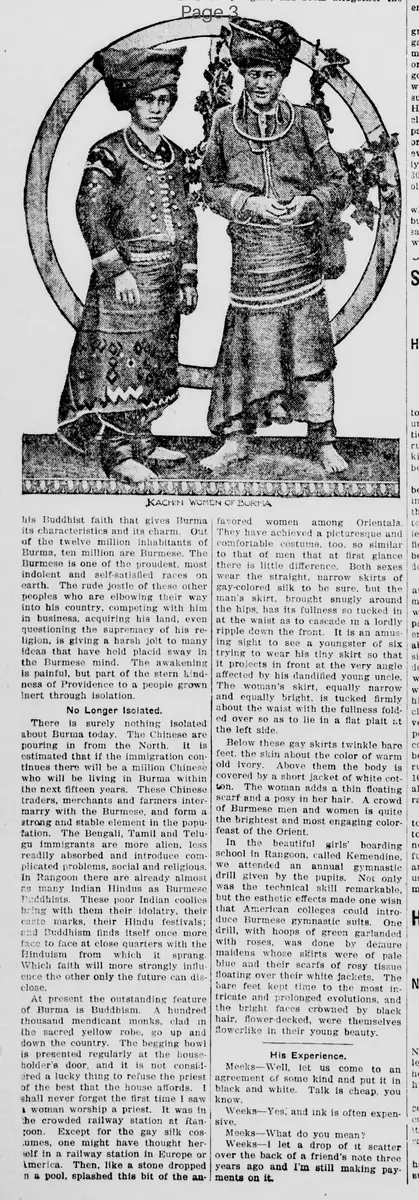
They have achieved a picturesque and comfortable costume, too, so similar to that of men that at first glance there is little difference. Both sexes wear the straight, narrow skirts of gay-colored silk to be sure, but the man's skirt, brought snugly around the hips, has its fullness so tucked in at the waist as to cascade in a lordly ripple down the front. It is an amusing sight to see a youngster of six trying to wear his tiny skirt so that it projects in front at the very angle affected by his dandified young uncle. The woman's skirt, equally narrow and equally bright, is tucked firmly about the waist with the fullness folded over so as to lie in a flat plait at the left side.
Below these gay skirts twinkle bare feet, the skin about the color of warm old ivory. Above them the body is covered by a short jacket of white cotton. The woman adds a thin floating scarf and a posy in her hair. A crowd of Burmese men and women is quite the brightest and most engaging color-feast of the Orient.
In the beautiful girls' boarding school in Rangoon, called Kemendine, we attended an annual gymnastic drill given by the pupils. Not only was the technical skill remarkable, but the esthetic effects made one wish that American colleges could introduce Burmese gymnastic suits. One drill, with hoops of green garlanded with roses, was done by demure maidens whose skirts were of pale blue and their scarfs of rosy tissue floating over their white jackets. The bare feet kept time to the most intricate and prolonged evolutions, and the bright faces crowned by black hair, flower-decked, were themselves flowerlike in their young beauty.
No Longer Isolated.
There is surely nothing isolated about Burma today. The Chinese are pouring in from the North. It is estimated that if the immigration continues there will be a million Chinese who will be living in Burma within the next fifteen years. These Chinese traders, merchants and farmers intermarry with the Burmese, and form a strong and stable element in the population. The Bengali, Tamil and Telugu immigrants are more alien, less readily absorbed and introduce complicated problems, social and religious. In Rangoon there are already almost as many Indian Hindus as Burmese Buddhists. These poor Indian coolies bring with them their idolatry, their caste marks, their Hindu festivals; and Buddhism finds itself once more face to face at close quarters with the Hinduism from which it sprang. Which faith will more strongly influence the other only the future can disclose.
At present the outstanding feature of Burma is Buddhism. A hundred thousand mendicant monks, clad in the sacred yellow robe, go up and down the country. The begging bowl is presented regularly at the householder's door, and it is not considered a lucky thing to refuse the priest of the best that the house affords. I shall never forget the first time I saw a woman worship a priest. It was in the crowded railway station at Rangoon. Except for the gay silk costumes, one might have thought her in a railway station in Europe or America. Then, like a stone dropped in a pool, splashed this bit of the ancient East.
Favored women among Orientals.
They have achieved a picturesque and comfortable costume, too, so similar to that of men that at first glance there is little difference. Both sexes wear the straight, narrow skirts of gay-colored silk to be sure, but the man's skirt, brought snugly around the hips, has its fullness so tucked in at the waist as to cascade in a lordly ripple down the front. It is an amusing sight to see a youngster of six trying to wear his tiny skirt so that it projects in front at the very angle affected by his dandified young uncle. The woman's skirt, equally narrow and equally bright, is tucked firmly about the waist with the fullness folded over so as to lie in a flat plait at the left side.
Below these gay skirts twinkle bare feet, the skin about the color of warm old ivory. Above them the body is covered by a short jacket of white cotton. The woman adds a thin floating scarf and a posy in her hair. A crowd of Burmese men and women is quite the brightest and most engaging color-feast of the Orient.
In the beautiful girls' boarding school in Rangoon, called Kemendine, we attended an annual gymnastic drill given by the pupils. Not only was the technical skill remarkable, but the esthetic effects made one wish that American colleges could introduce Burmese gymnastic suits. One drill, with hoops of green garlanded with roses, was done by demure maidens whose skirts were of pale blue and their scarfs of rosy tissue floating over their white jackets. The bare feet kept time to the most intricate and prolonged evolutions, and the bright faces crowned by black hair, flower-decked, were themselves flowerlike in their young beauty.
What sub-type of article is it?
Colonial Affairs
Religious Affairs
Economic
What keywords are associated?
Burma
Buddhism
Immigration
Chinese
Indian
Rangoon
Culture
Attire
Where did it happen?
Burma
Foreign News Details
Primary Location
Burma
Event Details
Description of Burma's Buddhist culture, proud and indolent Burmese people facing jolts from immigration of Chinese traders and Indian laborers, leading to social, business, and religious tensions; observations of monks, worship, traditional attire, and a gymnastic display in Rangoon.