Thank you for visiting SNEWPapers!
Sign up free
The Enquirer
Richmond, Henrico County, Virginia
What is this article about?
In a US Senate debate on November 30, Mr. Pickering concludes his speech against the Embargo Act, arguing that the President's message misrepresented threats from France's Berlin Decree as imminent dangers, while British Orders in Council were unknown at the time. He unveils French coercion as the true motive and urges repeal to restore national honor and commerce.
Clipping
OCR Quality
Full Text
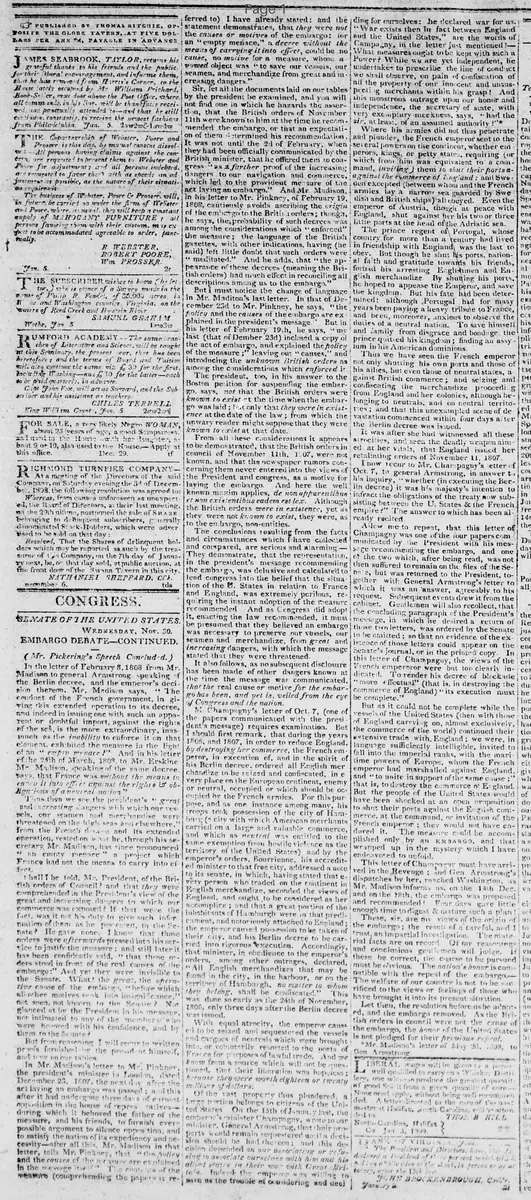
SENATE OF THE UNITED STATES.
WEDNESDAY, NOV. 30.
EMBARGO DEBATE--CONTINUED.
(Mr. Pickering's Speech Concluded.)
In the letter of February 8, 1808 from Mr. Madison to General Armstrong speaking of the Berlin decree, and the emperor's decision thereon. Mr. Madison says, "The conduct of the French government, in giving this extended operation to its decree, and indeed in issuing one with such an apparent or doubtful import, against the rights of the sea, is the more extraordinary, inasmuch as the inability to enforce it on that element, exhibited the measure in the light of an "empty menace!" And in his letter of the 25th of March, 1808, to Mr. Erskine Mr. Madison, speaking of the same decree, says, that France was without the means to carry it into effect against the rights or obligations of a neutral nation"
Thus this opinion we see the president's "great and increasing dangers with which our vessels, our seamen and merchandise were threatened on the high seas and elsewhere," from the French decree and its extended operation, rested on what he, through his secretary Mr. Madison, has since pronounced "an empty menace" a project which France had not the means to carry into effect.
Shall I be told, Mr. President, of the British orders of Council? and that they were comprehended in the President's view of the great and increasing dangers to which our commerce was exposed? If that were the fact, was it not his duty to give such information of them as he possessed, to the Senate? He gave none. I know that those orders were afterwards pressed into his service to justify the measure: and still later it has been confidently said, "that those orders stood in front of the real causes of the embargo:" And yet they were invisible to the Senate. What! the great, the operative cause of the embargo, "before which all other motives sink into insignificance," not seen, not known to the Senate? Nor glanced at by the President in his message, nor intimated to any of the members who were honored with his confidence, and by them to the Senate?
But from reasoning I will recur to written proofs furnished by the president himself, and now on our tables.
In Mr. Madison's letter to Mr. Pinkney, the president's minister in London, dated December 23, 1807, the next day after the act laying an embargo was passed: and this after it had undergone three days of earnest opposition in the house of representatives--during which it behooved the father of the measure, and his friends, to furnish every possible argument to silence opposition, and to satisfy the nation of its expediency and necessity--after all this. Mr. Madison in that letter, tells Mr. Pinkney, that "the policy and the causes of the measure are explained in the message itself The contents of the measure (comprehending the papers it referred to) I have already stated: and the statement demonstrates, that they were not the causes or motives of the embargo: for an "empty menace," a decree without the means of carrying it into effect, could be no cause, no motive for a measure, whose avowed object was "to save our vessels, our seamen, and merchandise from great and increasing dangers."
Sir, let all the documents laid on our tables by the president be examined, and you will not find one in which he hazards the assertion, that the British orders of November 11th were known to him at the time he recommended the embargo, or that an expectation of them determined his recommendation. It was not until the 2d of February, when they had been officially communicated by the British minister, that he offered them to congress "as a farther proof of the increasing dangers to our navigation and commerce, which led to the provident measure of the act laying an embargo." And Mr. Madison, in his letter to Mr. Pinkney, of February 19, 1808, cautiously avoids ascribing the origin of the embargo to the British orders; though he says, the probability of such decrees was among the considerations which "enforced" the measure: the language of the British gazettes, with other indications, having (he said) left little doubt that such orders were "meditated." And he adds, that "the appearance of these decrees (meaning the British orders) had much effect in reconciling all descriptions among us to the embargo."
But I must notice the change of language in Mr. Madison's last letter. In that of December 23d to Mr. Pinkney, he says, "the policy and the causes of the embargo are explained in the president's message." But in his letter of February 19th, he says, "my last (that of December 23d) enclosed a copy of the act of embargo, and explained the policy of the measure;" leaving out "causes," and introducing the unknown British orders as among the considerations which enforced it
The president, too, in his answer to the Boston petition for suspending the embargo, says, not that the British orders were known to exist at the time when the embargo was laid; but only that they were in existence at the date of the law; from which the unwary reader might suppose that they were known to exist at that date.
From all these considerations it appears to be demonstrated, that the British orders in council of November 11th, 1807, were not known, and that the newspaper rumors concerning them never entered into the views of the President and congress, as a motive for laying the embargo.
And here the well known maxim applies, de non apparentibus et non existentibus eadem est lex. Although the British orders were in existence, yet as they were not known to exist, they were, as to the embargo, non-entities.
The conclusions resulting from the facts and circumstances which I have collected and compared, are serious and alarming. They demonstrate, that the representation, in the president's message recommending the embargo, was delusive and calculated to lead congress into the belief that the situation of the U. States in relation to France and England, was extremely perilous, requiring the instant adoption of the measure recommended And as Congress did adopt it, enacting the law recommended, it must be presumed that they believed an embargo was necessary to preserve our vessels, our seamen and merchandise, from great and increasing dangers, with which the message stated that they were threatened.
It also follows, as no subsequent disclosure has been made of other dangers known at the time the message was communicated, that the real cause or motive for the embargo has been, and yet is, veiled from the eye of Congress and the nation.
Mr. Champagny's letter of Oct. 7, (one of the papers communicated with the president's message) requires examination. But I should first remark, that during the years 1806 and 1807, in order to reduce England, by destroying her commerce, the French emperor, in execution of, and in the spirit of his Berlin decree, ordered all English merchandise to be seized and confiscated, in every place on the European continent, enemy or neutral, occupied or which should be occupied by the French armies. For this purpose, and as one instance among many, his troops took possession of the city of Hamburg (a city with which American merchants carried on a large and valuable commerce, and which as neutral was entitled to the same exemption from hostile violence as the territory of the United States) and by the emperor's orders, Bourrienne, his accredited minister to that free city, addressed a note to its senate, in which, having stated that every person who traded on the continent in English merchandise, seconded the views of England, and ought to be considered as her accomplice; and that a great portion of the inhabitants of Hamburgh were in that predicament, and notoriously attached to England; the emperor caused possession to be taken of their city, and his Berlin decree to be carried into rigorous execution. Accordingly, that minister, in obedience to the emperor's orders, among other outrages, declared, "All English merchandise that may be found in the city, in the harbour, or on the territory of Hamburgh, no matter to whom they belong, shall be confiscated." This was done so early as the 24th of November, 1806, only three days after the Berlin decree was issued.
With equal atrocity, the emperor caused to be seized and sequestered the vessels and cargoes of neutrals which were brought into, or voluntarily resorted to the ports of France for purposes of lawful trade. And we know from a source which will not be questioned, that their liberation was hopeless; because they were worth eighteen or twenty millions of dollars.
Of the vast property thus plundered, a large portion belongs to citizens of the United States On the 15th of January last, the emperor's minister, Champagny, wrote to our minister, General Armstrong, that their property would remain sequestered until decision should be had thereon: and this decision depended on our associating or refusing to associate ourselves with him and his allied states in their war with Great Britain. Indeed the emperor was willing to save us the trouble of considering and deciding for ourselves: he declared war for us.
"War exists then in act between England and the United States," are the words of Champagny, in the letter just mentioned!
What measures ought to be taken with such a Power? While we are yet independent, he undertakes to prescribe the line of conduct we shall observe, on pain of confiscation of all the property of our innocent and suspecting merchants within his grasp! And this monstrous outrage upon our honor and independence, the secretary of state, with very exemplary meekness, says, "had the air, at least, of an assumed authority!"*
Where his armies did not thus penetrate and plunder, the French emperor sent to the several powers on the continent, whether emperors, kings, or petty states, requiring (or which from him was equivalent to a command, inviting) them to shut their ports against the commerce of England: and Sweden excepted (between whom and the French armies lay a narrow sea guarded by Swedish and British ships) all obeyed. Even the emperor of Austria, though at peace with England, shut against her his two or three little ports at the head of the Adriatic sea.
The prince regent of Portugal, whose country for more than a century had lived in friendship with England was the last to obey. But though he shut his ports, national faith and gratitude towards his friends, forbade his arresting Englishmen and English merchandise By shutting his ports, he hoped to appease the Emperor, and save the kingdom. But his fate had been determined: although Portugal had for many years been paying a heavy tribute to France, and been, moreover, anxious to observe the duties of a neutral nation. To save himself and family from disgrace and bondage, the prince quitted his kingdom; finding an asylum in his American dominions.
Thus we have seen the French emperor not only shutting his own ports and those of his allies, but even those of neutral states, against British commerce; and seizing and confiscating the merchandise proceeding from England and her colonies, although belonging to neutrals, and on neutral territories; and that this unexampled scene of devastation commenced within four days after the Berlin decree was issued.
It was after she had witnessed all these atrocities, and seen the deadly weapon aimed at her vitals, that England issued her retaliating orders of November 11, 1807.
I now recur to Mr. Champagny's letter of Oct. 7, to General Armstrong, in answer to his inquiry, "whether (in executing the Berlin decree) it was his majesty's intention to infract the obligations of the treaty now subsisting between the U. States & the French empire?" The answer to which has been already recited
Allow me to repeat, that this letter of Champagny was one of the four papers communicated by the President with his message recommending the embargo, and one of the two which, after being read, was not then suffered to remain on the files of the Senate, but was returned to the President, together with General Armstrong's letter to which it was an answer, agreeably to his request. Subsequent events drew it from the cabinet. Gentlemen will also recollect, that the concluding paragraph of the President's message, in which he desired a return of those two letters, was ordered by the Senate to be omitted; so that no evidence of the existence of those letters could appear on the Senate's journal, or in the printed copy. In this letter of Champagny, the views of the French emperor were but too clearly indicated. To render his decree of blockade "more effectual" (that is, in destroying the commerce of England) "its execution must be complete."
But as it could not be complete while the vessels of the United States [then with those of England carrying on, almost exclusively, the commerce of the world) continued their extensive trade with, England; we were, in language sufficiently intelligible, invited to fall into the imperial ranks, with the maritime powers of Europe, whom the French emperor had marshalled against England, and "to unite in support of the same cause:" that is, to destroy the commerce of England.
But the people of the United States would have been shocked at an open proposition to shut their ports against the English commerce, at the command, or invitation of the French emperor: they would not have endured it. The measure could be accomplished only by an EMBARGO, and that wrapped up in the mystery which I have endeavored to unfold.
This letter of Champagny must have arrived in the Revenge: and Gen. Armstrong's dispatches by her, reached Washington, as Mr. Madison informs us, on the 14th Dec. and on the 18th, the embargo was proposed and recommended! Four days gave little enough time to digest & mature such a plan!
These, sir, are my views of the origin of the embargo: the result of a careful, and I trust, an impartial investigation. The material facts are on record "Of my reasonings and conclusions gentlemen will judge. If these be correct, the course to be pursued must be obvious. The nation's honor is compatible with the repeal of the embargo. The welfare of our country is not to be sacrificed to the views or feelings of those who have brought it into its present situation.
Let then, the resolution before us be adopted, and the embargo removed. As the British orders in council were not the cause of the embargo, the honor of the United States is not pledged for their previous repeal.
*Mr. Madison's letter of May 2d, 1808, to Gen. Armstrong
What sub-type of article is it?
What themes does it cover?
What keywords are associated?
What entities or persons were involved?
Where did it happen?
Story Details
Key Persons
Location
Senate Of The United States
Event Date
Wednesday, Nov. 30
Story Details
Mr. Pickering argues that the 1807 Embargo Act was recommended based on misrepresented French threats from the Berlin Decree, described as an 'empty menace,' rather than known British Orders in Council. He details French seizures of neutral property, coercion via Champagny's letter inviting US alignment against Britain, and calls for embargo repeal without conditioning on British repeal.