Thank you for visiting SNEWPapers!
Sign up free
Gazette Of The United States
New York, New York County, New York
What is this article about?
A letter to the editor defines 'Aristocrat' as someone seeking to concentrate power away from the people in favor of the few, contrasting it with democracy. It lists indicators like supporting large election districts, opposing numerous representation, undermining jury trials, and favoring titles, to help identify true aristocrats versus men of worth.
Clipping
OCR Quality
Full Text
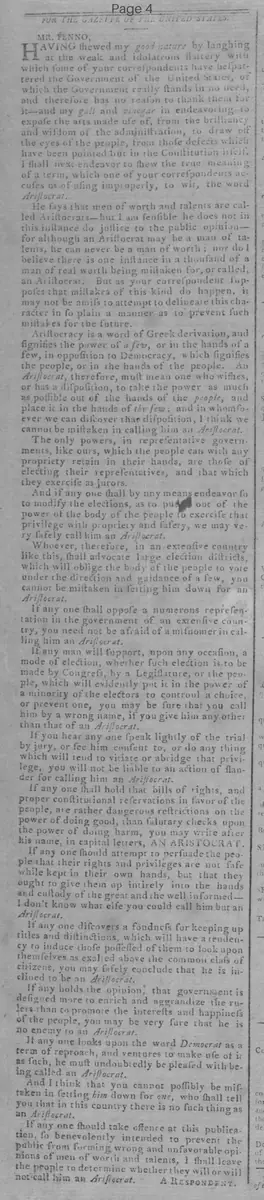
MR. FENNO,
HAVING shewed my good nature by laughing at the weak and idolatrous flattery with which some of your correspondents have bespattered the Government of the United States, or which the Government really stands in no need, and therefore has no reason to thank them for it—and my gall and vinegar in endeavoring to expose the arts made use of, from the brilliancy and wisdom of the administration, to draw off the eyes of the people, from those defects which have been pointed out in the Constitution itself.
I shall next endeavor to shew the true meaning of a term, which one of your correspondents accuses us of using improperly, to wit, the word Aristocrat.
He says that men of worth and talents are called Aristocrats—but I am sensible he does not in this instance do justice to the public opinion—for although an Aristocrat may be a man of talents, he can never be a man of worth; nor do I believe there is one instance in a thousand of a man of real worth being mistaken for, or called, an Aristocrat. But as your correspondent supposes that mistakes of this kind do happen, it may not be amiss to attempt to delineate this character in so plain a manner as to prevent such mistakes for the future.
Aristocracy is a word of Greek derivation, and signifies the power of a few, or in the hands of a few, in opposition to Democracy, which signifies the people, or in the hands of the people. An Aristocrat, therefore, must mean one who wishes, or has a disposition, to take the power as much as possible out of the hands of the people, and place it in the hands of the few; and in whomever we can discover that disposition, I think we cannot be mistaken in calling him an Aristocrat.
The only powers, in representative governments, like ours, which the people can with any propriety retain in their hands, are those of electing their representatives, and that which they exercise as jurors.
And if any one shall by any means endeavor to modify the elections, so as to put out of the power of the body of the people to exercise that privilege with propriety and safety, we may very safely call him an Aristocrat.
Whoever, therefore, in an extensive country like this, shall advocate large election districts, which will oblige the body of the people to vote under the direction and guidance of a few, you cannot be mistaken in setting him down for an Aristocrat.
If any one shall oppose a numerous representation in the government of an extensive country, you need not be afraid of a misnomer in calling him an Aristocrat.
If any man will support, upon any occasion, a mode of election, whether such election is to be made by Congress, by a Legislature, or the people, which will evidently put it in the power of a minority of the electors to control a choice, or prevent one, you may be sure that you call him by a wrong name, if you give him any other than that of an Aristocrat.
If you hear any one speak lightly of the trial by jury, or see him consent to, or do any thing which will tend to vitiate or abridge that privilege, you will not be liable to an action of slander for calling him an Aristocrat.
If any one shall hold that bills of rights, and proper constitutional reservations in favor of the people, are rather dangerous restrictions on the power of doing good, than salutary checks upon the power of doing harm, you may write after his name, in capital letters, AN ARISTOCRAT.
If any one should attempt to persuade the people that their rights and privileges are not safe while kept in their own hands, but that they ought to give them up entirely into the hands and custody of the great and the well informed—I don't know what else you could call him but an Aristocrat.
If any one discovers a fondness for keeping up titles and distinctions, which will have a tendency to induce those possessed of them to look upon themselves as exalted above the common class of citizens, you may safely conclude that he is inclined to be an Aristocrat.
If any holds the opinion, that government is designed more to enrich and aggrandize the rulers than to promote the interests and happiness of the people, you may be very sure that he is no enemy to an Aristocrat.
If any one looks upon the word Democrat as a term of reproach, and ventures to make use of it as such, he must undoubtedly be pleased with being called an Aristocrat.
And I think that you cannot possibly be mistaken in setting him down as one, who shall tell you that in this country there is no such thing as an Aristocrat.
If any one should take offence at this publication, so benevolently intended to prevent the public from forming wrong and unfavorable opinions of men of worth and talents, I shall leave the people to determine whether they will or will not call him an Aristocrat.
A RESPONDENT.
What sub-type of article is it?
What themes does it cover?
What keywords are associated?
What entities or persons were involved?
Letter to Editor Details
Author
A Respondent
Recipient
Mr. Fenno
Main Argument
an aristocrat is defined as one who seeks to transfer power from the people to the few, identifiable by support for large election districts, opposition to numerous representation, undermining jury trials, dismissing bills of rights, favoring titles, and viewing government as benefiting rulers over the people.
Notable Details