Thank you for visiting SNEWPapers!
Sign up free
Fowle's New Hampshire Gazette And General Advertiser
Portsmouth, Rockingham County, New Hampshire
What is this article about?
Translation of Esprit Fléchier's French description of the profound sufferings of prisoners deprived of liberty, health, and family, likened to living death. Followed by reflections condemning the inhumanity of imprisoning debtors unable to pay, urging Christian mercy over resentment.
Merged-components note: This is a continuation of the same literary piece describing miseries in gaols, with the text flowing directly across pages; the second part includes reflective commentary but remains part of the overall translated and opined work.
Clippings
1 of 2
OCR Quality
Full Text
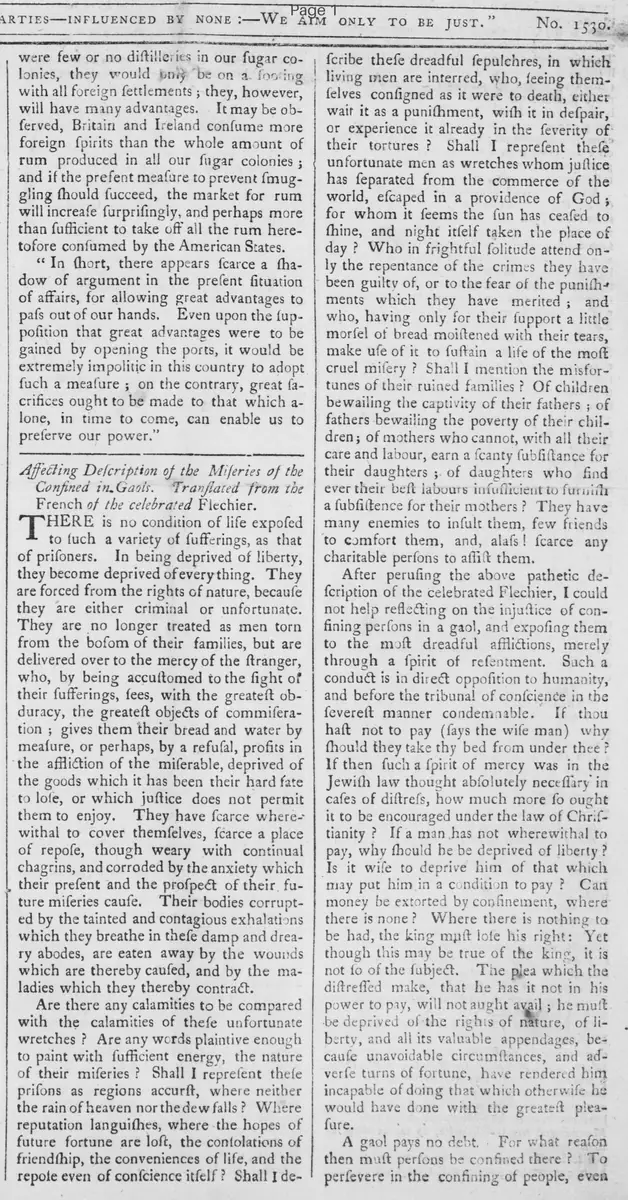
There is no condition of life exposed to such a variety of sufferings, as that of prisoners. In being deprived of liberty, they become deprived of everything. They are forced from the rights of nature, because they are either criminal or unfortunate. They are no longer treated as men torn from the bosom of their families, but are delivered over to the mercy of the stranger, who, by being accustomed to the sight of their sufferings, sees, with the greatest obduracy, the greatest objects of commiseration; gives them their bread and water by measure, or perhaps, by a refusal, profits in the affliction of the miserable, deprived of the goods which it has been their hard fate to lose, or which justice does not permit them to enjoy. They have scarce wherewithal to cover themselves, scarce a place of repose, though weary with continual chagrins, and corroded by the anxiety which their present and the prospect of their future miseries cause. Their bodies corrupted by the tainted and contagious exhalations which they breathe in these damp and dreary abodes, are eaten away by the wounds which are thereby caused, and by the maladies which they thereby contract.
Are there any calamities to be compared with the calamities of these unfortunate wretches? Are any words plaintive enough to paint with sufficient energy the nature of their miseries? Shall I represent these prisons as regions accursed, where neither the rain of heaven nor the dew falls? Where reputation languishes, where the hopes of future fortune are lost, the consolations of friendship, the conveniences of life, and the repose even of conscience itself? Shall I describe these dreadful sepulchres, in which living men are interred, who, seeing themselves consigned as it were to death, either wait it as a punishment, with it in despair, or experience it already in the severity of their tortures? Shall I represent these unfortunate men as wretches whom justice has separated from the commerce of the world, escaped in a providence of God; for whom it seems the sun has ceased to shine, and night itself taken the place of day? Who in frightful solitude attend only the repentance of the crimes they have been guilty of, or to the fear of the punishments which they have merited; and who, having only for their support a little morsel of bread moistened with their tears, make use of it to sustain a life of the most cruel misery? Shall I mention the misfortunes of their ruined families? Of children bewailing the captivity of their fathers; of fathers bewailing the poverty of their children; of mothers who cannot, with all their care and labour, earn a scanty subsistence for their daughters; of daughters who find ever their best labours insufficient to furnish a subsistence for their mothers? They have many enemies to insult them, few friends to comfort them, and, alas! scarce any charitable persons to assist them.
After perusing the above pathetic description of the celebrated Flechier, I could not help reflecting on the injustice of confining persons in a gaol, and exposing them to the most dreadful afflictions, merely through a spirit of resentment. Such a conduct is in direct opposition to humanity, and before the tribunal of conscience in the severest manner condemnable. If thou hast not to pay (says the wise man) why should they take thy bed from under thee? If then such a spirit of mercy was in the Jewish law thought absolutely necessary in cases of distress, how much more so ought it to be encouraged under the law of Christianity? If a man has not wherewithal to pay, why should he be deprived of liberty? Is it wise to deprive him of that which may put him in a condition to pay? Can money be extorted by confinement, where there is none? Where there is nothing to be had, the king must lose his right: Yet though this may be true of the king, it is not so of the subject. The plea which the distressed make, that he has it not in his power to pay, will not aught avail; he must be deprived of the rights of nature, of liberty, and all its valuable appendages, because unavoidable circumstances and adverse turns of fortune have rendered him incapable of doing that which otherwise he would have done with the greatest pleasure.
A gaol pays no debt. For what reason then must persons be confined there? To persevere in the confining of people, even under a conviction that they have it not in their power to discharge what they owe, is cruel indeed! and in the sight of the Deity most abominable. In that awful presence, what mercy can he expect who has himself set mercy at a distance, and, in the pride of resentment, punished merely because he had the power of punishing
What sub-type of article is it?
What themes does it cover?
What keywords are associated?
What entities or persons were involved?
Literary Details
Title
Affecting Description Of The Miseries Of The Confined In Gaols
Author
Translated From The French Of The Celebrated Flechier
Subject
Miseries Of Prisoners And Injustice Of Debtor Imprisonment
Key Lines