Thank you for visiting SNEWPapers!
Sign up free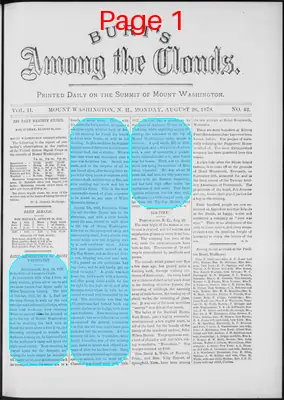
Letter to Editor
August 26, 1878
Burt's Among The Clouds
Mount Washington, Coos County, New Hampshire
What is this article about?
A letter recounting two historical incidents on Mount Washington: Dr. B. L. Ball's 1855 survival after 60 hours of extreme exposure without food or shelter, and Benjamin Chandler's 1856 disappearance and death, with his skeleton found in 1857 containing valuables.
Clipping
OCR Quality
98%
Excellent
Full Text
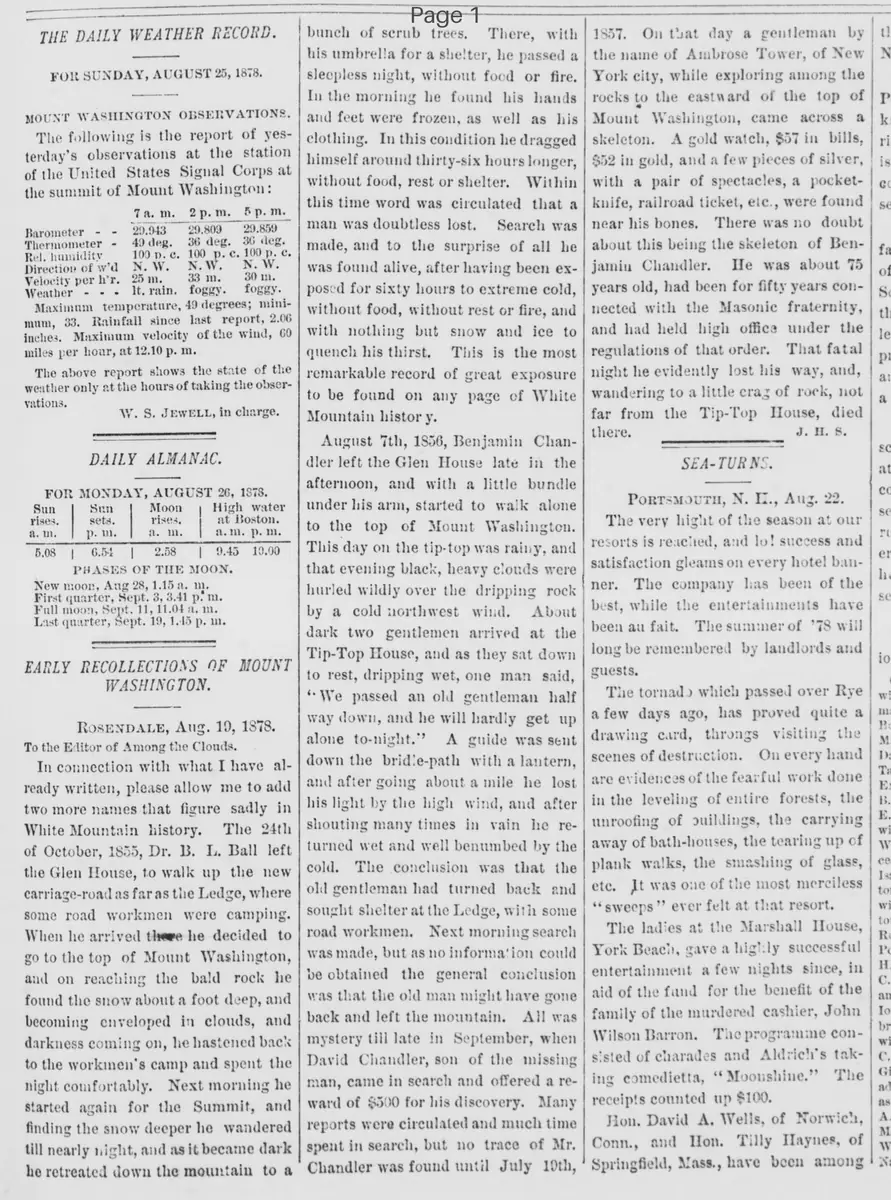
EARLY RECOLLECTIONS OF MOUNT
WASHINGTON.
ROSENDALE, Aug. 19, 1878.
To the Editor of Among the Clouds.
In connection with what I have already written, please allow me to add two more names that figure sadly in White Mountain history.
The 24th of October, 1855. Dr. B. L. Ball left the Glen House, to walk up the new carriage-road as far as the Ledge, where some road workmen were camping. When he arrived there he decided to go to the top of Mount Washington, and on reaching the bald rock he found the snow about a foot deep, and becoming enveloped in clouds, and darkness coming on, he hastened back to the workmen's camp and spent the night comfortably. Next morning he started again for the Summit, and finding the snow deeper he wandered till nearly night, and as it became dark he retreated down the mountain to a bunch of scrub trees.
There, with his umbrella for a shelter, he passed a sleepless night, without food or fire. In the morning he found his hands and feet were frozen, as well as his clothing. In this condition he dragged himself around thirty-six hours longer, without food, rest or shelter. Within this time word was circulated that a man was doubtless lost.
Search was made, and to the surprise of all he was found alive, after having been exposed for sixty hours to extreme cold, without food, without rest or fire, and with nothing but snow and ice to quench his thirst.
This is the most remarkable record of great exposure to be found on any page of White Mountain history.
August 7th, 1856, Benjamin Chandler left the Glen House late in the afternoon, and with a little bundle under his arm, started to walk alone to the top of Mount Washington. This day on the tip-top was rainy, and that evening black, heavy clouds were hurled wildly over the dripping rock by a cold northwest wind. About dark two gentlemen arrived at the Tip-Top House, and as they sat down to rest, dripping wet, one man said, "He passed an old gentleman half way down, and he will hardly get up alone to-night." A guide was sent down the bride-path with a lantern, and after going about a mile he lost his light by the high wind, and after shouting many times in vain he returned wet and well benumbed by the cold. The conclusion was that the old gentleman had turned back and sought shelter at the Ledge, with some road workmen. Next morning search was made, but as no information could be obtained the general conclusion was that the old man might have gone back and left the mountain. All was mystery till late in September, when David Chandler, son of the missing man, came in search and offered a reward of $500 for his discovery. Many reports were circulated and much time spent in search, but no trace of Mr. Chandler was found until July 19th, 1857. On that day a gentleman by the name of Ambrose Tower, of New York city, while exploring among the rocks to the eastward of the top of Mount Washington, came across a skeleton. A gold watch, $57 in bills, $52 in gold, and a few pieces of silver, with a pair of spectacles, a pocket-knife, railroad ticket, etc., were found near his bones. There was no doubt about this being the skeleton of Benjamin Chandler. He was about 75 years old, had been for fifty years connected with the Masonic fraternity, and had held high office under the regulations of that order.
That fatal night he evidently lost his way, and, wandering to a little crag of rock, not far from the Tip-Top House, died there.
J. I. S.
WASHINGTON.
ROSENDALE, Aug. 19, 1878.
To the Editor of Among the Clouds.
In connection with what I have already written, please allow me to add two more names that figure sadly in White Mountain history.
The 24th of October, 1855. Dr. B. L. Ball left the Glen House, to walk up the new carriage-road as far as the Ledge, where some road workmen were camping. When he arrived there he decided to go to the top of Mount Washington, and on reaching the bald rock he found the snow about a foot deep, and becoming enveloped in clouds, and darkness coming on, he hastened back to the workmen's camp and spent the night comfortably. Next morning he started again for the Summit, and finding the snow deeper he wandered till nearly night, and as it became dark he retreated down the mountain to a bunch of scrub trees.
There, with his umbrella for a shelter, he passed a sleepless night, without food or fire. In the morning he found his hands and feet were frozen, as well as his clothing. In this condition he dragged himself around thirty-six hours longer, without food, rest or shelter. Within this time word was circulated that a man was doubtless lost.
Search was made, and to the surprise of all he was found alive, after having been exposed for sixty hours to extreme cold, without food, without rest or fire, and with nothing but snow and ice to quench his thirst.
This is the most remarkable record of great exposure to be found on any page of White Mountain history.
August 7th, 1856, Benjamin Chandler left the Glen House late in the afternoon, and with a little bundle under his arm, started to walk alone to the top of Mount Washington. This day on the tip-top was rainy, and that evening black, heavy clouds were hurled wildly over the dripping rock by a cold northwest wind. About dark two gentlemen arrived at the Tip-Top House, and as they sat down to rest, dripping wet, one man said, "He passed an old gentleman half way down, and he will hardly get up alone to-night." A guide was sent down the bride-path with a lantern, and after going about a mile he lost his light by the high wind, and after shouting many times in vain he returned wet and well benumbed by the cold. The conclusion was that the old gentleman had turned back and sought shelter at the Ledge, with some road workmen. Next morning search was made, but as no information could be obtained the general conclusion was that the old man might have gone back and left the mountain. All was mystery till late in September, when David Chandler, son of the missing man, came in search and offered a reward of $500 for his discovery. Many reports were circulated and much time spent in search, but no trace of Mr. Chandler was found until July 19th, 1857. On that day a gentleman by the name of Ambrose Tower, of New York city, while exploring among the rocks to the eastward of the top of Mount Washington, came across a skeleton. A gold watch, $57 in bills, $52 in gold, and a few pieces of silver, with a pair of spectacles, a pocket-knife, railroad ticket, etc., were found near his bones. There was no doubt about this being the skeleton of Benjamin Chandler. He was about 75 years old, had been for fifty years connected with the Masonic fraternity, and had held high office under the regulations of that order.
That fatal night he evidently lost his way, and, wandering to a little crag of rock, not far from the Tip-Top House, died there.
J. I. S.
What sub-type of article is it?
Historical
Informative
Reflective
What themes does it cover?
Science Nature
White Mountain History
What keywords are associated?
Mount Washington
White Mountains
Dr B L Ball
Benjamin Chandler
Exposure Survival
Mountain Death
1855 Incident
1856 Disappearance
What entities or persons were involved?
J. I. S.
To The Editor Of Among The Clouds
Letter to Editor Details
Author
J. I. S.
Recipient
To The Editor Of Among The Clouds
Main Argument
shares two remarkable and tragic stories from white mountain history involving extreme exposure and loss of life on mount washington.
Notable Details
Dr. B. L. Ball Survived 60 Hours Of Exposure In 1855
Benjamin Chandler's Skeleton Found In 1857 With Valuables Intact
Chandler Was 75, Masonic Leader