Thank you for visiting SNEWPapers!
Sign up free
Alexandria Advertiser And Commercial Intelligencer
Alexandria, Virginia
What is this article about?
Transcript of U.S. House debate on February 17 on repealing Senate bill reorganizing federal courts. Speakers Mr. Davis and Mr. Bacon argue constitutionality, expediency of abolishing courts, critiquing prior acts and judicial power.
Merged-components note: This is a continuation of the congressional debate report on the judiciary bill, spanning pages 2 and 3; relabeled from 'editorial' to 'story' as it is a factual report of proceedings.
Clippings
1 of 2
OCR Quality
Full Text
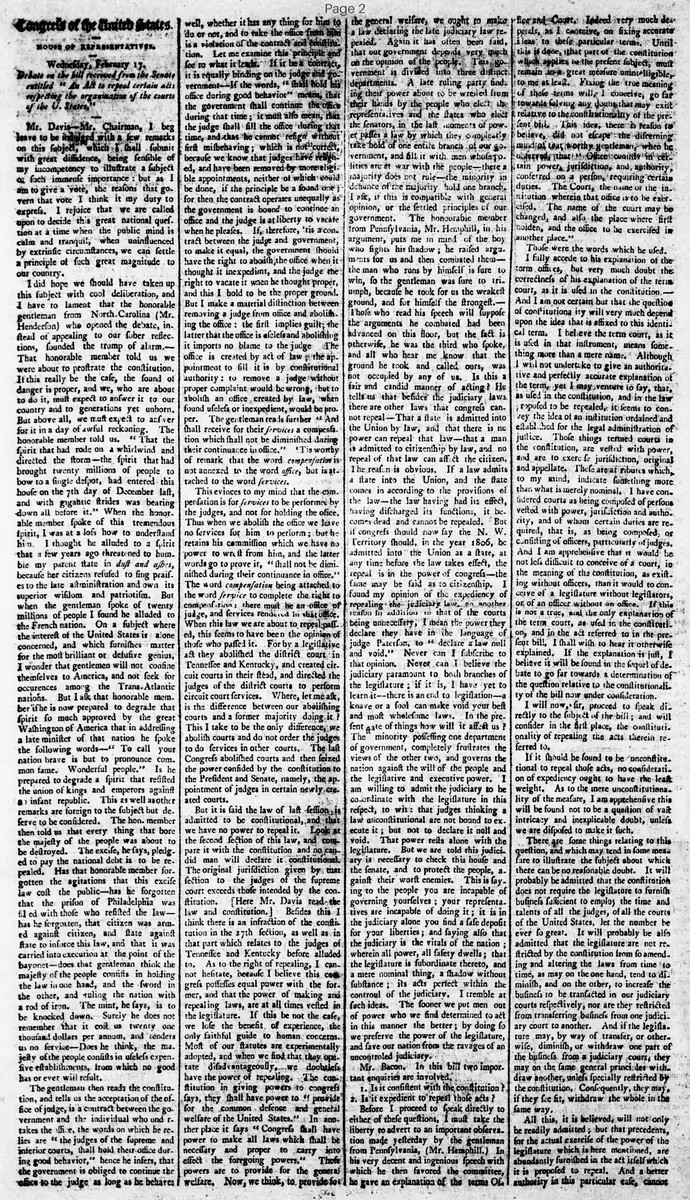
House of Representatives.
Wednesday February 17.
Debate on the bill received from the Senate entitled "An Act to repeal certain acts respecting the organization of the courts of the U. States."
247
Mr. Davis in the Chair, I beg leave to be indulged with a few remarks on this subject, which I shall submit with great diffidence, being sensible of my incompetency to illustrate a subject of such immense importance: but as I am to give a vote, the reasons that govern that vote I think it my duty to express. I rejoice that we are called upon to decide this great national question at a time when the public mind is calm and tranquil, when uninfluenced by extrinsic circumstances, we can settle a principle of such great magnitude to our country.
I did hope we should have taken up this subject with cool deliberation, and I have to lament that the honorable gentleman from North-Carolina (Mr. Henderson) who opened the debate, instead of appealing to our sober reflections, sounded the trump of alarm. That honorable member told us we were about to prostrate the constitution. If this really be the case, the sound of danger is proper, and we, who are about to do it, must expect to answer it to our country and to generations yet unborn. But above all, we must expect to answer for it in a day of awful reckoning. The honorable member told us "That the spirit that had rode on a whirlwind and directed the storm—the spirit that had brought twenty millions of people to bow to a single despot, had entered this house on the 7th day of December last, and with gigantic strides was bearing down all before it." When the honorable member spoke of this tremendous spirit, I was at a loss how to understand him. I thought he alluded to a spirit that a few years ago threatened to humble my parent state in dust and ashes, because her citizens refused to sing praises to the late administration and own its superior wisdom and patriotism. But when the gentleman spoke of twenty millions of people I found he alluded to the French nation. On a subject where the interest of the United States is alone concerned, and which furnishes matter for the most brilliant or diffusive genius, I wonder that gentlemen will not confine themselves to America, and not seek for occurrences among the Trans-Atlantic nations. But I ask that honorable member if he is now prepared to degrade that spirit so much approved by the great Washington of America that in addressing a late minister of that nation he spoke the following words—"To call your nation brave is but to pronounce common fame. Wonderful people." Is he prepared to degrade a spirit that resisted the union of kings and emperors against an infant republic. This as well as other remarks are foreign to the subject but deserve to be considered. The hon. member then told us that every thing that bore the majesty of the people was about to be destroyed. The excise, he says, pledged to pay the national debt is to be repealed. Has that honorable member forgotten the agitations that this excise law cost the public—has he forgotten that the prison of Philadelphia was filled with those who resisted the law—has he forgotten, that citizen was armed against citizen, and state against state to enforce this law, and that it was carried into execution at the point of the bayonet—does that gentleman think the majesty of the people consists in holding the law in one hand, and the sword in the other, and ruling the nation with a rod of iron. The mint, he says, is to be knocked down. Surely he does not remember that it cost us twenty one thousand dollars per annum, and renders us no service—Does he think, the majesty of the people consists in useless expensive establishments, from which no good has or ever will result.
The gentleman then reads the constitution, and tells us the acceptation of the office of judge, is a contract between the government and the individual who undertakes the office. the words on which he relies are "the judges of the supreme and inferior courts, shall hold their office during good behavior," hence he infers, that the government is obliged to continue the office to the judge as long as he behaves well, whether it has any thing for him to do or not, and to take the office from him is a violation of the contract and constitution. Let me examine this principle and see to what it leads. If it be a contract, it is equally binding on the judge and government—If the words, "shall hold his office during good behavior" means, that the government shall continue the office during that time ; it must also mean, that the judge shall fill the office during that time, and that he cannot resign without first misbehaving : which is not correct: because we know that judges have resigned, and have been removed by more eligible appointments, neither of which would be done, if the principle be a sound one ; for then the contract operates unequally as the government is bound to continue an office and the judge is at liberty to vacate when he pleases. If, therefore, 'tis a contract between the judge and government, to make it equal, the government should have the right to abolish the office when it thought it inexpedient, and the judge the right to vacate it when he thought proper, and this I hold to be the proper ground. But I make a material distinction between removing a judge from office and abolishing the office : the first implies guilt; the latter that the office is useless and abolishing it imports no blame to the judge The office is created by act of law ; the appointment to fill it is by constitutional authority: to remove a judge without proper complaint would be wrong , but to abolish an office. created by law, when found useless or inexpedient, would be proper. The gentleman reads further And shall receive for their services a compensation which shall not be diminished during their continuance in office." 'Tis worthy of remark that the word compensation is not annexed to the word office. but is attached to the word services. This evinces to my mind that the compensation is for services to be performed by the judges, and not for holding the office. Thus when we abolish the office we have no services for him to perform; but he retains his commission which we have no power to wrest it from him, and the latter words go to prove it. " shall not be diminished during their continuance in office." The word compensation being attached to the word service to complete the right to compensation : there must be an office of judge, and services rendered in that office. When this law we are about to repeal passed, this seems to have been the opinion of those who passed it. For by a legislative act they abolished the district court in Tennessee and Kentucky, and created circuit courts in their stead, and directed the judges of the district courts to perform circuit court services. Where, let me ask, is the difference between our abolishing courts and a former majority doing it ? This I take to be the only difference we abolish courts and do not order the judges to do services in other courts.. The last Congress abolished courts and then seized the power confided by the constitution to the President and Senate, namely, the appointment of judges in certain newly created courts.
But it is said the law of last session,is admitted to be constitutional, and that we have no power to repeal it. Look at the second section of this law, and compare it with the constitution and no candid man will declare it constitutional. The original jurisdiction given by that section to the judges of the supreme court exceeds those intended by the constitution. Here Mr. Davis read the law and constitution. Besides this. I think there is an infraction of the constitution in the 27th section, as well as in that part which relates to the judges of Tennessee and Kentucky before alluded to. As to the right of repealing, I cannot hesitate, because I believe this congress possesses equal power with the former, and that the power of making and repealing laws, are at all times vested in the legislature. If this be not the case, we lose the benefit, of experience, the only faithful guide to human concerns. Most of our statutes are experimentally adopted, and when we find that they operate disadvantageously. we doubtless have the power of repealing. The constitution in giving powers to congress says, they shall have power to "provide for the common defence and general welfare of the United States." In another place it says " Congress shall have power to make all laws which shall be necessary and proper to carry into effect the foregoing powers." Those powers are to provide for the general welfare. Now, we think, to provide for the general welfare; we ought to make a law declaring the late judiciary law repealed. Again it has often been said, that our government depends very much on the opinion of the people. This government is divided into three distinct departments. A late ruling party finding their power about to be wrested from their hands by the people who elect the representatives and the states who select the senators, in the last moments of power passes a law by which they completely take hold of one entire branch of our government, and fill it with men whose politics are at war with the people --there a majority does not rule—the minority in defiance of the majority hold one branch. I ask, if this is compatible with general opinion, or the settled principles of our government. The honourable member from Pennsylvania, Mr. Hemphill, in his argument, puts me in mind of the boy who fights his shadow : he raised arguments for us and then combated them— the man who runs by himself is sure to win, so the gentleman was sure to triumph, because he took for us the weakest ground, and for himself the strongest. Those who read his speech will suppose the arguments he combated had been advanced on this floor, but the fact is otherwise, he was the third who spoke, and all who hear me know that the ground he took and called ours, was not occupied by any of us. Is this a fair and candid manner of acting? He tells us that besides the judiciary laws. there are other laws that congress cannot repeal—That a state is admitted into the Union by law. and that there is no power can repeal that law—that a man is admitted to citizenship by law, and no repeal of that law can affect the citizen. The reason is obvious. If a law admits a state into the Union, and the state comes in according to the provisions of the law—the law having had its effect, having discharged its functions, it becomes dead and cannot be repealed. But if congress should now say the N. W. territory should, in the year 1806, be admitted into the Union as a state, at any time before the law takes effect, the repeal is in the power of congress—the same may be said as to citizenship. I found my opinion of the expediency of repealing the judiciary law. on another reason in addition to that of the courts being unnecessary,' I mean the power they declare they have in the language of judge Paterson, to declare a law null and void." Never can I subscribe to that opinion. Never can I believe the judiciary paramount to both branches of the legislature : if it is, I have yet to learn it—there is an end to legislation—a knave or a fool can make void your best and most wholesome laws." In the present state of things how will it affect us ? The minority possessing one department of government, completely frustrates the views of the other two, and governs the nation against the will of the people and the legislative and executive power. I am willing to admit the judiciary to be co-ordinate with the legislature in this respect, to wit: that judges thinking a law unconstitutional are not bound to execute it ; but not to declare it null and void. That power rests alone with the legislature. But we are told this judiciary is necessary to check this house and the senate, and to protect the people, against their worst enemies. This is saying to the people you are incapable of governing yourselves ; your representatives are incapable of doing it ; it is in the judiciary alone you find a safe deposit for your liberties; and saying also that the judiciary is the vitals of the nation ; wherein all power, all Safety dwells ; that the legislature is subordinate thereto, and a mere nominal thing, a shadow without substance ; its acts perfect within the controul of the judiciary. I tremble at such ideas. The sooner we put men out of power who we find determined to act in this manner the better; by doing so we preserve the power of the legislature, and save our nation from the ravages of an uncontrolled judiciary.
Mr. Bacon. In this bill two important enquiries are involved.
1. Is it consistent with the constitution ?
2. Is it expedient to repeal those acts ?
Before I proceed to speak directly to either of these questions, I must take the liberty to advert to an important observation made yesterday by the gentleman from Pennsylvania, (Mr. Hemphill.) In his very decent and ingenious speech with which he then favored the committee, he gave an explanation of the terms Office and Court : Indeed very much depends, as I conceive, on having accurate ideas to these particular terms. Until this is done, that part of the constitution which applies to the present subject, must remain in a great measure unintelligible. to me at least. Fixing the true meaning of these terms- will, I conceive, go far towards solving any doubt that may exist- relative to the constitutionality of the present bill. This idea, there is reason to believe, did not escape : the discerning mind of that worthy gentleman, when he observed that notion Of office consists in certain power jurisdiction, and, authority, conferred on a person, requiring certain duties. The Court, the name or the institution . wherein that office is to be exercised. The name of the court may be changed, and also-the place where first holden, and the office to be exercised in another place."
Those were the words which he used. I fully accede to his explanation of the term offices, but very much doubt the correctness of his explanation of the term court, as it is used in the constitution. And I am not certain but that the question of constitutionality will very much depend upon the idea that is affixed to this identical term. I believe the term court, as it is used in that instrument, means something more than a mere name. Although I will not undertake to give an authoritative and perfectly accurate explanation of the term, yet I may venture to say, that, as used in the constitution, and in the law proposed to be repealed, it seems to convey the idea of an institution ordained and established for the legal administration of justice. Those things termed courts in the constitution, are vested with power, and are to exercise jurisdiction, original and appellate. These are attributes which, to my mind, indicate something more. than what is merely nominal. I have considered courts as being composed of persons vested with power, jurisdiction and authority, and of whom certain duties are required, that is, as being composed, or consisting of officers, particularly of judges. And I am apprehensive that it would be not less difficult to conceive of a court, in the meaning of the constitution, as existing without officers, than it would to conceive of a legislature without legislators, or of an officer without an office. If this is not a true, and the only explanation of the term court, as used in the constitution, and in the act referred to in the present bill," I shall wish to hear it otherwise explained. If the explanation is just, I believe it will be found in the sequel of debate to go far towards a determination of the question relative to the constitutionality of the bill now under consideration.
I will now, sir, proceed to speak directly to the subject of the bill; and will consider in the first place, the constitutionality of repealing the acts therein referred to. If it should be found to be unconstitutional to repeal those acts, no consideration of expediency ought to have the least weight. As to the mere unconstitutionality of the measure, I am apprehensive this will be found not to be a question of vast intricacy and inexplicable doubt, unless we are disposed to make it such. There are some things relating to this question, and which may tend in some measure to illustrate the subject about which there can be no reasonable doubt. It will probably be admitted that the constitution does not require the legislature to furnish business sufficient to employ the time and talents of all the judges, of all the courts of the United States, let the number be ever so great. It will probably be also admitted that the legislature are not restricted by the constitution from so amending and altering the laws from time to time, as may on the one hand. tend to diminish, and on the other, to increase the business to be transacted in our judiciary courts respectively, nor are they restricted from transferring business from one judiciary court to another. And if the legislature may, by way of transfer, or otherwise, diminish, or withdraw one part of the business from a judiciary court; they may on the same general principles withdraw another unless specially restricted by the constitution, Consequently, they may. if they see fit, withdraw the whole in the same way..
All this, it is believed, will not only be readily admitted ; but that precedents, for the actual exercise of the power of the legislature - which is here mentioned, are abundantly furnished in the act itself which it is proposed to repeal. And a better authority in this particular case cannot
possibly exist than what is furnished by this act. It is an authority which, as it applies to this particular case, is not inferior to the constitution itself. It is an authority which can neither be explained away, nor misunderstood: It may with propriety be said, that in this particular case, it is an authority instar omnium--it is indeed equal to all others: because if I am not mistaken, it absolutely and unequivocally determines the question relative to the constitutionality of the present bill. I should be willing for myself to rest the issue entirely on this ground. This is the principal ground that I shall take: By sec. 10, of this law, the powers in general which, by the state law, were vested in the former circuit courts, are transferred from those courts to the circuit courts which are established by the present law. By sec. 20, it is expressly provided, that, "all actions, suits, process, pleadings, and other proceedings, of what nature or kind soever, depending or existing in any of the present circuit courts of the United States, or in any of the present district courts of the United States, acting as circuit courts, shall be, and hereby are, continued over to the circuit courts established by this act." By sec. 10, it is provided that the circuit courts established by this act shall have cognizance of a great number of causes which were not in like manner cognizable before the former circuit courts, viz. of all actions, cognizable by the judicial authority of the United States, where the matter in dispute is between four and five hundred dollars. By the 28th section it is "enacted that the district courts of the United States, in and for the districts of Tennessee and Kentucky" in particular, "shall be, and hereby are abolished." By the 27th sec. "it is further enacted," generally, "that the circuit courts of the United States, heretofore established, shall cease and be abolished." Here we have a precedent for abolishing, by a single legislative act, all the judicial courts of a certain description throughout the United States. In short, Sir, the present circuit courts are not only vested with power different from the former circuit courts, but they are composed of different men; and that while the former judges of those courts are still living--during their good behaviour, and without their resignation, impeachment, or conviction. All former circuit courts are, by the law in question, ipso facto, abolished. If the circuit courts established by the law in question are constitutional courts, as I take for granted they are, then the former circuit courts do not now exist. If, as some gentlemen contend, it is a violation of the constitution for the legislature to abolish a judicial court, the law itself, which it is in contemplation to repeal, must be an unconstitutional law. And I should not suppose it to be a violation of the constitution for the legislature to repeal an unconstitutional law.
(To be continued.)
What sub-type of article is it?
What themes does it cover?
What keywords are associated?
What entities or persons were involved?
Where did it happen?
Story Details
Key Persons
Location
House Of Representatives, United States
Event Date
Wednesday February 17
Story Details
Debate on repealing acts organizing U.S. courts; speakers argue constitutionality of abolishing courts, distinction between office and services, precedents from prior laws, and expediency to prevent judicial overreach.