Thank you for visiting SNEWPapers!
Sign up free
Editorial
May 11, 1830
Constitutional Whig
Richmond, Virginia
What is this article about?
This editorial from Tennessee defends Gen. Jackson against Lynchburg Virginian's claims of using State Bank funds for bribery in the 1828 election. It details defalcations as non-political loans, refutes each interrogatory, and describes legislative actions to investigate and resolve the issue.
Clipping
OCR Quality
95%
Excellent
Full Text
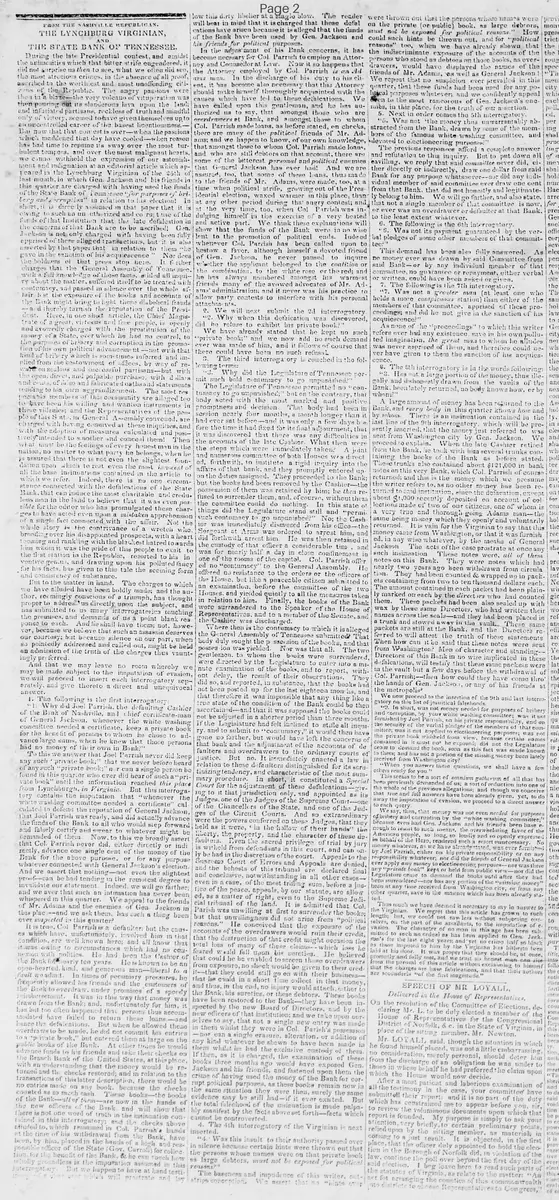
THE STATE BANK OF TENNESSEE.
During the late Presidential contest, and amidst the animosities which that bitter strife engendered, it did not surprise us then to see, what we often did see, the most atrocious crimes, in the absence of all proof, ascribed to the worthiest and most unoffending citizens of the Republic. The angry passions were then in a blaze—the very volcano of vituperation was then pouring out its slanderous lava upon the land; and infuriated partisans, reckless of truth and mindful only of victory, seemed to have given themselves up to an uncontrolled career of the basest licentiousness.
But now that that contest is over—when the passions which maddened that day have cooled—when reason has had time to resume its sway over the most turbulent tempers, and over the most malignant hearts, we cannot withhold the expression of our astonishment and indignation at an editorial article which appeared in the Lynchburg Virginian of the 28th of last month, in which Gen. Jackson and his friends in this quarter are charged with having used the funds of the State Bank of Tennessee "for purposes of bribery and corruption" in relation to his election! In short, it is directly assumed in that paper that it is owing to such an unauthorized and corrupt use of the funds of that Institution that the late defalcation in the concerns of that Bank are to be ascribed! Gen. Jackson is not only charged with having been fully apprised of these alleged transactions, but it is also asserted by that paper that in relation to them "he gave in the sanction of his acquiescence." Nor does the boldness of that press stop there. It further charges that the General Assembly of Tennessee, with a full knowledge of these facts, still-dalinquished inquiry about the matter, suffered itself to be treated with contumely, and passed in silence over the whole affair, lest the exposure of the books and accounts of the Bank might bring to light these diabolical frauds—and thereby tarnish the reputation of the President. Here, in one short article, the Chief Magistrate of a great, virtuous and free people, is openly and avowedly charged with the prostitution of the money of a State, over which he had no control, to the purposes of bribery and corruption in the promotion of his own political advancement—not with that kind of bribery which is sometimes inferred and implied from the bestowment of offices, by way of rewarding zealous and successful partisans—but with the open, direct, and palpable purchase, with dollars and coins, of false and fabricated oaths and statements tending to his own aggrandizement. The most respectable members of this community are alleged too to have been his willing and wanton instruments in these villainies; and the Representatives of the people of this State, in General Assembly convened, are charged with having connived at these iniquities, and with the adoption of measures calculated and positively intended to smother and conceal them! Then what must be the feelings of every honest man in the nation, no matter to what party he belongs, when he is assured that there is not even the slightest foundation upon which to rest even the most innocent of all the base insinuations contained in the article to which we refer. Indeed, there is no one circumstance connected with the defalcations of the State Bank, that can induce the most charitable and credulous man in the land to believe that it was even possible for the editor who has promulgated these charges to have acted even upon a mistaken apprehension of a single fact connected with the affair. No! the whole story is the contrivance of a wretch who, brooding over his disappointed prospects, with a heart teeming and rankling with the blackest hatred towards him whom it was the pride of this people to exalt to the first station in the Republic, resorted to his inventive genius, and drawing upon his polluted fancy for his facts, has given to this tale the seeming form and consistency of substance.
But to the matter in hand. The charges to which we have alluded have been boldly made: and the author, seemingly conscious of a triumph, has thought proper to address us directly upon the subject, and has submitted to us many interrogatories touching the premises, and demands of us a point blank response to each. And he shall have them; not, however, because we believe that such an assassin deserves our courtesy: but because silence on our part, when so pointedly addressed and called out, might be held an admission of the truth of the charges thus vauntingly preferred.
And that we may leave no room whereby we may be made subject to the imputation of evasion, we will proceed to insert each interrogatory separately, and give thereto a direct and unequivocal answer.
1. The following is the first interrogatory:
"1. Why did Joel Parrish, the defaulting Cashier of the Bank of Nashville, and chief certificate-man of General Jackson, whenever the white washing committee needed a certificate, keep a private book for the benefit of persons to whom he chose to advance large sums, when he knew that those persons had no money of their own in Bank?"
To this we answer that Joel Parrish never did keep any such "private book;" that we never before heard of any such "private book;" nor can a single person be found in this quarter who ever did hear of such a "private book" until the information reached this place from Lynchburg, in Virginia. But this interrogatory contains the imputation that "whenever the white washing committee needed a certificate" calculated to defend the reputation of General Jackson, that Joel Parrish was ready, and did actually advance the funds of the Bank to all who would step forward and falsely certify and swear to whatever might be demanded of them. Now, to this we broadly assert that Col. Parrish never did, either directly or indirectly, advance one single cent of the money of the Bank for the above purpose, or for any purpose whatever connected with General Jackson's election. And we assert that nothing—not even the slightest proof—can be had tending in the remotest degree to invalidate our statement. Indeed, we will go farther; and we aver that such an intimation has never been whispered in this quarter. We appeal to the friends of Mr. Adams and the enemies of Gen. Jackson in this place—and we ask them, has such a thing been ever suspected in this quarter?
It is true, Col. Parrish is a defaulter: but the causes which have, unfortunately, involved him in that condition, are well known here; and all know that it was owing to circumstances which had no connexion with politics. He had been the Cashier of the Bank for nearly ten years. He is known to be an open-hearted, kind, and generous man—liberal to a fault we admit. In times of pecuniary pressures, he frequently allowed his friends and the customers of the Bank to overdraw, under promises of a speedy reimbursement. It was in this way that money was drawn from the Bank; and, unfortunately for him, it has but too often happened that persons thus accommodated have failed to return these loans—and hence the defalcations. But when he allowed these overdrafts to be made, he did not commit his entries to a "private book," but entered them at large on the public books of the Bank. At other times he would advance funds to his friends and take their checks on the Branch Bank of the United States, at this place, with an understanding that the money would be returned and the checks restored; and in relation to the transactions of this latter description, there would be no entries made on any book, because the checks counted as so much cash. These books—the books of the Bank—all of them—are now in the hands of the new officers of the Bank and will show that there is not one word of truth in the insinuation contained in this interrogatory; and the checks above alluded to, which remained in Col. Parrish's hands at the time of his withdrawal from the Bank, have been, by him, placed in the hands of a high and responsible officer of the State (Gov. Carroll) for collection, for the benefit of the Bank, & he can vouch how wholly groundless is the imputation assumed in this interrogatory.
But we happen to have at hand testimony which will prostrate this dirty libeler at a single blow. The reader will bear in mind that it is charged that these defalcations have arisen because it is alleged that the funds of the Bank have been used by Gen. Jackson and his friends for political purposes.
In the adjustment of his Bank concerns, it has become necessary for Col. Parrish to employ an Attorney and Counsellor at Law. Now it so happens that the Attorney employed by Col. Parrish is an Adams man. In the discharge of his duty to his client, it has become also necessary that this Attorney should make himself thoroughly acquainted with the causes which have led to these defalcations. We have called upon this gentleman, and he has authorized us to say, that amongst those who are overdraweis at Bank, and amongst those to whom Col. Parrish made loans, as before stated, on checks, there are many of the political friends of Mr. Adams; and we happen to know, of our own knowledge, that amongst those to whom Col. Parrish made loans, and who are still debtors on that account, there are some of the bitterest personal and political enemies that General Jackson ever had! And we are assured, too, that some of these loans, thus made to the friends of Mr. Adams, were made, too, at a time when political strife, growing out of the Presidential election, waxed warmer in this place, than at any other period during that angry contest; and at the very time, too, when Col. Parrish was indulging himself in the exercise of a very heated and active part. We think these explanations will show that the funds of the Bank were in no wise lent to the promotion of political ends. Indeed whenever Col. Parrish has been called upon to bestow a favor, although himself a devoted friend of Gen. Jackson, he "never paused to inquire whether the applicant belonged to the coalition or the combination, to the public rose or the red;" and he has always numbered amongst his warmest friends many of the avowed advocates of Mr. Adams' administration; and it never was his practice to allow party contests to interfere with his personal attachments.
2. We will next submit the 2d interrogatory:
"2. Why when this defalcation was discovered, did he refuse to exhibit his private book?"
We have already stated that he kept no such "private book;" and we now add no such demand ever was made of him, and it follows of course that there could have been no such refusal.
3.
The third interrogatory is couched in the following terms:
"3." Why did the Legislature of Tennessee permit such bold contumacy to go unpunished?"
The Legislature of Tennessee permitted no "contumacy to go unpunished;" but on the contrary, that body acted with the most marked and positive promptness and decision. That body had been in session nearly four months, a month longer than it had ever sat before—and it was only a few days before the time it had fixed for its final adjournment, that it was discovered that there was any difficulties in the accounts of the late Cashier. What then were the steps which were immediately taken? A joint and numerous committee of both Houses was directed, forthwith, to institute a rigid inquiry into the affairs of that bank, and they promptly entered upon the duties assigned. They proceeded to the Bank; but the books had been removed by the Cashier—the possession of them was retained by him; he then refused to surrender them, and, of course, without them the committee could do nothing. In this state of things did the Legislature stand still and "permit such contumacy to go unpunished?" No; the Cashier was immediately dismissed from his office—the Sergeant at Arms was ordered to arrest him, and did forthwith arrest him. He was then retained in the custody of that officer a considerable time, and was for nearly half a day in close confinement in one of the rooms of the capitol. Col. Parrish offered no "contumacy" to the General Assembly. He offered no resistance to the orders or the officers of the House, but like a peaceable citizen submitted to an examination, before the committee of the two Houses, and yielded quietly to all the measures taken in relation to him. Finally, the books of the Bank were surrendered to the Speaker of the House of Representatives, and to a member of the Senate, and the Cashier was discharged.
Where then is the contumacy to which it is alleged the General Assembly of Tennessee submitted? That body duly sought the possession of the books, and that possession was yielded. Nor was that all. The two gentlemen, to whom the books were surrendered, were directed by the Legislature to enter into a minute examination of the books, and to report, without delay, the result of their observations. They did so, and reported, in substance, that the books had not been posted up for the last eighteen months, and that therefore it was impossible that any thing like a true state of the condition of the Bank could be then ascertained—and that it was supposed the books could not be adjusted in a shorter period than three months.
If the Legislature had felt inclined to stifle all inquiry, and to submit to "contumacy," it would then have gone no farther, but would have left the concerns of that bank and the adjustment of the accounts of defaulters and overdrawers to the ordinary courts of justice. But no. It immediately enacted a law in relation to these defaulters distinguished for its scrutinizing tendency, and characteristic of the most summary procedure. In short, it constituted a Special Court for the adjustment of these defalcations—giving to it that jurisdiction only, and appointed as its Judges, one of the Judges of the Supreme Court—one of the Chancellors of the State, and one of the Judges of the Circuit Courts. And so extraordinary were the powers conferred on these Judges, that they held as it were, "in the hollow of their hands" the liberty, the property, and the character of these defaulters. Even the sacred privilege of trial by jury is withheld from defendants in this court, and can only be had in the discretion of the court. Appeals to the Supreme Court of Errors and Appeals are denied, and the behests of this tribunal are declared final and conclusive, notwithstanding in all other cases—even in a case, of the most trifling sum, before a justice of the peace, appeals, by our statute, are allowed as a matter of right, even to the Supreme Judicial tribunal of the land. It is admitted that Col. Parish was unwilling at first to surrender the books; but that unwillingness did not arise from "political reasons."
He conceived that the exposure of the accounts of the overdrawers would ruin their credit, that the destruction of that credit might occasion the total loss of many of these claims—which loss he feared would fall upon his sureties. He believed that could he be enabled to screen these overdrawers from exposure, no shock would be given to their credit—that they could still go on with their business—that he could in a short time collect in that money, and thus, in the end, no injury would attach, either to the Bank, his sureties, or these debtors. These books have been restored to the Bank—they have been inspected by the new Board of Directors, and by the new officers of that institution; and we take upon ourselves to say, that not a single new entry was made in them whilst they were in Col. Parish's possession—nor can a single erasure, alteration, or addition of any kind whatever be shown to have been made in them whilst he had the exclusive custody of them.
If then, as it is charged, the examination of these books three months ago would have exposed Gen. Jackson and his friends, and fastened upon them the crime of having used the money of the Bank for corrupt political purposes, as these books remain now in the same situation they were then, surely the same evidence may be still had—if it ever existed. But the total falsehood of the insinuation is made palpably manifest by the facts above set forth—facts which cannot be controverted.
4. The 4th interrogatory of the Virginian is next inserted.
"4.' Was this insult to their authority passed over in silence because certain hints were thrown out that the persons whose names were on that private book as large debtors, must not be exposed for political reasons?'"
The baseness and impudence of this writer, outstrips conception. We assert that no "hints were thrown out that the persons whose names were on the private (or public) book, as large debtors, must not be exposed for political reasons." How could such hints be thrown out, and for "political reasons" too, when we have already shown that the indiscriminate exposure of the accounts of the persons who stood as debtors on those books, as over-drawers, would have displayed the names of the friends of Mr. Adams as well as General Jackson. We repeat that no suspicion ever prevailed in this quarter, that these funds had been used for any political purposes whatever; and we confidently appeal even to the most rancorous of Gen. Jackson's enemies, in this place, for the truth of our assertion.
5. Next in order comes the 5th interrogatory.
"5. Was not the money thus unwarrantably abstracted from the Bank, drawn by some of the members of the famous white-washing committee, and devoted to electioneering purposes?"
The previous responses afford a complete answer and refutation to this inquiry. But to put down all cavilling, we reply that said committee never did, either directly or indirectly, draw one dollar from said Bank for any purpose whatsoever—nor did any individual member of said committee ever draw one cent from that Bank, that did not honestly and legitimately belong to him. We will go farther, and also state, that not a single member of that committee is now, or ever was an overdrawer or defaulter at that Bank, to the least extent whatever.
6. The following is the 6th interrogatory.
"6. Was not its payment guaranteed by the verbal pledges of some other members of that committee?"
This demand has been also fully answered. As no money ever was drawn by said Committee from said Bank—or by any individual member of that committee, no guarantee or repayment, either verbal or written, could have been asked or given.
7. The following is the 7th interrogatory.
"7. Was not a greater man (at least one who holds a more conspicuous station) than either of the members of that committee, apprised of these proceedings: and did he not give in the sanction of his acquiescence?"
As none of the "proceedings" to which this writer refers ever had any existence save in his own polluted imagination, the great man to whom he alludes was never apprised of them, and therefore could never have given to them the sanction of his acquiescence.
8. The 8th interrogatory is in the words following:
"8. Has not a large portion of the money, thus illegally and dishonestly drawn from the vaults of the Bank, been lately returned, no body knows how, or by whom?"
A large amount of money has been returned to the Bank, and every body in this quarter knows how and by whom. There is an insinuation contained in the last line of the 9th interrogatory, which will be presently inserted, that the money just referred to was sent from Washington city by Gen. Jackson. We proceed to explain. When the late Cashier retired from the Bank, he took with him several trunks containing the books of the Bank as before stated. These trunks also contained about $121,000 in bank notes on this very Bank, which Col. Parrish of course returned; and this is the money which we presume the writer refers to, as no other money has been returned to said institution, either the defalcation, except about $1,000 recently deposited on account of collections made of two of our citizens, one of whom is a very true and thorough going Adams man—the same being money which they openly and voluntarily returned. It is vain for the Virginian to say that this money came from Washington, or that it was furnished, in any wise whatever, by the means of General Jackson. The facts of the case prostrate at once any such insinuation. These notes were, all of them, notes on this Bank. They were notes which had nearly two years ago been withdrawn from circulation. They had been counted & wrapped up in packets containing from two to ten thousand dollars each. The amount contained in each packet had been plainly marked on each by the directors who had counted them. These packets had been also sealed up with wax by these same Directors, who had written their names across the seals—and they had been placed in a trunk and stowed away in the vault. These same packets are still at the Bank, and the Directors referred to will attest the truth of these statements. Then how can it be said that these notes were sent from Washington? Men of character and standing—Directors of this Bank in no wise implicated in these defalcations, will testify that these same packets were in the vault but a few days before the withdrawal of Col. Parrish:—then how could they have come through the hands of Gen. Jackson, or any of his friends at the metropolis?
We now proceed to the insertion of the 9th and last interrogatory on this list of jesuitical falsehoods.
"9. In short, was not money needed for purposes of bribery and corruption, by your white washing committee; was it not furnished by Joel Parrish, on his private responsibility, and on the security of the verbal pledges of the members of that committee; was it not applied to electioneering purposes; was not the private book withheld from view, because certain names contained in it must not be exposed; did not the Legislature cease to demand the book, soon as this fact was made known to them; and has not a portion of the missing money been lately received from Washington city?
"When you answer these questions, we shall have a few others ready for you."
This seems to be a sort of omnium gatherum of all that has been previously demanded of us; a sort of reduction into one of the whole of the previous allegations; and though we conceive that true and full answers have been already given, yet, to do away the imputation of evasion, we proceed to a direct answer to each query.
We say, then, that money was not even needed for purposes of bribery and corruption by the "white washing committee;" because even had Gen. Jackson and his friends been base enough to resort to such means, the overwhelming favor of the American people, so long, so loudly and so openly expressed in behalf of the Hero, rendered such a resort unnecessary. No money whatever, as we have already stated, was ever furnished by Joel Parrish, either on his private responsibility or on any responsibility whatever; nor did the friends of General Jackson ever apply any money to electioneering purposes—nor was there any "private book" kept or held from public view—nor did the Legislature cease to demand the books until after they had been surrendered—nor has any portion of the "missing money" been at any time received from Washington city, or from any other quarter, save in the manner which has been already stated.
Thus much we have deemed it necessary to say in answer to the Virginian. We regret that this article has grown to such length; but, we could not say less without subjecting ourselves, on the part of the assailants, to the imputation of evasion. The character of no man in this age has been submitted to such an ordeal as has been applied to Gen. Jackson's for the last eight years; and yet no crime half so black as those imputed to him by the Virginian has hitherto been laid at his door. It was proper that they should be, at once, promptly and fully met, and we trust no honest man can rise from the perusal of this article without exclaiming to himself that the charges are base fabrications, and that their authors are scoundrels "of the first magnitude."
During the late Presidential contest, and amidst the animosities which that bitter strife engendered, it did not surprise us then to see, what we often did see, the most atrocious crimes, in the absence of all proof, ascribed to the worthiest and most unoffending citizens of the Republic. The angry passions were then in a blaze—the very volcano of vituperation was then pouring out its slanderous lava upon the land; and infuriated partisans, reckless of truth and mindful only of victory, seemed to have given themselves up to an uncontrolled career of the basest licentiousness.
But now that that contest is over—when the passions which maddened that day have cooled—when reason has had time to resume its sway over the most turbulent tempers, and over the most malignant hearts, we cannot withhold the expression of our astonishment and indignation at an editorial article which appeared in the Lynchburg Virginian of the 28th of last month, in which Gen. Jackson and his friends in this quarter are charged with having used the funds of the State Bank of Tennessee "for purposes of bribery and corruption" in relation to his election! In short, it is directly assumed in that paper that it is owing to such an unauthorized and corrupt use of the funds of that Institution that the late defalcation in the concerns of that Bank are to be ascribed! Gen. Jackson is not only charged with having been fully apprised of these alleged transactions, but it is also asserted by that paper that in relation to them "he gave in the sanction of his acquiescence." Nor does the boldness of that press stop there. It further charges that the General Assembly of Tennessee, with a full knowledge of these facts, still-dalinquished inquiry about the matter, suffered itself to be treated with contumely, and passed in silence over the whole affair, lest the exposure of the books and accounts of the Bank might bring to light these diabolical frauds—and thereby tarnish the reputation of the President. Here, in one short article, the Chief Magistrate of a great, virtuous and free people, is openly and avowedly charged with the prostitution of the money of a State, over which he had no control, to the purposes of bribery and corruption in the promotion of his own political advancement—not with that kind of bribery which is sometimes inferred and implied from the bestowment of offices, by way of rewarding zealous and successful partisans—but with the open, direct, and palpable purchase, with dollars and coins, of false and fabricated oaths and statements tending to his own aggrandizement. The most respectable members of this community are alleged too to have been his willing and wanton instruments in these villainies; and the Representatives of the people of this State, in General Assembly convened, are charged with having connived at these iniquities, and with the adoption of measures calculated and positively intended to smother and conceal them! Then what must be the feelings of every honest man in the nation, no matter to what party he belongs, when he is assured that there is not even the slightest foundation upon which to rest even the most innocent of all the base insinuations contained in the article to which we refer. Indeed, there is no one circumstance connected with the defalcations of the State Bank, that can induce the most charitable and credulous man in the land to believe that it was even possible for the editor who has promulgated these charges to have acted even upon a mistaken apprehension of a single fact connected with the affair. No! the whole story is the contrivance of a wretch who, brooding over his disappointed prospects, with a heart teeming and rankling with the blackest hatred towards him whom it was the pride of this people to exalt to the first station in the Republic, resorted to his inventive genius, and drawing upon his polluted fancy for his facts, has given to this tale the seeming form and consistency of substance.
But to the matter in hand. The charges to which we have alluded have been boldly made: and the author, seemingly conscious of a triumph, has thought proper to address us directly upon the subject, and has submitted to us many interrogatories touching the premises, and demands of us a point blank response to each. And he shall have them; not, however, because we believe that such an assassin deserves our courtesy: but because silence on our part, when so pointedly addressed and called out, might be held an admission of the truth of the charges thus vauntingly preferred.
And that we may leave no room whereby we may be made subject to the imputation of evasion, we will proceed to insert each interrogatory separately, and give thereto a direct and unequivocal answer.
1. The following is the first interrogatory:
"1. Why did Joel Parrish, the defaulting Cashier of the Bank of Nashville, and chief certificate-man of General Jackson, whenever the white washing committee needed a certificate, keep a private book for the benefit of persons to whom he chose to advance large sums, when he knew that those persons had no money of their own in Bank?"
To this we answer that Joel Parrish never did keep any such "private book;" that we never before heard of any such "private book;" nor can a single person be found in this quarter who ever did hear of such a "private book" until the information reached this place from Lynchburg, in Virginia. But this interrogatory contains the imputation that "whenever the white washing committee needed a certificate" calculated to defend the reputation of General Jackson, that Joel Parrish was ready, and did actually advance the funds of the Bank to all who would step forward and falsely certify and swear to whatever might be demanded of them. Now, to this we broadly assert that Col. Parrish never did, either directly or indirectly, advance one single cent of the money of the Bank for the above purpose, or for any purpose whatever connected with General Jackson's election. And we assert that nothing—not even the slightest proof—can be had tending in the remotest degree to invalidate our statement. Indeed, we will go farther; and we aver that such an intimation has never been whispered in this quarter. We appeal to the friends of Mr. Adams and the enemies of Gen. Jackson in this place—and we ask them, has such a thing been ever suspected in this quarter?
It is true, Col. Parrish is a defaulter: but the causes which have, unfortunately, involved him in that condition, are well known here; and all know that it was owing to circumstances which had no connexion with politics. He had been the Cashier of the Bank for nearly ten years. He is known to be an open-hearted, kind, and generous man—liberal to a fault we admit. In times of pecuniary pressures, he frequently allowed his friends and the customers of the Bank to overdraw, under promises of a speedy reimbursement. It was in this way that money was drawn from the Bank; and, unfortunately for him, it has but too often happened that persons thus accommodated have failed to return these loans—and hence the defalcations. But when he allowed these overdrafts to be made, he did not commit his entries to a "private book," but entered them at large on the public books of the Bank. At other times he would advance funds to his friends and take their checks on the Branch Bank of the United States, at this place, with an understanding that the money would be returned and the checks restored; and in relation to the transactions of this latter description, there would be no entries made on any book, because the checks counted as so much cash. These books—the books of the Bank—all of them—are now in the hands of the new officers of the Bank and will show that there is not one word of truth in the insinuation contained in this interrogatory; and the checks above alluded to, which remained in Col. Parrish's hands at the time of his withdrawal from the Bank, have been, by him, placed in the hands of a high and responsible officer of the State (Gov. Carroll) for collection, for the benefit of the Bank, & he can vouch how wholly groundless is the imputation assumed in this interrogatory.
But we happen to have at hand testimony which will prostrate this dirty libeler at a single blow. The reader will bear in mind that it is charged that these defalcations have arisen because it is alleged that the funds of the Bank have been used by Gen. Jackson and his friends for political purposes.
In the adjustment of his Bank concerns, it has become necessary for Col. Parrish to employ an Attorney and Counsellor at Law. Now it so happens that the Attorney employed by Col. Parrish is an Adams man. In the discharge of his duty to his client, it has become also necessary that this Attorney should make himself thoroughly acquainted with the causes which have led to these defalcations. We have called upon this gentleman, and he has authorized us to say, that amongst those who are overdraweis at Bank, and amongst those to whom Col. Parrish made loans, as before stated, on checks, there are many of the political friends of Mr. Adams; and we happen to know, of our own knowledge, that amongst those to whom Col. Parrish made loans, and who are still debtors on that account, there are some of the bitterest personal and political enemies that General Jackson ever had! And we are assured, too, that some of these loans, thus made to the friends of Mr. Adams, were made, too, at a time when political strife, growing out of the Presidential election, waxed warmer in this place, than at any other period during that angry contest; and at the very time, too, when Col. Parrish was indulging himself in the exercise of a very heated and active part. We think these explanations will show that the funds of the Bank were in no wise lent to the promotion of political ends. Indeed whenever Col. Parrish has been called upon to bestow a favor, although himself a devoted friend of Gen. Jackson, he "never paused to inquire whether the applicant belonged to the coalition or the combination, to the public rose or the red;" and he has always numbered amongst his warmest friends many of the avowed advocates of Mr. Adams' administration; and it never was his practice to allow party contests to interfere with his personal attachments.
2. We will next submit the 2d interrogatory:
"2. Why when this defalcation was discovered, did he refuse to exhibit his private book?"
We have already stated that he kept no such "private book;" and we now add no such demand ever was made of him, and it follows of course that there could have been no such refusal.
3.
The third interrogatory is couched in the following terms:
"3." Why did the Legislature of Tennessee permit such bold contumacy to go unpunished?"
The Legislature of Tennessee permitted no "contumacy to go unpunished;" but on the contrary, that body acted with the most marked and positive promptness and decision. That body had been in session nearly four months, a month longer than it had ever sat before—and it was only a few days before the time it had fixed for its final adjournment, that it was discovered that there was any difficulties in the accounts of the late Cashier. What then were the steps which were immediately taken? A joint and numerous committee of both Houses was directed, forthwith, to institute a rigid inquiry into the affairs of that bank, and they promptly entered upon the duties assigned. They proceeded to the Bank; but the books had been removed by the Cashier—the possession of them was retained by him; he then refused to surrender them, and, of course, without them the committee could do nothing. In this state of things did the Legislature stand still and "permit such contumacy to go unpunished?" No; the Cashier was immediately dismissed from his office—the Sergeant at Arms was ordered to arrest him, and did forthwith arrest him. He was then retained in the custody of that officer a considerable time, and was for nearly half a day in close confinement in one of the rooms of the capitol. Col. Parrish offered no "contumacy" to the General Assembly. He offered no resistance to the orders or the officers of the House, but like a peaceable citizen submitted to an examination, before the committee of the two Houses, and yielded quietly to all the measures taken in relation to him. Finally, the books of the Bank were surrendered to the Speaker of the House of Representatives, and to a member of the Senate, and the Cashier was discharged.
Where then is the contumacy to which it is alleged the General Assembly of Tennessee submitted? That body duly sought the possession of the books, and that possession was yielded. Nor was that all. The two gentlemen, to whom the books were surrendered, were directed by the Legislature to enter into a minute examination of the books, and to report, without delay, the result of their observations. They did so, and reported, in substance, that the books had not been posted up for the last eighteen months, and that therefore it was impossible that any thing like a true state of the condition of the Bank could be then ascertained—and that it was supposed the books could not be adjusted in a shorter period than three months.
If the Legislature had felt inclined to stifle all inquiry, and to submit to "contumacy," it would then have gone no farther, but would have left the concerns of that bank and the adjustment of the accounts of defaulters and overdrawers to the ordinary courts of justice. But no. It immediately enacted a law in relation to these defaulters distinguished for its scrutinizing tendency, and characteristic of the most summary procedure. In short, it constituted a Special Court for the adjustment of these defalcations—giving to it that jurisdiction only, and appointed as its Judges, one of the Judges of the Supreme Court—one of the Chancellors of the State, and one of the Judges of the Circuit Courts. And so extraordinary were the powers conferred on these Judges, that they held as it were, "in the hollow of their hands" the liberty, the property, and the character of these defaulters. Even the sacred privilege of trial by jury is withheld from defendants in this court, and can only be had in the discretion of the court. Appeals to the Supreme Court of Errors and Appeals are denied, and the behests of this tribunal are declared final and conclusive, notwithstanding in all other cases—even in a case, of the most trifling sum, before a justice of the peace, appeals, by our statute, are allowed as a matter of right, even to the Supreme Judicial tribunal of the land. It is admitted that Col. Parish was unwilling at first to surrender the books; but that unwillingness did not arise from "political reasons."
He conceived that the exposure of the accounts of the overdrawers would ruin their credit, that the destruction of that credit might occasion the total loss of many of these claims—which loss he feared would fall upon his sureties. He believed that could he be enabled to screen these overdrawers from exposure, no shock would be given to their credit—that they could still go on with their business—that he could in a short time collect in that money, and thus, in the end, no injury would attach, either to the Bank, his sureties, or these debtors. These books have been restored to the Bank—they have been inspected by the new Board of Directors, and by the new officers of that institution; and we take upon ourselves to say, that not a single new entry was made in them whilst they were in Col. Parish's possession—nor can a single erasure, alteration, or addition of any kind whatever be shown to have been made in them whilst he had the exclusive custody of them.
If then, as it is charged, the examination of these books three months ago would have exposed Gen. Jackson and his friends, and fastened upon them the crime of having used the money of the Bank for corrupt political purposes, as these books remain now in the same situation they were then, surely the same evidence may be still had—if it ever existed. But the total falsehood of the insinuation is made palpably manifest by the facts above set forth—facts which cannot be controverted.
4. The 4th interrogatory of the Virginian is next inserted.
"4.' Was this insult to their authority passed over in silence because certain hints were thrown out that the persons whose names were on that private book as large debtors, must not be exposed for political reasons?'"
The baseness and impudence of this writer, outstrips conception. We assert that no "hints were thrown out that the persons whose names were on the private (or public) book, as large debtors, must not be exposed for political reasons." How could such hints be thrown out, and for "political reasons" too, when we have already shown that the indiscriminate exposure of the accounts of the persons who stood as debtors on those books, as over-drawers, would have displayed the names of the friends of Mr. Adams as well as General Jackson. We repeat that no suspicion ever prevailed in this quarter, that these funds had been used for any political purposes whatever; and we confidently appeal even to the most rancorous of Gen. Jackson's enemies, in this place, for the truth of our assertion.
5. Next in order comes the 5th interrogatory.
"5. Was not the money thus unwarrantably abstracted from the Bank, drawn by some of the members of the famous white-washing committee, and devoted to electioneering purposes?"
The previous responses afford a complete answer and refutation to this inquiry. But to put down all cavilling, we reply that said committee never did, either directly or indirectly, draw one dollar from said Bank for any purpose whatsoever—nor did any individual member of said committee ever draw one cent from that Bank, that did not honestly and legitimately belong to him. We will go farther, and also state, that not a single member of that committee is now, or ever was an overdrawer or defaulter at that Bank, to the least extent whatever.
6. The following is the 6th interrogatory.
"6. Was not its payment guaranteed by the verbal pledges of some other members of that committee?"
This demand has been also fully answered. As no money ever was drawn by said Committee from said Bank—or by any individual member of that committee, no guarantee or repayment, either verbal or written, could have been asked or given.
7. The following is the 7th interrogatory.
"7. Was not a greater man (at least one who holds a more conspicuous station) than either of the members of that committee, apprised of these proceedings: and did he not give in the sanction of his acquiescence?"
As none of the "proceedings" to which this writer refers ever had any existence save in his own polluted imagination, the great man to whom he alludes was never apprised of them, and therefore could never have given to them the sanction of his acquiescence.
8. The 8th interrogatory is in the words following:
"8. Has not a large portion of the money, thus illegally and dishonestly drawn from the vaults of the Bank, been lately returned, no body knows how, or by whom?"
A large amount of money has been returned to the Bank, and every body in this quarter knows how and by whom. There is an insinuation contained in the last line of the 9th interrogatory, which will be presently inserted, that the money just referred to was sent from Washington city by Gen. Jackson. We proceed to explain. When the late Cashier retired from the Bank, he took with him several trunks containing the books of the Bank as before stated. These trunks also contained about $121,000 in bank notes on this very Bank, which Col. Parrish of course returned; and this is the money which we presume the writer refers to, as no other money has been returned to said institution, either the defalcation, except about $1,000 recently deposited on account of collections made of two of our citizens, one of whom is a very true and thorough going Adams man—the same being money which they openly and voluntarily returned. It is vain for the Virginian to say that this money came from Washington, or that it was furnished, in any wise whatever, by the means of General Jackson. The facts of the case prostrate at once any such insinuation. These notes were, all of them, notes on this Bank. They were notes which had nearly two years ago been withdrawn from circulation. They had been counted & wrapped up in packets containing from two to ten thousand dollars each. The amount contained in each packet had been plainly marked on each by the directors who had counted them. These packets had been also sealed up with wax by these same Directors, who had written their names across the seals—and they had been placed in a trunk and stowed away in the vault. These same packets are still at the Bank, and the Directors referred to will attest the truth of these statements. Then how can it be said that these notes were sent from Washington? Men of character and standing—Directors of this Bank in no wise implicated in these defalcations, will testify that these same packets were in the vault but a few days before the withdrawal of Col. Parrish:—then how could they have come through the hands of Gen. Jackson, or any of his friends at the metropolis?
We now proceed to the insertion of the 9th and last interrogatory on this list of jesuitical falsehoods.
"9. In short, was not money needed for purposes of bribery and corruption, by your white washing committee; was it not furnished by Joel Parrish, on his private responsibility, and on the security of the verbal pledges of the members of that committee; was it not applied to electioneering purposes; was not the private book withheld from view, because certain names contained in it must not be exposed; did not the Legislature cease to demand the book, soon as this fact was made known to them; and has not a portion of the missing money been lately received from Washington city?
"When you answer these questions, we shall have a few others ready for you."
This seems to be a sort of omnium gatherum of all that has been previously demanded of us; a sort of reduction into one of the whole of the previous allegations; and though we conceive that true and full answers have been already given, yet, to do away the imputation of evasion, we proceed to a direct answer to each query.
We say, then, that money was not even needed for purposes of bribery and corruption by the "white washing committee;" because even had Gen. Jackson and his friends been base enough to resort to such means, the overwhelming favor of the American people, so long, so loudly and so openly expressed in behalf of the Hero, rendered such a resort unnecessary. No money whatever, as we have already stated, was ever furnished by Joel Parrish, either on his private responsibility or on any responsibility whatever; nor did the friends of General Jackson ever apply any money to electioneering purposes—nor was there any "private book" kept or held from public view—nor did the Legislature cease to demand the books until after they had been surrendered—nor has any portion of the "missing money" been at any time received from Washington city, or from any other quarter, save in the manner which has been already stated.
Thus much we have deemed it necessary to say in answer to the Virginian. We regret that this article has grown to such length; but, we could not say less without subjecting ourselves, on the part of the assailants, to the imputation of evasion. The character of no man in this age has been submitted to such an ordeal as has been applied to Gen. Jackson's for the last eight years; and yet no crime half so black as those imputed to him by the Virginian has hitherto been laid at his door. It was proper that they should be, at once, promptly and fully met, and we trust no honest man can rise from the perusal of this article without exclaiming to himself that the charges are base fabrications, and that their authors are scoundrels "of the first magnitude."
What sub-type of article is it?
Partisan Politics
Economic Policy
What keywords are associated?
Jackson Defense
State Bank Tennessee
Defalcation
Partisan Slander
Election Bribery
Political Corruption Accusations
What entities or persons were involved?
Gen. Jackson
Joel Parrish
State Bank Of Tennessee
Lynchburg Virginian
General Assembly Of Tennessee
Gov. Carroll
Mr. Adams
Editorial Details
Primary Topic
Defense Against Accusations Of State Bank Of Tennessee Funds Misuse For Jackson's Election
Stance / Tone
Strong Refutation Of Slanderous Charges
Key Figures
Gen. Jackson
Joel Parrish
State Bank Of Tennessee
Lynchburg Virginian
General Assembly Of Tennessee
Gov. Carroll
Mr. Adams
Key Arguments
No Private Book Was Kept By Joel Parrish For Political Advances
Defalcations Resulted From Personal Overdrafts And Loans To Friends Across Parties, Not Political Bribery
Legislature Promptly Investigated, Arrested Parrish, And Established A Special Court For Defalcations
No Funds Were Used For Electioneering By Jackson's Committee
Returned Bank Notes Were Pre Existing And Not From Washington Or Jackson
Accusations Are Baseless Fabrications By A Disappointed Partisan