Thank you for visiting SNEWPapers!
Sign up free
Green Mountain Freeman
Montpelier, Washington County, Vermont
What is this article about?
A public meeting in Chardon, Ohio, chaired by Judge Converse, featured speeches against the Fugitive Slave Law, including a letter from Governor Ford denouncing it as unconstitutional and odious, pledging to seek its repeal. This contrasts with Daniel Webster's support for its constitutionality.
Clipping
OCR Quality
Full Text
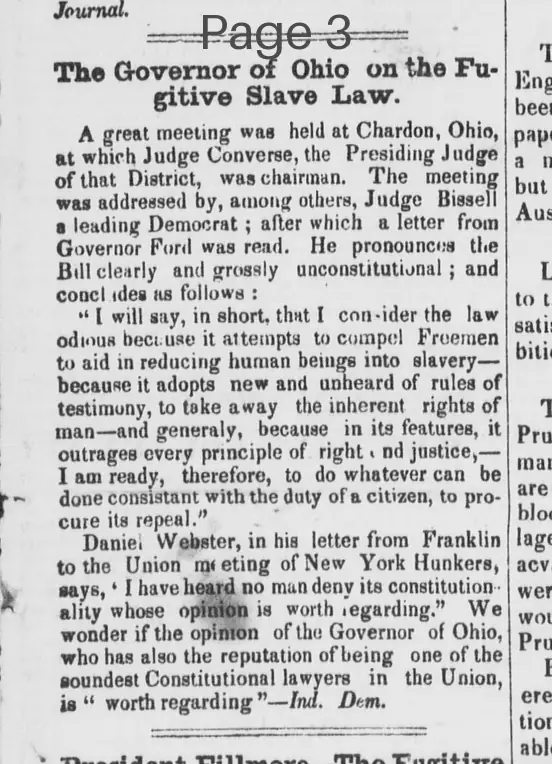
A great meeting was held at Chardon, Ohio, at which Judge Converse, the Presiding Judge of that District, was chairman. The meeting was addressed by, among others, Judge Bissell, a leading Democrat; after which a letter from Governor Ford was read. He pronounces the Bill clearly and grossly unconstitutional; and concludes as follows:
"I will say, in short, that I consider the law odious because it attempts to compel Freemen to aid in reducing human beings into slavery—because it adopts new and unheard of rules of testimony, to take away the inherent rights of man—and generally, because in its features, it outrages every principle of right and justice,—I am ready, therefore, to do whatever can be done consistent with the duty of a citizen, to procure its repeal."
Daniel Webster, in his letter from Franklin to the Union meeting of New York Hunkers, says, 'I have heard no man deny its constitutionality whose opinion is worth regarding.' We wonder if the opinion of the Governor of Ohio, who has also the reputation of being one of the soundest Constitutional lawyers in the Union, is "worth regarding"—Ind. Dem.
What sub-type of article is it?
What keywords are associated?
What entities or persons were involved?
Where did it happen?
Domestic News Details
Primary Location
Chardon, Ohio
Key Persons
Outcome
governor ford pledges to procure repeal of the fugitive slave law, denouncing it as unconstitutional and odious.
Event Details
A great meeting held at Chardon, Ohio, chaired by Judge Converse, addressed by Judge Bissell and others, where a letter from Governor Ford was read pronouncing the Fugitive Slave Bill unconstitutional. The letter concludes that the law is odious for compelling freemen to aid in slavery, adopting unfair testimony rules, and outraging principles of right and justice. The text contrasts this with Daniel Webster's statement supporting its constitutionality.