Thank you for visiting SNEWPapers!
Sign up free
Editorial
May 10, 1906
Rock Island Argus
Rock Island, Rock Island County County, Illinois
What is this article about?
Editorial defends the right to criticize federal courts, highlighting Republican hypocrisy: in 1896 they decried such criticism as anarchism, but now their president attacks Judge Humphrey without backlash. Courts are human and reviewable.
Clipping
OCR Quality
88%
Good
Full Text
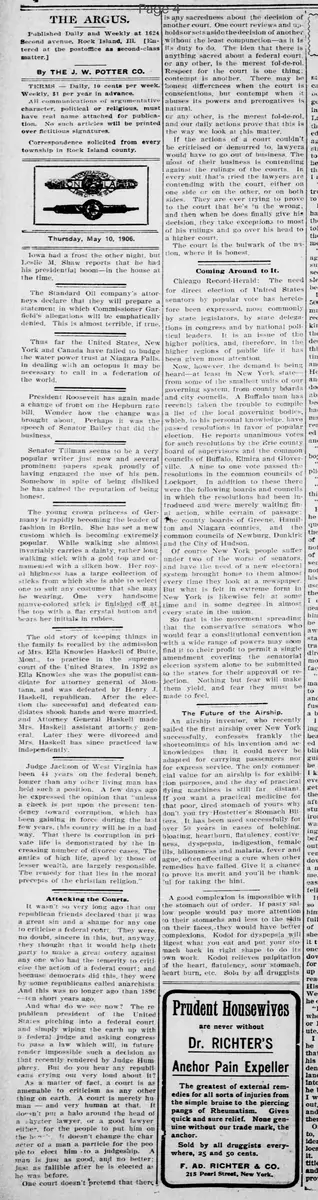
Attacking the Courts.
It wasn't so very long ago that our republican friends declared that it was a great sin and a shame for any one to criticise a federal court. They were, no doubt, sincere in this, but, anyway, they thought that it would help their party to make a great outcry against any one who had the temerity to criticise the action of a federal court: and because democrats did this, they were by some republicans called anarchists. And this was no longer ago than 1896 --ten short years ago.
And what do we see now? The republican president of the United States pitching into a federal court and simply wiping the earth up with a federal judge and asking congress to pass a law which will, in future, render impossible such a decision as that recently rendered by Judge Humphrey. But do you hear any republicans crying out very loud about it?
As a matter of fact, a court is as amenable to criticism as any other thing on earth. A court is merely human - and very human at that. It doesn't put a halo around the head of a shyster lawyer, or a good lawyer either, for the people to put him on the bench. It doesn't change the character of a man a particle for the people to elect him to a judgeship. A man is just as good, and no better; just as fallible after he is elected as he was before.
One court doesn't pretend that there is any sacredness about the decision of another court. One court reviews and upholds or sets aside the decision of another without the least compunction-as it is its duty to do. The idea that there is anything sacred about a federal court, or any other, is the merest fol-de-rol.
Respect for the court is one thing: contempt is another. There may be honest differences when the court is conscientious, but contempt when it abuses its powers and prerogatives is natural.
or any other, is the merest fol-de-rol and our daily actions prove that this is the way we look at this matter
If the actions of a court couldn't be criticised or demurred to, lawyers would have to go out of business. The most of their business is contending against the rulings of the courts. In every suit that's tried the lawyers are contending with the court, either on one side or on the other, or on both sides. They are ever trying to prove to the court that he's in the wrong, and then when he does finally give his decision, they take exceptions to most of his rulings and go over his head to a higher court.
The court is the bulwark of the nation, where it is honest
It wasn't so very long ago that our republican friends declared that it was a great sin and a shame for any one to criticise a federal court. They were, no doubt, sincere in this, but, anyway, they thought that it would help their party to make a great outcry against any one who had the temerity to criticise the action of a federal court: and because democrats did this, they were by some republicans called anarchists. And this was no longer ago than 1896 --ten short years ago.
And what do we see now? The republican president of the United States pitching into a federal court and simply wiping the earth up with a federal judge and asking congress to pass a law which will, in future, render impossible such a decision as that recently rendered by Judge Humphrey. But do you hear any republicans crying out very loud about it?
As a matter of fact, a court is as amenable to criticism as any other thing on earth. A court is merely human - and very human at that. It doesn't put a halo around the head of a shyster lawyer, or a good lawyer either, for the people to put him on the bench. It doesn't change the character of a man a particle for the people to elect him to a judgeship. A man is just as good, and no better; just as fallible after he is elected as he was before.
One court doesn't pretend that there is any sacredness about the decision of another court. One court reviews and upholds or sets aside the decision of another without the least compunction-as it is its duty to do. The idea that there is anything sacred about a federal court, or any other, is the merest fol-de-rol.
Respect for the court is one thing: contempt is another. There may be honest differences when the court is conscientious, but contempt when it abuses its powers and prerogatives is natural.
or any other, is the merest fol-de-rol and our daily actions prove that this is the way we look at this matter
If the actions of a court couldn't be criticised or demurred to, lawyers would have to go out of business. The most of their business is contending against the rulings of the courts. In every suit that's tried the lawyers are contending with the court, either on one side or on the other, or on both sides. They are ever trying to prove to the court that he's in the wrong, and then when he does finally give his decision, they take exceptions to most of his rulings and go over his head to a higher court.
The court is the bulwark of the nation, where it is honest
What sub-type of article is it?
Legal Reform
Partisan Politics
What keywords are associated?
Court Criticism
Federal Judges
Republican Hypocrisy
Judicial Fallibility
Legal Review
What entities or persons were involved?
Republicans
Democrats
Republican President
Federal Court
Judge Humphrey
Editorial Details
Primary Topic
Defense Of Criticizing Federal Courts
Stance / Tone
Critical Of Republican Hypocrisy, Supportive Of Court Criticism
Key Figures
Republicans
Democrats
Republican President
Federal Court
Judge Humphrey
Key Arguments
Republicans In 1896 Condemned Criticism Of Federal Courts As Anarchism
Current Republican President Criticizes Federal Judge Without Republican Outcry
Courts Are Human And Fallible, Amenable To Criticism
No Sacredness In Court Decisions; Higher Courts Review Lower Ones
Contempt For Courts Abusing Power Is Natural
Lawyers' Business Relies On Challenging Court Rulings