Thank you for visiting SNEWPapers!
Sign up free
Story
June 25, 1896
The Bryan Daily Eagle
Bryan, Brazos County, Texas
What is this article about?
Historical article on privateering as a tool for weak naval powers, tracing its origins to ancient times, US advocacy for its abolition in international treaties, and its limited use in the US Civil War by the Confederacy, including the capture of the steamboat Chesapeake.
Clipping
OCR Quality
95%
Excellent
Full Text
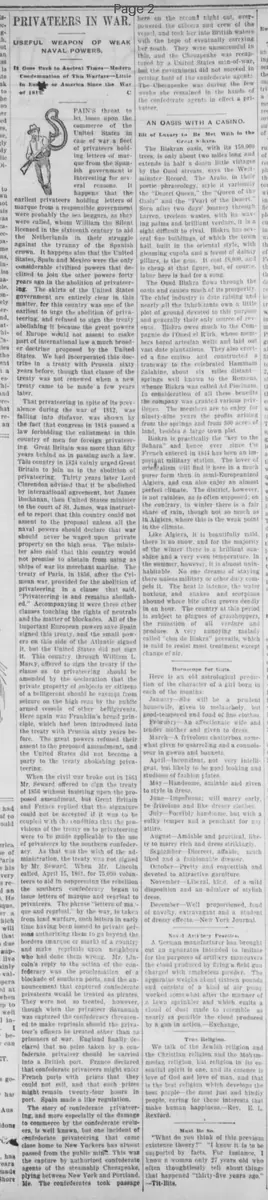
PRIVATEERS IN WAR.
USEFUL WEAPON OF WEAK NAVAL POWERS.
It Goes Back to Ancient Times—Modern Condemnation of This Warfare—Little in East or America Since the War of 1812.
Spain's threat to let loose upon the commerce of the United States in case of war a fleet of privateers holding letters of marque from the Spanish government is interesting for several reasons. It happens that the earliest privateers holding letters of marque from a responsible government were probably the sea beggars, as they were called, whom William the Silent licensed in the sixteenth century to aid the Netherlands in their struggle against the tyranny of the Spanish crown. It happens also that the United States, Spain and Mexico were the only considerable civilized powers that declined to join the other powers forty years ago in the abolition of privateering. The skirts of the United States government are entirely clear in this matter, for this country was one of the earliest to urge the abolition of privateering, and refused to sign the treaty abolishing it because the great powers of Europe would not assent to make part of international law a much broader doctrine proposed by the United States. We had incorporated this doctrine in a treaty with Prussia sixty years before, though that clause of the treaty was not renewed when a new treaty came to be made a few years later.
That privateering in spite of its prevalence during the war of 1812, was falling into disfavor, was shown by the fact that congress in 1818 passed a law forbidding the enlistment in this country of men for foreign privateering. Great Britain was more than fifty years behind us in passing such a law. This country in 1824 vainly urged Great Britain to join us in the abolition of privateering. Thirty years later Lord Clarendon advised that it be abolished by international agreement, but James Buchanan, then United States minister to the court of St. James, was instructed to report that this country could not assent to the proposal unless all the naval powers should declare that war should never be waged upon private property on the high seas. The minister also said that this country would not promise to abstain from using as ships of war its merchant marine. The treaty of Paris, in 1856, after the Crimean war, provided for the abolition of privateering in a clause that said, "Privateering is and remains abolished." Accompanying it were three other clauses touching the rights of neutrals and the matter of blockades. All of the important European powers save Spain signed this treaty, and the small powers on this side of the Atlantic signed it, but the United States did not sign it. This country, through William L. Marcy, offered to sign the treaty if the clause as to privateering should be amended by the declaration that the private property of subjects or citizens of a belligerent should be exempt from seizure on the high seas by the public armed vessels of other belligerents. Here again was Franklin's broad principle, which had been introduced into the treaty with Prussia sixty years before. The great powers refused their assent to the proposed amendment, and the United States did not become a party to the treaty abolishing privateering.
When the civil war broke out in 1861 Mr. Seward offered to sign the treaty of 1856 without insisting upon the proposed amendment, but Great Britain and France replied that the signature could not be accepted if it was to be coupled with the condition that the provisions of the treaty as to privateering were to be made applicable to the use of privateers by the southern confederacy. As that was the wish of the administration, the treaty was not signed by Mr. Seward. When Mr. Lincoln called, April 15, 1861, for 75,000 volunteers to aid in suppressing the rebellion the southern confederacy began to issue letters of marque and reprisal to privateers. The phrase "letters of marque and reprisal," by the way, is taken from land warfare, such letters in early time having been issued to private persons authorizing them to go beyond the borders (marque or mark) of a country and make reprisals upon neighbors who had done them wrong. Mr. Lincoln's reply to the action of the confederacy was the proclamation of a blockade of southern ports, and the announcement that captured confederate privateers would be treated as pirates. They were not so treated, however, though when the privateer Savannah was captured the confederacy threatened to make reprisals should the privateer's officers be treated other than as prisoners of war. England finally declared that no prize taken by a confederate privateer should be carried into a British port. France declared that confederate privateers might enter French ports with prizes that they could not sell, and that such prizes might remain twenty-four hours in port. Spain made a like regulation.
The story of confederate privateering, and more especially of the damage to commerce by the confederate cruisers, is well known, but one incident of confederate privateering that came close home to New Yorkers has almost passed from the public mind. This was the capture by authorized confederate agents of the steamboat Chesapeake, plying between New York and Portland, Me. The confederates took passage here on the second night out, overpowered the officers and crew of the vessel, and took her into British waters with the hope of eventually carrying her south. They were unsuccessful in this, and the Chesapeake was recaptured by a United States man-of-war, but the government did not succeed in getting hold of the confederate agents. The Chesapeake was during the few weeks she remained in the hands of the confederate agents ineffectual privateer.
USEFUL WEAPON OF WEAK NAVAL POWERS.
It Goes Back to Ancient Times—Modern Condemnation of This Warfare—Little in East or America Since the War of 1812.
Spain's threat to let loose upon the commerce of the United States in case of war a fleet of privateers holding letters of marque from the Spanish government is interesting for several reasons. It happens that the earliest privateers holding letters of marque from a responsible government were probably the sea beggars, as they were called, whom William the Silent licensed in the sixteenth century to aid the Netherlands in their struggle against the tyranny of the Spanish crown. It happens also that the United States, Spain and Mexico were the only considerable civilized powers that declined to join the other powers forty years ago in the abolition of privateering. The skirts of the United States government are entirely clear in this matter, for this country was one of the earliest to urge the abolition of privateering, and refused to sign the treaty abolishing it because the great powers of Europe would not assent to make part of international law a much broader doctrine proposed by the United States. We had incorporated this doctrine in a treaty with Prussia sixty years before, though that clause of the treaty was not renewed when a new treaty came to be made a few years later.
That privateering in spite of its prevalence during the war of 1812, was falling into disfavor, was shown by the fact that congress in 1818 passed a law forbidding the enlistment in this country of men for foreign privateering. Great Britain was more than fifty years behind us in passing such a law. This country in 1824 vainly urged Great Britain to join us in the abolition of privateering. Thirty years later Lord Clarendon advised that it be abolished by international agreement, but James Buchanan, then United States minister to the court of St. James, was instructed to report that this country could not assent to the proposal unless all the naval powers should declare that war should never be waged upon private property on the high seas. The minister also said that this country would not promise to abstain from using as ships of war its merchant marine. The treaty of Paris, in 1856, after the Crimean war, provided for the abolition of privateering in a clause that said, "Privateering is and remains abolished." Accompanying it were three other clauses touching the rights of neutrals and the matter of blockades. All of the important European powers save Spain signed this treaty, and the small powers on this side of the Atlantic signed it, but the United States did not sign it. This country, through William L. Marcy, offered to sign the treaty if the clause as to privateering should be amended by the declaration that the private property of subjects or citizens of a belligerent should be exempt from seizure on the high seas by the public armed vessels of other belligerents. Here again was Franklin's broad principle, which had been introduced into the treaty with Prussia sixty years before. The great powers refused their assent to the proposed amendment, and the United States did not become a party to the treaty abolishing privateering.
When the civil war broke out in 1861 Mr. Seward offered to sign the treaty of 1856 without insisting upon the proposed amendment, but Great Britain and France replied that the signature could not be accepted if it was to be coupled with the condition that the provisions of the treaty as to privateering were to be made applicable to the use of privateers by the southern confederacy. As that was the wish of the administration, the treaty was not signed by Mr. Seward. When Mr. Lincoln called, April 15, 1861, for 75,000 volunteers to aid in suppressing the rebellion the southern confederacy began to issue letters of marque and reprisal to privateers. The phrase "letters of marque and reprisal," by the way, is taken from land warfare, such letters in early time having been issued to private persons authorizing them to go beyond the borders (marque or mark) of a country and make reprisals upon neighbors who had done them wrong. Mr. Lincoln's reply to the action of the confederacy was the proclamation of a blockade of southern ports, and the announcement that captured confederate privateers would be treated as pirates. They were not so treated, however, though when the privateer Savannah was captured the confederacy threatened to make reprisals should the privateer's officers be treated other than as prisoners of war. England finally declared that no prize taken by a confederate privateer should be carried into a British port. France declared that confederate privateers might enter French ports with prizes that they could not sell, and that such prizes might remain twenty-four hours in port. Spain made a like regulation.
The story of confederate privateering, and more especially of the damage to commerce by the confederate cruisers, is well known, but one incident of confederate privateering that came close home to New Yorkers has almost passed from the public mind. This was the capture by authorized confederate agents of the steamboat Chesapeake, plying between New York and Portland, Me. The confederates took passage here on the second night out, overpowered the officers and crew of the vessel, and took her into British waters with the hope of eventually carrying her south. They were unsuccessful in this, and the Chesapeake was recaptured by a United States man-of-war, but the government did not succeed in getting hold of the confederate agents. The Chesapeake was during the few weeks she remained in the hands of the confederate agents ineffectual privateer.
What sub-type of article is it?
Historical Event
Military Action
What themes does it cover?
Justice
Moral Virtue
What keywords are associated?
Privateering
Letters Of Marque
War Of 1812
Civil War
Confederate Privateers
Treaty Of Paris
Chesapeake Capture
What entities or persons were involved?
William The Silent
James Buchanan
William L. Marcy
Mr. Seward
Mr. Lincoln
Lord Clarendon
Where did it happen?
High Seas, United States, Europe, Southern Ports
Story Details
Key Persons
William The Silent
James Buchanan
William L. Marcy
Mr. Seward
Mr. Lincoln
Lord Clarendon
Location
High Seas, United States, Europe, Southern Ports
Event Date
Sixteenth Century To 1861
Story Details
Overview of privateering history, from sea beggars in the 16th century to Confederate use in the Civil War, including US efforts to abolish it via treaties like Paris 1856, and the Chesapeake capture incident.