Thank you for visiting SNEWPapers!
Sign up free
Gazette Of The United States
New York, New York County, New York
What is this article about?
Satirical essay in letter form by J. Courtenay to Rev. Dr. Priestley, condemning the French Revolution as caused by atheistic philosophers like Voltaire and Rousseau, who undermined religion and monarchy. Warns against English dissenters promoting similar radical ideas, exaggerating their influence globally.
Merged-components note: Continuation of the philosophical reflections on the French Revolution across pages 1 and 2, indicated by seamless text flow and 'TO BE CONTINUED'.
Clippings
1 of 2
OCR Quality
Full Text
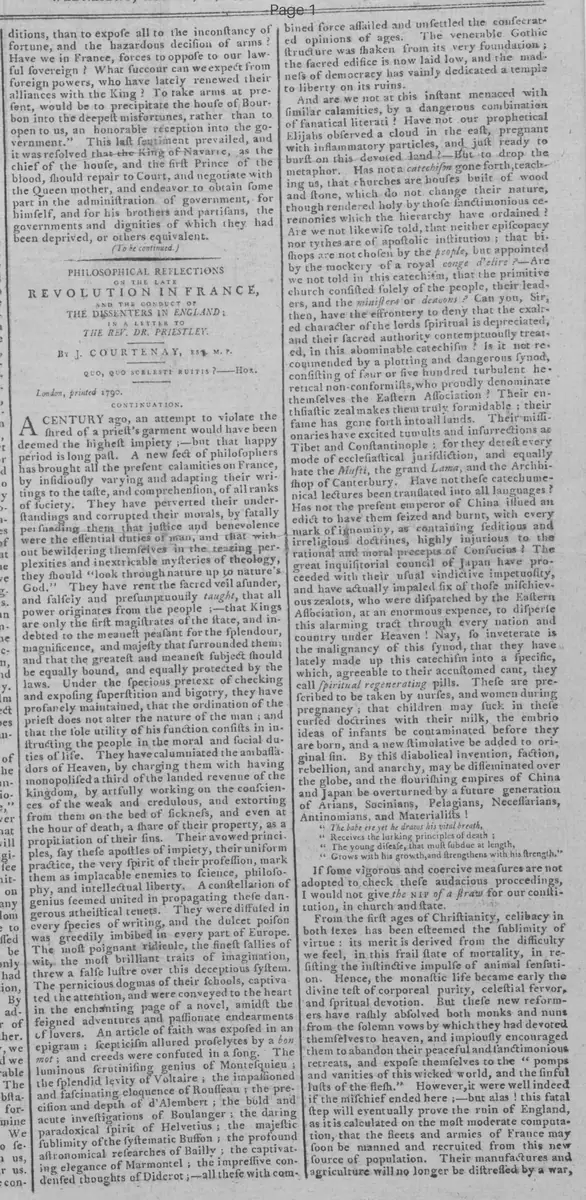
ON THE LATE
REVOLUTION IN FRANCE
AND THE CONDUCT OF
THE DISSENTERS IN ENGLAND;
IN A LETTER TO
THE REV. DR. PRIESTLEY.
By J. COURTENAY,
ESQ.
M.P.
QUO, QUO SCELESTI RUITIS?
HOR.
London, printed 1790.
A CENTURY ago, an attempt to violate the shred of a priest's garment would have been deemed the highest impiety;—but that happy period is long past. A new sect of philosophers has brought all the present calamities on France, by insidiously varying and adapting their writings to the taste, and comprehension, of all ranks of society.
They have perverted their understandings and corrupted their morals, by fatally persuading them that justice and benevolence were the essential duties of man, and that without bewildering themselves in the teazing perplexities and inextricable mysteries of theology, they should "look through nature up to nature's God."
They have rent the sacred veil asunder, and insidiously and presumptuously taught, that all power originates from the people; that Kings are only the first magistrates of the state, and indebted to the meanest peasant for the splendour, magnificence, and majesty that surrounded them; and that the greatest and meanest subject should be equally bound, and equally protected by the laws.
Under the specious pretext of checking and exposing superstition and bigotry, they have profanely maintained, that the ordination of the priest does not alter the nature of the man; and that the sole utility of his function consists in instructing the people in the moral and social duties of life.
They have calumniated the ambassadors of Heaven, by charging them with having monopolised a third of the landed revenue of the kingdom, by artfully working on the consciences of the weak and credulous, and extorting from them on the bed of sickness, and even at the hour of death, a share of their property, as a propitiation of their sins.
Their avowed principles, as these apostles of impiety, their uniform practice, the very spirit of their profession, mark them as implacable enemies to science, philosophy, and intellectual liberty.
A constellation of genius seemed united in propagating these dangerous atheistical tenets. They were diffused in every species of writing, and the dulcet poison was greedily imbibed in every part of Europe.
The wit, the most brilliant traits of imagination, the most poignant ridicule, the finest fallacies of argument, threw a false lustre over this deceptious system.
The pernicious dogmas of their schools, captivated the attention, and were conveyed to the heart in the enchanting page of a novel, amidst the feigned adventures and passionate endearments of lovers.
An article of faith was exposed in an epigram; scepticism allured proselytes by a bon mot; and creeds were confuted in a song.
The luminous scrutinising genius of Montesquieu; the splendid levity of Voltaire; the impassioned and fascinating eloquence of Rousseau; the precision and depth of d'Alembert; the bold and acute investigations of Boulanger; the daring paradoxical spirit of Helvetius; the majestic sublimity of the systematic Buffon; the profound astonishing elegance of Marmontel; the impressive astronomical researches of Bailly; the captivating, undefined thoughts of Diderot;-all these with combined force assailed and unsettled the consecrated opinions of ages.
The venerable Gothic structure was shaken from its very foundation; the sacred edifice is now laid low, and the madness of democracy has vainly dedicated a temple to liberty on its ruins.
And are we not at this instant menaced with similar calamities, by a dangerous combination of fanatical literati! Have not our prophetical Elijahs observed a cloud in the east, pregnant with inflammatory particles, and just ready to burst on this devoted land?-But to drop the metaphor.
Has not a catechism gone forth, teaching us, that churches are houses built of wood and stone, which do not change their nature, though rendered holy by those sanctimonious ceremonies which the hierarchy have ordained?
Are we not likewise told, that neither episcopacy nor tythes are of apostolic institution; that bi- shops are not chosen by the people, but appointed by the mockery of a royal conge d'elire?-Are we not told in this catechism, that the primitive church consisted solely of the people, their leaders, and the ministers or deacons?
Can you, Sir, then, have the effrontery to deny that the exalted character of the lords spiritual is depreciated, and their sacred authority contemptuously treated, in this abominable catechism?
Is it not recommended by a plotting and dangerous synod, consisting of four or five hundred turbulent heretical non-conformists, who proudly denominate themselves the Eastern Association?
Their enthusiastic zeal makes them truly formidable; their fame has gone forth into all lands.
Their missionaries have excited tumults and insurrections at Tibet and Constantinople; for they detest every mode of ecclesiastical jurisdiction, and equally hate the Mufti, the grand Lama, and the Archbishop of Canterbury.
Have not these catechumenical lectures been translated into all languages?
Has not the present emperor of China issued an edict to have them seized and burnt, with every mark of ignominy, as containing seditious and irreligious doctrines, highly injurious to the rational and moral precepts of Confucius?
The great inquiritorial council of Japan have proceeded with their usual vindictive impetuosity, and have actually impaled six of those mischievous zealots, who were dispatched by the Eastern Association, at an enormous expence, to disperse this alarming tract through every nation and country under Heaven!
Nay, so inveterate is the malignancy of this synod, that they have lately made up this catechism into a specific, which, agreeable to their accustomed cant, they call Spiritual regenerating pills.
These are prescribed to be taken by nurses, and women during pregnancy; that children may suck in these accursed doctrines with their milk, the embryo ideas of infants be contaminated before they are born, and a new stimulus be added to original sin.
By this diabolical invention, faction, rebellion, and anarchy, may be disseminated over the globe, and the flourishing empires of China and Japan be overturned by a future generation of Arians, Socinians, Pelagians, Necearians, Antinomians, and Materialists!
"The babe ere yet he draws his vital breath,
Receives the lurking principles of death;
The young disease, that must subdue at length,
Grows with his growth, and strengthens with his strength."
If some vigorous and coercive measures are not adopted to check these audacious proceedings, I would not give the nip of a straw for our constitution, in church and state.
From the first ages of Christianity, celibacy in both sexes has been esteemed the sublimity of virtue: its merit is derived from the difficulty we feel, in this frail state of mortality, in resisting the instinctive impulse of animal enation.
Hence, the monastic life became early the divine test of corporeal purity, celestial fervor, and spiritual devotion.
But these new reformers have rashly absolved both monks and nuns from the solemn vows by which they had devoted themselves to heaven, and impiously encouraged them to abandon their peaceful and sanctimonious retreats, and expose themselves to the "pomps and vanities of this wicked world, and the sinful lusts of the flesh."
However, it were well indeed if the mischief ended here: but alas! this fatal step will eventually prove the ruin of England, as it is calculated on the most moderate computation, that the fleets and armies of France may soon be manned and recruited from this new source of population.
Their manufactures and agriculture will no longer be distressed by a war,
as it may be carried on with vigor and facility
without calling a single man from the plough or
loom. Our most experienced statesmen, our wis-
est patriots, our most enlightened senators, are
convinced of this melancholy truth: The French
Revolution is therefore generally execrated—
and has only received the contemptible plaudits
of an obscure society, composed of atheistical dis-
senters, republican deists, and levelling free-
thinkers, who impatiently long for the destruc-
tion of our civil and ecclesiastical establishment.
The celebrated Mr. Necker has sagaciously ob-
served, that it daily became more requisite than
ever, to inculcate the general dictates of religion
on the minds of the people, as the only effectual
consolation to support them under the weight of
oppressive, unequal, and impoverishing taxation.
But the necessity of enforcing this pious doctrine
is unhappily done away, as a redress of grievan-
ces, and a restoration of rights have already taken
place—and it is a melancholy truth, that revolu-
tionary felicity makes but a slight impression on
those who have a prospect of enjoying the com-
forts of this life. The celestial specific so ear-
estly recommended by Mr. Necker derives its
vital efficacy from the exertions of arbitrary pow-
er, which compels us to purchase eternal joy by
a few years misery in this transitory state of pro-
bation. The priesthood, influenced by this sacred
motive, have ever been the zealous advocates of
despotism, except when their own privileges and
immunities are endangered—as in such a predic-
ament, they are precluded from exercising their
own judgment, and only act as trustees and dele-
gates for the rights of heaven.
The late emperor, Joseph the Great, who aston-
ished the world by the sublimity of his genius and
the grandeur of his actions, not adverting to this
political axiom, seems to have committed a fatal
error, in not conciliating the affections, and se-
curing the attachment of the church (and perhaps
the law) before he commenced his comprehen-
sive and beneficent system of government in the
Austrian Netherlands.
TO BE CONTINUED.
What sub-type of article is it?
What themes does it cover?
What keywords are associated?
What entities or persons were involved?
Literary Details
Title
Philosophical Reflections On The Late Revolution In France And The Conduct Of The Dissenters In England; In A Letter To The Rev. Dr. Priestley.
Author
By J. Courtenay, Esq. M.P.
Subject
In A Letter To The Rev. Dr. Priestley
Form / Style
Satirical Prose Essay In Epistolary Form
Key Lines