Thank you for visiting SNEWPapers!
Sign up free
Editorial
November 28, 1860
The Evansville Daily Journal
Evansville, Vanderburgh County, Indiana
What is this article about?
An editorial reassures farmers and others amid the 1859 financial panic, citing low northern debt, good crops, and bankers' confidence in New York and Boston as signs of recovery by spring, dismissing fears of union dissolution.
Clipping
OCR Quality
95%
Excellent
Full Text
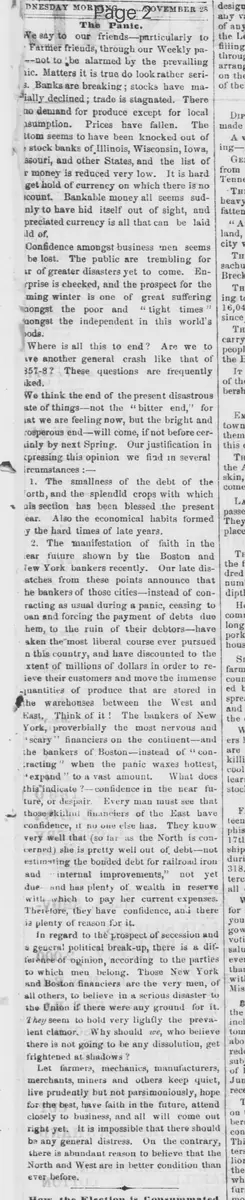
The Panic.
We say to our friends—particularly to our Farmer friends, through our Weekly paper—not to be alarmed by the prevailing panic. Matters it is true do look rather serious. Banks are breaking; stocks have materially declined; trade is stagnated. There is no demand for produce except for local consumption. Prices have fallen. The bottom seems to have been knocked out of stock banks of Illinois, Wisconsin, Iowa, Missouri, and other States, and the list of broken banks is daily increasing. The currency for money is reduced very low. It is hard to get hold of currency on which there is no discount. Bankable money all seems suddenly to have hid itself out of sight, and depreciated currency is all that can be laid hold of.
Confidence amongst business men seems to be lost. The public are trembling for fear of greater disasters yet to come. Enterprise is checked, and the prospect for the coming winter is one of great suffering amongst the poor and 'tight times' amongst the independent in this world's goods.
Where is all this to end? Are we to have another general crash like that of 1857-8? These questions are frequently asked.
We think the end of the present disastrous state of things—not the 'bitter end,' for that we are feeling now, but the bright and prosperous end—will come, if not before, certainly by next Spring. Our justification in expressing this opinion we find in several circumstances:—
1. The smallness of the debt of the North, and the splendid crops with which this section has been blessed the present year. Also the economical habits formed by the hard times of late years.
2. The manifestation of faith in the near future shown by the Boston and New York bankers recently. Our late dispatches from these points announce that the bankers of those cities—instead of contracting as usual during a panic, ceasing to loan and forcing the payment of debts due them, to the ruin of their debtors—have taken the most liberal course ever pursued in this country, and have discounted to the extent of millions of dollars in order to relieve their customers and move the immense quantities of produce that are stored in the warehouses between the West and East. Think of it! The bankers of New York, proverbially the most nervous and 'scary' financiers on the continent—and the bankers of Boston—instead of 'contracting' when the panic waxes hottest, 'expand,' to a vast amount. What does this indicate?—confidence in the near future, or despair. Every man must see that those skillful, trimners of the East have confidence, if no one else has. They know very well that (so far as the North is concerned) she is pretty well out of debt—not estimating the bonded debt for railroad iron and 'internal improvements,' not yet due—and has plenty of wealth in reserve with which to pay her current expenses. Therefore, they have confidence, and there is plenty of reason for it.
In regard to the prospect of secession and a general political break-up, there is a difference of opinion, according to the parties to which men belong. Those New York and Boston financiers are the very men, of all others, to believe in a serious disaster to the Union if there were any ground for it. They seem to hold very lightly the prevalent clamor. Why should we, who believe there is not going to be any dissolution, get frightened at shadows?
Let farmers, mechanics, manufacturers, merchants, miners and others keep quiet, live prudently but not parsimoniously, hope for the best, have faith in the future, attend closely to business, and all will come out right yet. It is impossible that there should be any general distress. On the contrary, there is abundant reason to believe that the North and West are in better condition than ever before.
We say to our friends—particularly to our Farmer friends, through our Weekly paper—not to be alarmed by the prevailing panic. Matters it is true do look rather serious. Banks are breaking; stocks have materially declined; trade is stagnated. There is no demand for produce except for local consumption. Prices have fallen. The bottom seems to have been knocked out of stock banks of Illinois, Wisconsin, Iowa, Missouri, and other States, and the list of broken banks is daily increasing. The currency for money is reduced very low. It is hard to get hold of currency on which there is no discount. Bankable money all seems suddenly to have hid itself out of sight, and depreciated currency is all that can be laid hold of.
Confidence amongst business men seems to be lost. The public are trembling for fear of greater disasters yet to come. Enterprise is checked, and the prospect for the coming winter is one of great suffering amongst the poor and 'tight times' amongst the independent in this world's goods.
Where is all this to end? Are we to have another general crash like that of 1857-8? These questions are frequently asked.
We think the end of the present disastrous state of things—not the 'bitter end,' for that we are feeling now, but the bright and prosperous end—will come, if not before, certainly by next Spring. Our justification in expressing this opinion we find in several circumstances:—
1. The smallness of the debt of the North, and the splendid crops with which this section has been blessed the present year. Also the economical habits formed by the hard times of late years.
2. The manifestation of faith in the near future shown by the Boston and New York bankers recently. Our late dispatches from these points announce that the bankers of those cities—instead of contracting as usual during a panic, ceasing to loan and forcing the payment of debts due them, to the ruin of their debtors—have taken the most liberal course ever pursued in this country, and have discounted to the extent of millions of dollars in order to relieve their customers and move the immense quantities of produce that are stored in the warehouses between the West and East. Think of it! The bankers of New York, proverbially the most nervous and 'scary' financiers on the continent—and the bankers of Boston—instead of 'contracting' when the panic waxes hottest, 'expand,' to a vast amount. What does this indicate?—confidence in the near future, or despair. Every man must see that those skillful, trimners of the East have confidence, if no one else has. They know very well that (so far as the North is concerned) she is pretty well out of debt—not estimating the bonded debt for railroad iron and 'internal improvements,' not yet due—and has plenty of wealth in reserve with which to pay her current expenses. Therefore, they have confidence, and there is plenty of reason for it.
In regard to the prospect of secession and a general political break-up, there is a difference of opinion, according to the parties to which men belong. Those New York and Boston financiers are the very men, of all others, to believe in a serious disaster to the Union if there were any ground for it. They seem to hold very lightly the prevalent clamor. Why should we, who believe there is not going to be any dissolution, get frightened at shadows?
Let farmers, mechanics, manufacturers, merchants, miners and others keep quiet, live prudently but not parsimoniously, hope for the best, have faith in the future, attend closely to business, and all will come out right yet. It is impossible that there should be any general distress. On the contrary, there is abundant reason to believe that the North and West are in better condition than ever before.
What sub-type of article is it?
Economic Policy
Agriculture
What keywords are associated?
Financial Panic
Bank Failures
Economic Recovery
Northern Crops
Banker Confidence
Union Stability
What entities or persons were involved?
Boston Bankers
New York Bankers
Farmers
North
West
Editorial Details
Primary Topic
Reassurance During Financial Panic
Stance / Tone
Optimistic And Reassuring
Key Figures
Boston Bankers
New York Bankers
Farmers
North
West
Key Arguments
Small Northern Debt And Splendid Crops Ensure Recovery
Economical Habits From Recent Hard Times Aid Resilience
Bankers In Boston And New York Are Expanding Loans, Showing Confidence
No Serious Threat Of Union Dissolution
Advice To Maintain Prudence And Faith For Better Times