Thank you for visiting SNEWPapers!
Sign up free
The New York Packet
New York, New York County, New York
What is this article about?
An extract from a 1787 letter praises the Society for relieving small debtors' work in a New York gaol, where diverse religious men provide aid. It critiques harsh English-derived debtor imprisonment laws for causing undue suffering and calls for milder, more benevolent legislation in the young United States.
Clipping
OCR Quality
Full Text
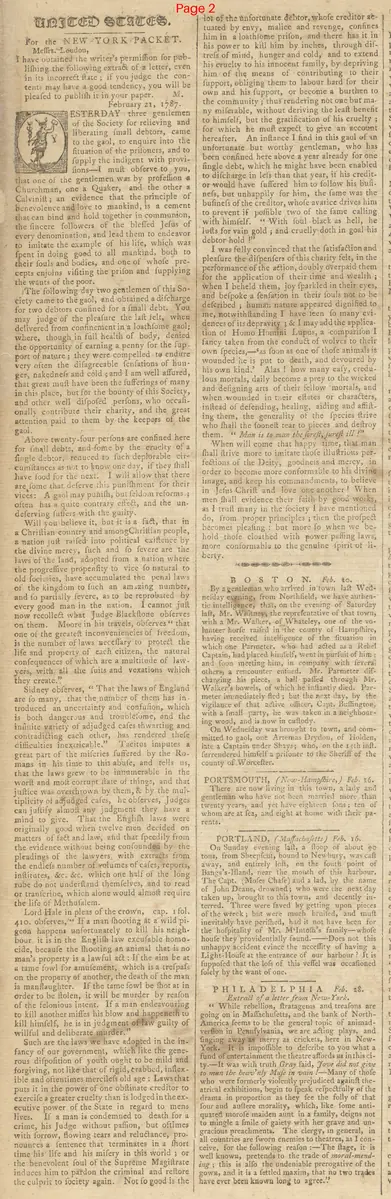
For the NEW-YORK PACKET.
Messrs. Loudon,
I have obtained the writer's permission for publishing the following extract of a letter, even in its incorrect state; if you judge the contents may have a good tendency, you will be pleased to publish it in your paper.
M.
February 21, 1787.
YESTERDAY three gentlemen of the Society for relieving and liberating small debtors, came to the gaol, to enquire into the situation of the prisoners, and to supply the indigent with provisions—I must observe to you, that one of the gentlemen was by profession a Churchman, one a Quaker, and the other a Calvinist: an evidence that the principle of benevolence and love to mankind, is a cement that can bind and hold together in communion, the sincere followers of the blessed Jesus of every denomination, and lead them to endeavor to imitate the example of his life, which was spent in doing good to all mankind, both to their souls and bodies, and one of whose precepts enjoins visiting the prison and supplying the wants of the poor.
The following day two gentlemen of this Society came to the gaol, and obtained a discharge for two debtors confined for a small debt. You may judge of the pleasure the last felt, when delivered from confinement in a loathsome gaol; where, though in full health of body, denied the opportunity of earning a penny for the support of nature; they were compelled to endure very often the disagreeable sensations of hunger, nakedness and cold; and I am well assured that great must have been the sufferings of many in this place, but for the bounty of this Society, and other well disposed persons, who occasionally contribute their charity, and the great attention paid to them by the keepers of the gaol.
Above twenty-four persons are confined here for small debts, and some by the cruelty of a single debtor, reduced to such deplorable circumstances as not to know one day, if they shall have food for the next. I will allow that there are some that deserve this punishment for their vices: A gaol may punish, but seldom reforms; often has a quite contrary effect, and the undeserving suffers with the guilty.
Will you believe it, but it is a fact, that in a Christian country and among Christian people, a nation just raised into political existence by the divine mercy, such and so severe are the laws of the land, adopted from a nation where the progressive propensity to vice so natural to old societies, have accumulated the penal laws of the kingdom to such an amazing number, and so partially severe, as to be reprobated by every good man in the nation. I cannot just now recollect what Judge Blackstone observes on them. Moore in his travels, observes "that one of the greatest inconveniencies of freedom, is the number of laws necessary to protect the life and property of each citizen, the natural consequences of which are a multitude of lawyers, with all the suits and vexations which they create."
Sidney observes, "That the laws of England are so many, that the number of them has introduced an uncertainty and confusion, which is both dangerous and troublesome, and the infinite variety of adjudged cases thwarting and contradicting each other, has rendered these difficulties inextricable." Tacitus imputes a great part of the miseries suffered by the Romans in his time to this abuse, and tells us, that the laws grew to be innumerable in the worst and most corrupt state of things, and that justice was overthrown by them, & by the multiplicity of adjudged cases, he observes, Judges can justify almost any judgment they have a mind to give. That the English laws were originally good when twelve men decided on matters of fact and law, and that speedily from the evidence without being confounded by the pleadings of the lawyers, with extracts from the endless number of volumes of cases, reports, institutes. &c. &c. which one half of the long robe do not understand themselves, and to read or transcribe, which alone would almost require the life of Methusalem.
Lord Hale in pleas of the crown, cap. fol. 410. observes, "If a man shooting at a wild pigeon happens unfortunately to kill his neighbour it is in the English law excusable homicide, because the shooting an animal that is no man's property is a lawful act: If the aim be at a tame fowl for amusement, which is a trespass on the property of another, the death of the man is manslaughter. If the tame fowl be shot at in order to be stolen, it will be murder by reason of the felonious intent. If a man endeavouring to kill another misses his blow and happeneth to kill himself, he is in judgment of law guilty of willful and deliberate murder."
Such are the laws we have adopted in the infancy of our government, which like the generous disposition of youth ought to be mild and forgiving, not like that of rigid, crabbed, inflexible and oftentimes merciless old age: Laws that puts it in the power of one obstinate creditor to exercise a greater cruelty than is lodged in the executive power of the State in regard to mens lives. If a man is condemned to death for a crime, his Judge without passion, but oftentimes with sorrow, flowing tears and reluctance, pronounces a sentence that terminates in a short time his life and his misery in this world; or the benevolent soul of the Supreme Magistrate induces him to pardon the criminal and restore the culprit to society again. Not so good is the lot of the unfortunate debtor, whose creditor actuated by envy, malice and revenge, confines him in a loathsome prison, and there has it in his power to kill him by inches, through distresses of mind, hunger and cold, and to extend his cruelty to his innocent family, by depriving him of the means of contributing to their support, obliging them to labour hard for their own and his support, or become a burthen to the community; thus rendering not one but many miserable, without deriving the least benefit to himself, but the gratification of his cruelty; for which he must expect to give an account hereafter. An instance I find in this gaol of an unfortunate but worthy gentleman, who has been confined here above a year already for one single debt, which he might have been enabled to discharge in less than that year, if his creditor would have suffered him to follow his business, but unhappily for him, the same was the business of the creditor, whose avarice drives him to prevent if possible two of the same calling with himself. "With soul black as hell, he lusts for vain gold; and cruelly doth in goal his debtor hold!"
I was fully convinced that the satisfaction and pleasure the dispensers of this charity felt, in the performance of the action, doubly overpaid them for the application of their time and wealth: when I beheld them, joy sparkled in their eyes, and bespoke a sensation in their souls not to be described: human nature appeared dignified to me, notwithstanding I have seen so many evidences of its depravity; & I may add the application of Homo Homini Lupus, a comparison I fancy taken from the conduct of wolves to their own species,—as soon as one of those animals is wounded he is put to death, and devoured by his own kind.' Alas! how many easy, credulous mortals, daily become a prey to the wicked and designing arts of their fellow mortals, and when wounded in their estates or characters, instead of defending, healing, aiding and assisting them, the generality of the species strive who shall the soonest tear to pieces and destroy them. "Man is to man the sorest, surest ill!"
When will come that happy time, that man shall strive more to imitate those illustrious perfections of the Deity, goodness and mercy, in order to become more conformable to his divine image, and keep his commandments, to believe in Jesus Christ and love one another! When men shall evidence their faith by good works, as I trust many in the society I have mentioned do, from proper principles; then the prospect becomes pleasing: but more so when we behold those clothed with power passing laws more conformable to the genuine spirit of liberty.
What sub-type of article is it?
What themes does it cover?
What keywords are associated?
What entities or persons were involved?
Letter to Editor Details
Recipient
Messrs. Loudon
Main Argument
the letter praises the charitable work of the society for relieving small debtors and strongly critiques the adoption of harsh english debtor imprisonment laws in the young united states, arguing they cause unnecessary suffering and that laws should be milder and more forgiving to reflect benevolence and liberty.
Notable Details