Thank you for visiting SNEWPapers!
Sign up free
Literary
April 19, 1814
The Rhode Island American, And General Advertiser
Providence, Providence County, Rhode Island
What is this article about?
In this tale from Disraeli's Romances, Lycidas invents music by blowing into reeds to mimic a nightingale's song, consoling the mourning Amaryllis under a myrtle tree.
Clipping
OCR Quality
82%
Good
Full Text
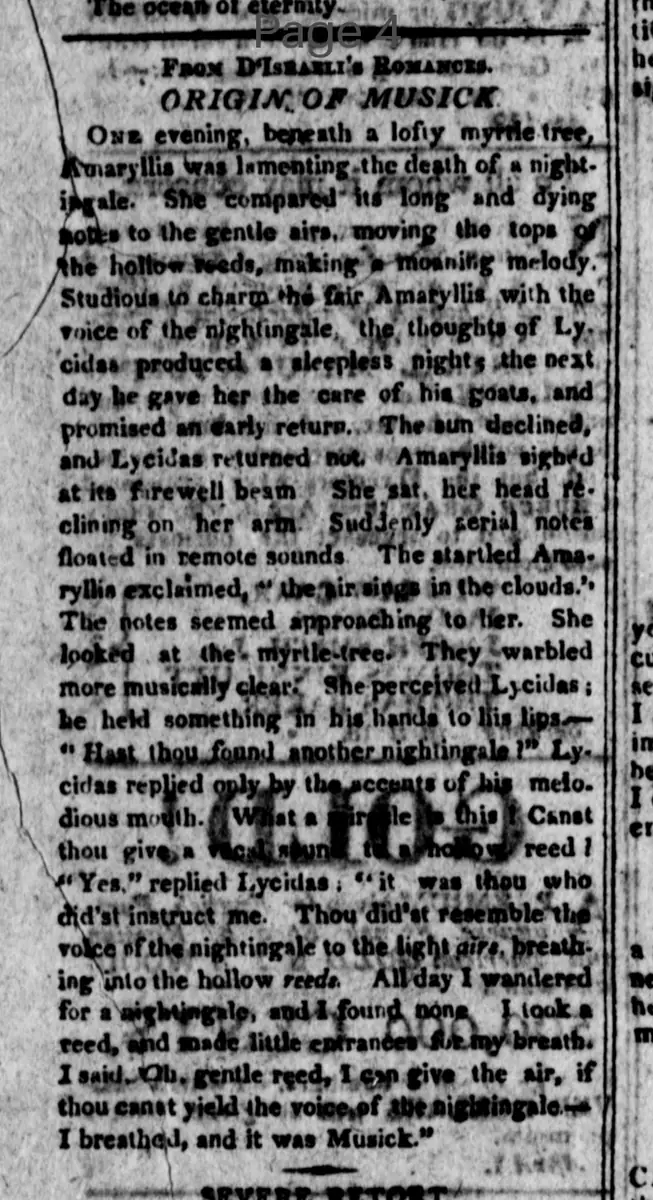
Disraeli's Romances.
Origin of Musick.
One evening, beneath a lofty myrtle tree
Amaryllis was lamenting the death of a nightingale. She compared its long and dying
notes to the gentle airs, moving the tops
the hollow reeds, making moaning melody.
Studious to charm the fair Amaryllis with the
voice of the nightingale, the thoughts of Lycidas produced sleepless nights the next
day he gave her the care of his goats, and
promised an early return. The sun declined,
and Lycidas returned not. Amaryllis sighed
at its farewell beam. She sat, her head reclining on her arm. Suddenly aerial notes
floated in remote sounds. The startled Amaryllis exclaimed, 'the air sings in the clouds.'
The notes seemed approaching to her. She
looked at the myrtle tree: They warbled
more musically clear. She perceived Lycidas:
he held something in his hands to his lips.
'Hast thou found another nightingale?' Lycidas replied only by the accents of his melody.
'Dionysius mouth
What
Le
This
Canst
Yes,' replied Lycidas: 'it was thou who
didst instruct me. Thou didst resemble the
voice of the nightingale to the light air, breathing into the hollow reeds. All day I wandered
for a nightingale, and I found none. I took a
reed, and made little entrances for my breath.
I said, O gentle reed, I can give the air, if
thou canst yield the voice of the nightingale.
I breathed, and it was Musick.'
Origin of Musick.
One evening, beneath a lofty myrtle tree
Amaryllis was lamenting the death of a nightingale. She compared its long and dying
notes to the gentle airs, moving the tops
the hollow reeds, making moaning melody.
Studious to charm the fair Amaryllis with the
voice of the nightingale, the thoughts of Lycidas produced sleepless nights the next
day he gave her the care of his goats, and
promised an early return. The sun declined,
and Lycidas returned not. Amaryllis sighed
at its farewell beam. She sat, her head reclining on her arm. Suddenly aerial notes
floated in remote sounds. The startled Amaryllis exclaimed, 'the air sings in the clouds.'
The notes seemed approaching to her. She
looked at the myrtle tree: They warbled
more musically clear. She perceived Lycidas:
he held something in his hands to his lips.
'Hast thou found another nightingale?' Lycidas replied only by the accents of his melody.
'Dionysius mouth
What
Le
This
Canst
Yes,' replied Lycidas: 'it was thou who
didst instruct me. Thou didst resemble the
voice of the nightingale to the light air, breathing into the hollow reeds. All day I wandered
for a nightingale, and I found none. I took a
reed, and made little entrances for my breath.
I said, O gentle reed, I can give the air, if
thou canst yield the voice of the nightingale.
I breathed, and it was Musick.'
What sub-type of article is it?
Prose Fiction
Fable
What themes does it cover?
Nature
Love Romance
What keywords are associated?
Origin Of Music
Nightingale
Reeds
Amaryllis
Lycidas
What entities or persons were involved?
Disraeli
Literary Details
Title
Origin Of Musick
Author
Disraeli
Subject
Origin Of Music
Key Lines
I Breathed, And It Was Musick.