Thank you for visiting SNEWPapers!
Sign up free
Richmond Enquirer
Richmond, Richmond County, Virginia
What is this article about?
Editorial from Richmond discusses Mr. Hamilton's prediction of Henry Clay's opposition to incoming President Andrew Jackson, expresses reluctance to believe it, and quotes Mr. Hammond's supportive stance toward Jackson if he pursues sound policies like peace, debt reduction, industry protection, and internal improvements.
Clipping
OCR Quality
Full Text
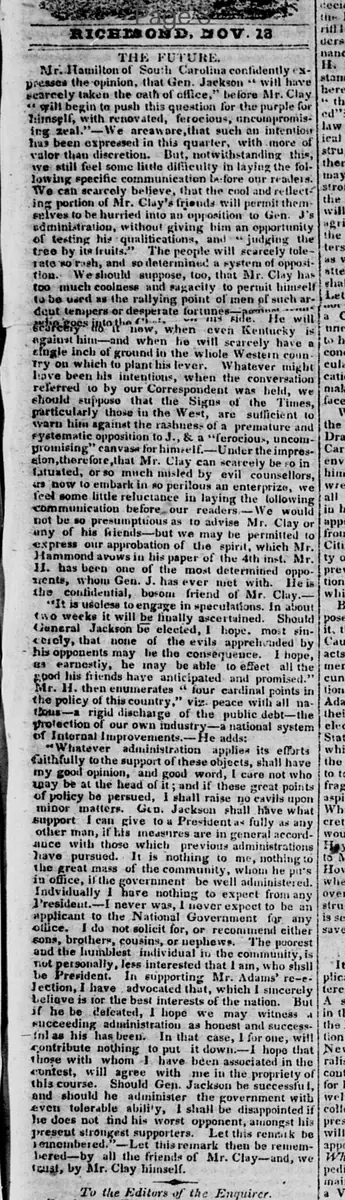
Mr. Hamilton of South Carolina confidently expresses the opinion, that Gen. Jackson "will have scarcely taken the oath of office," before Mr. Clay "will begin to push this question for the purple for himself, with renovated, ferocious, uncompromising zeal."—We are aware, that such an intention has been expressed in this quarter, with more of valor than discretion. But notwithstanding this, we still feel some little difficulty in laying the following specific communication before our readers. We can scarcely believe, that the cool and reflecting portion of Mr. Clay's friends will permit themselves to be hurried into an opposition to Gen. J.'s administration, without giving him an opportunity of testing his qualifications, and "judging the tree by its fruits." The people will scarcely tolerate so rash, and so determined a system of opposition. We should suppose, too, that Mr. Clay has too much coolness and sagacity to permit himself to be used as the rallying point of men of such ardent tempers or desperate fortunes—portions of the community, when victory will be against him—and when he will scarcely have a single inch of ground in the whole Western country on which to plant his lever. Whatever might have been his intentions, when the conversation referred to by our Correspondent was held, we should suppose that the Signs of the Times, particularly those in the West, are sufficient to warn him against the rashness of a premature and systematic opposition to J., & a "ferocious, uncompromising" canvass for himself.—Under the impression, therefore, that Mr. Clay can scarcely be so infatuated, or so much misled by evil counsellors, as now to embark in so perilous an enterprise, we feel some little reluctance in laying the following communication before our readers.—We would not be so presumptuous as to advise Mr. Clay or any of his friends—but we may be permitted to express our approbation of the spirit, which Mr. Hammond avows in his paper of the 4th inst. Mr. H. has been one of the most determined opponents, whom Gen. J. has ever met with. He is the confidential, bosom friend of Mr. Clay.—
"It is useless to engage in speculations. In about two weeks it will be finally ascertained. Should General Jackson be elected, I hope, most sincerely, that none of the evils apprehended by his opponents may be the consequence. I hope, as earnestly, he may be able to effect all the good his friends have anticipated and promised."
Mr. H. then enumerates "four cardinal points in the policy of this country." viz. peace with all nations—a rigid discharge of the public debt—the protection of our own industry—a national system of Internal Improvements.—He adds:
Whatever administration applies its efforts faithfully to the support of these objects, shall have my good opinion, and good word, I care not who may be at the head of it; and if these great points of policy be pursued, I shall raise no cavils upon minor matters. Gen. Jackson shall have what support I can give to a President as fully as any other man, if his measures are in general accordance with those which previous administrations have pursued. It is nothing to me, nothing to the great mass of the community, whom he puts in office, if the government be well administered. Individually I have nothing to expect from any President.—I never was, I never expect to be an applicant to the National Government for any office. I do not solicit for, or recommend either sons, brothers, cousins, or nephews. The poorest and the humblest individual in the community, is not personally, less interested than I am, who shall be President. In supporting Mr. Adams' re-election, I have advocated that, which I sincerely believe is for the best interests of the nation. But if he be defeated, I hope we may witness succeeding administration as honest and successful as his has been. In that case, I for one, will contribute nothing to put it down.—I hope that those with whom I have been associated in the contest, will agree with me in the propriety of this course. Should Gen. Jackson be successful, and should he administer the government with even tolerable ability, I shall be disappointed if he does not find his worst opponent, amongst his present strongest supporters. Let this remark be remembered."—Let this remark then be remembered—by all the friends of Mr. Clay—and, we trust, by Mr. Clay himself.
What sub-type of article is it?
What themes does it cover?
What keywords are associated?
What entities or persons were involved?
Where did it happen?
Story Details
Key Persons
Location
Richmond
Event Date
Nov. 18
Story Details
Political commentary warns against premature opposition to Andrew Jackson's administration by Henry Clay's supporters, quoting Charles Hammond's conditional support for Jackson based on adherence to key policies like peace, debt payment, industry protection, and internal improvements.