Thank you for visiting SNEWPapers!
Sign up free
Editorial
February 18, 1853
The Ohio Organ, Of The Temperance Reform
Cincinnati, Hamilton County, Ohio
What is this article about?
This editorial criticizes proposals for inebriate hospitals as impractical and tyrannical, advocating instead for a prohibitory liquor law to prevent intemperance and protect future generations. It cites public support for prohibition in states like Minnesota and Vermont despite opposition.
Clipping
OCR Quality
98%
Excellent
Full Text
Tyrannical Legislation.
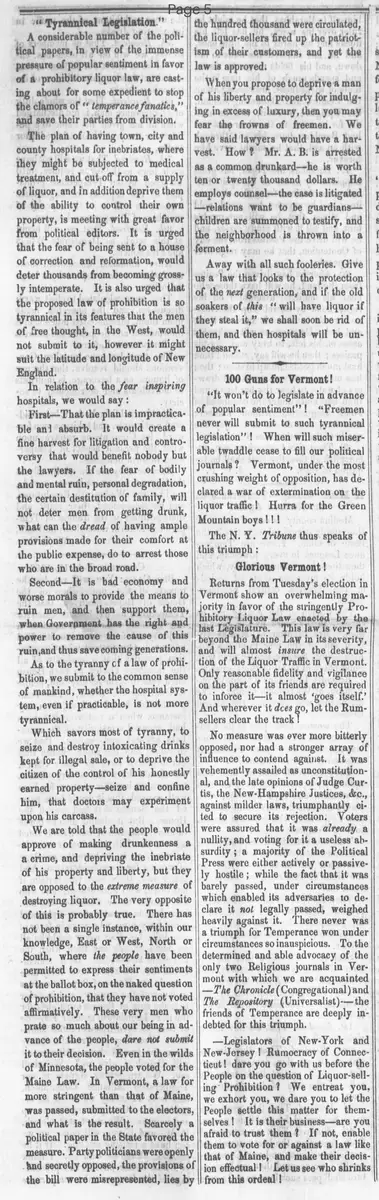
A considerable number of the political papers, in view of the immense pressure of popular sentiment in favor of a prohibitory liquor law, are casting about for some expedient to stop the clamors of "temperance fanatics," and save their parties from division. The plan of having town, city and county hospitals for inebriates, where they might be subjected to medical treatment, and cut off from a supply of liquor, and in addition deprive them of the ability to control their own property, is meeting with great favor from political editors. It is urged that the fear of being sent to a house of correction and reformation, would deter thousands from becoming grossly intemperate. It is also urged that the proposed law of prohibition is so tyrannical in its features that the men of free thought, in the West, would not submit to it, however it might suit the latitude and longitude of New England.
In relation to the fear inspiring hospitals, we would say:
First—That the plan is impracticable and absurd. It would create a fine harvest for litigation and controversy that would benefit nobody but the lawyers. If the fear of bodily and mental ruin, personal degradation, the certain destitution of family, will not deter men from getting drunk, what can the dread of having ample provisions made for their comfort at the public expense, do to arrest those who are in the broad road.
Second—It is bad economy and worse morals to provide the means to ruin men, and then support them, when Government has the right and power to remove the cause of this ruin, and thus save coming generations.
As to the tyranny of a law of prohibition, we submit to the common sense of mankind, whether the hospital system, even if practicable, is not more tyrannical.
Which savors most of tyranny, to seize and destroy intoxicating drinks kept for illegal sale, or to deprive the citizen of the control of his honestly earned property—seize and confine him, that doctors may experiment upon his carcass.
We are told that the people would approve of making drunkenness a crime, and depriving the inebriate of his property and liberty, but they are opposed to the extreme measure of destroying liquor. The very opposite of this is probably true. There has not been a single instance, within our knowledge, East or West, North or South, where the people have been permitted to express their sentiments at the ballot box, on the naked question of prohibition, that they have not voted affirmatively. These very men who prate so much about our being in advance of the people, dare not submit it to their decision. Even in the wilds of Minnesota, the people voted for the Maine Law. In Vermont, a law more stringent than that of Maine, was passed, submitted to the electors and what is the result. Scarcely a political paper in the State favored the measure. Party politicians were openly and secretly opposed, the provisions of the bill were misrepresented, lies by the hundred thousand were circulated, the liquor-sellers fired up the patriotism of their customers, and yet the law is approved.
When you propose to deprive a man of his liberty and property for indulging in excess of luxury, then you may fear the frowns of freemen. We have said lawyers would have a harvest. How? Mr. A. B. is arrested as a common drunkard—he is worth ten or twenty thousand dollars. He employs counsel—the case is litigated relations want to be guardians children are summoned to testify, and the neighborhood is thrown into a ferment.
Away with all such fooleries. Give us a law that looks to the protection of the next generation, and if the old soakers of this "will have liquor if they steal it," we shall soon be rid of them, and then hospitals will be unnecessary.
A considerable number of the political papers, in view of the immense pressure of popular sentiment in favor of a prohibitory liquor law, are casting about for some expedient to stop the clamors of "temperance fanatics," and save their parties from division. The plan of having town, city and county hospitals for inebriates, where they might be subjected to medical treatment, and cut off from a supply of liquor, and in addition deprive them of the ability to control their own property, is meeting with great favor from political editors. It is urged that the fear of being sent to a house of correction and reformation, would deter thousands from becoming grossly intemperate. It is also urged that the proposed law of prohibition is so tyrannical in its features that the men of free thought, in the West, would not submit to it, however it might suit the latitude and longitude of New England.
In relation to the fear inspiring hospitals, we would say:
First—That the plan is impracticable and absurd. It would create a fine harvest for litigation and controversy that would benefit nobody but the lawyers. If the fear of bodily and mental ruin, personal degradation, the certain destitution of family, will not deter men from getting drunk, what can the dread of having ample provisions made for their comfort at the public expense, do to arrest those who are in the broad road.
Second—It is bad economy and worse morals to provide the means to ruin men, and then support them, when Government has the right and power to remove the cause of this ruin, and thus save coming generations.
As to the tyranny of a law of prohibition, we submit to the common sense of mankind, whether the hospital system, even if practicable, is not more tyrannical.
Which savors most of tyranny, to seize and destroy intoxicating drinks kept for illegal sale, or to deprive the citizen of the control of his honestly earned property—seize and confine him, that doctors may experiment upon his carcass.
We are told that the people would approve of making drunkenness a crime, and depriving the inebriate of his property and liberty, but they are opposed to the extreme measure of destroying liquor. The very opposite of this is probably true. There has not been a single instance, within our knowledge, East or West, North or South, where the people have been permitted to express their sentiments at the ballot box, on the naked question of prohibition, that they have not voted affirmatively. These very men who prate so much about our being in advance of the people, dare not submit it to their decision. Even in the wilds of Minnesota, the people voted for the Maine Law. In Vermont, a law more stringent than that of Maine, was passed, submitted to the electors and what is the result. Scarcely a political paper in the State favored the measure. Party politicians were openly and secretly opposed, the provisions of the bill were misrepresented, lies by the hundred thousand were circulated, the liquor-sellers fired up the patriotism of their customers, and yet the law is approved.
When you propose to deprive a man of his liberty and property for indulging in excess of luxury, then you may fear the frowns of freemen. We have said lawyers would have a harvest. How? Mr. A. B. is arrested as a common drunkard—he is worth ten or twenty thousand dollars. He employs counsel—the case is litigated relations want to be guardians children are summoned to testify, and the neighborhood is thrown into a ferment.
Away with all such fooleries. Give us a law that looks to the protection of the next generation, and if the old soakers of this "will have liquor if they steal it," we shall soon be rid of them, and then hospitals will be unnecessary.
What sub-type of article is it?
Temperance
Legal Reform
Moral Or Religious
What keywords are associated?
Prohibitory Liquor Law
Inebriate Hospitals
Temperance Movement
Tyrannical Legislation
Maine Law
Public Sentiment
What entities or persons were involved?
Political Papers
Temperance Fanatics
Liquor Sellers
Maine Law
Minnesota
Vermont
Editorial Details
Primary Topic
Advocacy For Prohibitory Liquor Law Over Inebriate Hospitals
Stance / Tone
Strongly Pro Prohibition, Anti Hospital Plan As Tyrannical
Key Figures
Political Papers
Temperance Fanatics
Liquor Sellers
Maine Law
Minnesota
Vermont
Key Arguments
Hospital Plan For Inebriates Is Impracticable And Would Lead To Litigation
Fear Of Hospitals Won't Deter Drunkenness If Other Fears Don't
Providing Means To Ruin Then Supporting Ruined Is Bad Economy And Morals
Prohibition Removes Cause Of Ruin To Save Future Generations
Hospital System More Tyrannical Than Destroying Illegal Liquor
People Consistently Vote For Prohibition When Given Chance
Opposition From Politicians And Papers Despite Public Approval
Depriving Liberty For Drunkenness Invites Legal Challenges