Thank you for visiting SNEWPapers!
Sign up free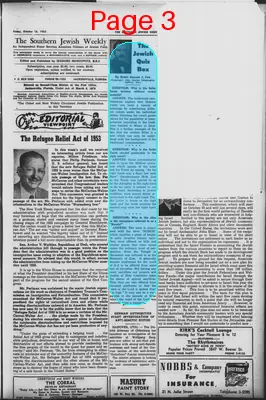
Literary
October 16, 1953
The Southern Jewish Weekly
Jacksonville, Duval County, Florida
What is this article about?
Rabbi Samuel J. Fox's 'The Jewish Quiz Box' explains Jewish traditions: why the Sefer Torah omits vowel symbols for interpretive flexibility, why it's carried in the right hand per biblical precedent, and why the synagogue altar is called 'Bimoh' linking to elevated sacred sites.
Clipping
OCR Quality
98%
Excellent
Full Text
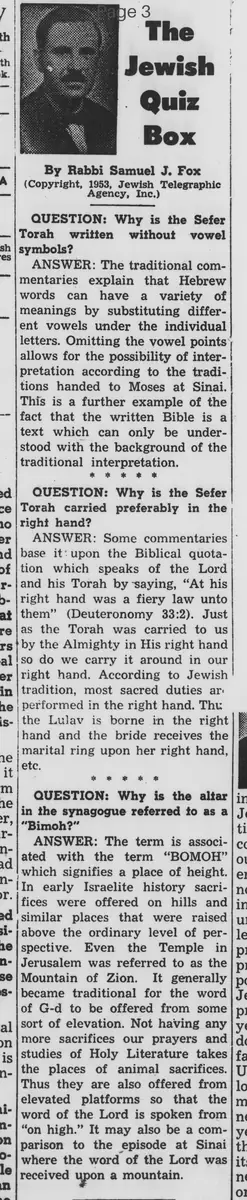
The Jewish Quiz Box
By Rabbi Samuel J. Fox
(Copyright, 1953, Jewish Telegraphic Agency, Inc.)
QUESTION: Why is the Sefer Torah written without vowel symbols?
ANSWER: The traditional commentaries explain that Hebrew words can have a variety of meanings by substituting different vowels under the individual letters. Omitting the vowel points allows for the possibility of interpretation according to the traditions handed to Moses at Sinai. This is a further example of the fact that the written Bible is a text which can only be understood with the background of the traditional interpretation.
QUESTION: Why is the Sefer Torah carried preferably in the right hand?
ANSWER: Some commentaries base it upon the Biblical quotation which speaks of the Lord and his Torah by saying, "At his right hand was a fiery law unto them" (Deuteronomy 33:2). Just as the Torah was carried to us by the Almighty in His right hand so do we carry it around in our right hand. According to Jewish tradition, most sacred duties are performed in the right hand. Thus the Lulav is borne in the right hand and the bride receives the marital ring upon her right hand, etc.
QUESTION: Why is the altar in the synagogue referred to as a "Bimoh?"
ANSWER: The term is associated with the term "BAMOH" which signifies a place of height. In early Israelite history sacrifices were offered on hills and similar places that were raised above the ordinary level of perspective. Even the Temple in Jerusalem was referred to as the Mountain of Zion. It generally became traditional for the word of G-d to be offered from some sort of elevation. Not having any more sacrifices our prayers and studies of Holy Literature takes the places of animal sacrifices. Thus they are also offered from elevated platforms so that the word of the Lord is spoken from "on high." It may also be a comparison to the episode at Sinai where the word of the Lord was received upon a mountain.
By Rabbi Samuel J. Fox
(Copyright, 1953, Jewish Telegraphic Agency, Inc.)
QUESTION: Why is the Sefer Torah written without vowel symbols?
ANSWER: The traditional commentaries explain that Hebrew words can have a variety of meanings by substituting different vowels under the individual letters. Omitting the vowel points allows for the possibility of interpretation according to the traditions handed to Moses at Sinai. This is a further example of the fact that the written Bible is a text which can only be understood with the background of the traditional interpretation.
QUESTION: Why is the Sefer Torah carried preferably in the right hand?
ANSWER: Some commentaries base it upon the Biblical quotation which speaks of the Lord and his Torah by saying, "At his right hand was a fiery law unto them" (Deuteronomy 33:2). Just as the Torah was carried to us by the Almighty in His right hand so do we carry it around in our right hand. According to Jewish tradition, most sacred duties are performed in the right hand. Thus the Lulav is borne in the right hand and the bride receives the marital ring upon her right hand, etc.
QUESTION: Why is the altar in the synagogue referred to as a "Bimoh?"
ANSWER: The term is associated with the term "BAMOH" which signifies a place of height. In early Israelite history sacrifices were offered on hills and similar places that were raised above the ordinary level of perspective. Even the Temple in Jerusalem was referred to as the Mountain of Zion. It generally became traditional for the word of G-d to be offered from some sort of elevation. Not having any more sacrifices our prayers and studies of Holy Literature takes the places of animal sacrifices. Thus they are also offered from elevated platforms so that the word of the Lord is spoken from "on high." It may also be a comparison to the episode at Sinai where the word of the Lord was received upon a mountain.
What sub-type of article is it?
Essay
What themes does it cover?
Religious
What keywords are associated?
Sefer Torah
Vowel Symbols
Right Hand Tradition
Bimoh Altar
Jewish Commentaries
Sinai Traditions
Synagogue Practices
What entities or persons were involved?
By Rabbi Samuel J. Fox
Literary Details
Title
The Jewish Quiz Box
Author
By Rabbi Samuel J. Fox
Subject
Explanations Of Sefer Torah And Synagogue Practices
Form / Style
Question And Answer Format With Traditional Commentaries
Key Lines
Question: Why Is The Sefer Torah Written Without Vowel Symbols?
Answer: Omitting The Vowel Points Allows For The Possibility Of Interpretation According To The Traditions Handed To Moses At Sinai.
Question: Why Is The Sefer Torah Carried Preferably In The Right Hand?
Answer: Just As The Torah Was Carried To Us By The Almighty In His Right Hand So Do We Carry It Around In Our Right Hand.
Question: Why Is The Altar In The Synagogue Referred To As A "Bimoh?"