Thank you for visiting SNEWPapers!
Sign up free
The Watchman And Southron
Sumter, Sumter County, South Carolina
What is this article about?
Editorial from Manufacturers Record argues that the American South has not reached its limit in cotton production, despite the boll weevil, and dismisses significant competition from other regions like Africa, India, and Argentina. It calls for fair prices to growers to ensure prosperity and diversified agriculture.
Clipping
OCR Quality
Full Text
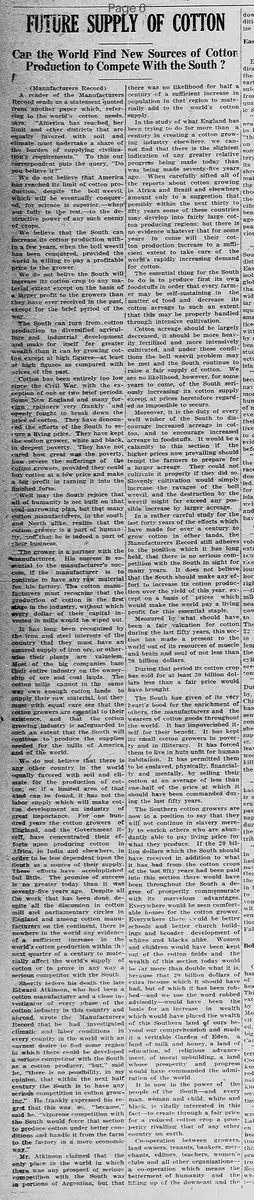
Can the World Find New Sources of Cotton Production to Compete With the South?
(Manufacturers Record)
A reader of the Manufacturers Record sends us a statement quoted from another paper which, referring to the world's cotton needs, says: "America has reached her limit and other districts that are equally favored with soil and climate, must undertake a share of the burden of supplying civilization's requirements." To this our correspondent puts the query, "Do you believe it?"
We do not believe that America has reached its limit of cotton production, despite the boll weevil, which will be eventually conquered for science is superior,--when fully put to the test,--to the destructive power of any such enemy of crops.
We believe that the South can increase its cotton production within a few years, when the boll weevil has been conquered, provided the world is willing to pay a profitable price to the grower.
We do not believe the South will increase its cotton crop to any material extent except on the basis of larger profit to the growers than they have ever received in the past, except for the brief period of the war.
The South can turn from cotton production to diversified agriculture and industrial development and make for itself far greater wealth than it can by growing cotton except at high figures--at least at high figures as compared with prices of the past.
Cotton has been entirely too low since the Civil War, with the exception of one or two brief periods. Some New England and many foreign spinners very frankly and openly fought to break down the price of cotton. They have denounced the efforts of the South to secure a living price. They have kept the cotton grower, white and black, in deepest poverty. They have not cared how great was the poverty, how severe the sufferings of the cotton growers, provided they could buy cotton at a low price and make a big profit in turning it into the finished form.
Well may the South rejoice that all of humanity is not built on that soul-narrowing plan, but that many cotton manufacturers, in the South and North alike, realize that the cotton grower is a part of humanity and that he is indeed a part of her business.
The grower is a partner with the manufacturer. His success is essential to the manufacturer's success. If the manufacturer is to continue to have any raw material for his factory. The cotton manufacturers must recognize that the production of cotton is the first stage in the industry, without which every dollar of their capital invested in mills would be wiped out.
It has long been recognized by the iron and steel interests of the country that they must have an assured supply of iron ore, otherwise their plants are valueless. Most of the big companies base their entire industry on the ownership of ore and coal lands. The cotton mills cannot in the same way own enough cotton lands to supply their raw material, but they must with equal care see that the cotton growers are essential to their existence, and that the cotton growing industry is safeguarded to such an extent that the South will continue to produce the supplies needed for the mills of America and of the world.
We do not believe that there is any other country in the world equally favored with soil and climate for the production of cotton; or, if a limited area of that kind can be found, it has not the labor supply which will make cotton development an industry of great importance. For one hundred years the cotton growers of England, and the Government itself, have concentrated their efforts upon producing cotton in Africa, in India and elsewhere, in order to be less dependent upon the South as a source of their supply.
These efforts have accomplished but little. The promise of success is no greater today than it was seventy-five years ago. Despite all the work that has been done, despite all the discussion in cotton mills and parliamentary circles in England and among cotton manufacturers on the continent, there is nowhere in the world any evidence of a sufficient increase in the world's cotton production within the next quarter of a century to materially affect the world's supply of cotton or to prove in any way a serious competitor with the South.
Shortly before his death the late Edward Atkinson, who had been a cotton manufacturer and a close investigator of every phase of the cotton industry in this country and abroad, wrote the Manufacturers Record that he had investigated climatic and labor conditions in every country in the world with an earnest desire to find some region in which there could be developed a serious competitor with the South as a cotton producer, "but," said he, "there is no possibility, in my opinion, that within the next half century the South is to have any serious competition in cotton growing." He frankly expressed his regret that this was so, "because," said he, "vigorous competition with the South would force that section to produce cotton under better conditions and handle it from the farm to the factory in a more economic way."
Mr. Atkinson claimed that the only place in the world in which there was any prospect of serious competition with the South was in portions of Argentina, but that there was no likelihood for half a century of a sufficient increase in population in that region to materially add to the world's cotton supply.
In the study of what England has been trying to do for more than a century in creating a cotton growing industry elsewhere, we cannot find that there is the slightest indication of any greater relative progress being made today than was being made seventy-five years ago. When carefully sifted all of the reports about cotton growing in Africa and Brazil and elsewhere amount only to a suggestion that possibly within the next thirty to fifty years some of these countries may develop into fairly large cotton producing regions; but there is no evidence whatever that for some years to come will their cotton production increase to a sufficient extent to take care of the world's rapidly increasing demand for cotton.
The essential thing for the South to do is to produce first its own foodstuffs in order that every farmer may be self-sustaining in the matter of food and decrease its cotton acreage to such an extent that this may be properly handled through intensive cultivation. Cotton acreage should be largely fertilized and more intensively cultivated and the South continue to raise a fair supply of cotton. We see no likelihood, however, for some years of any great increase in cotton acreage except at prices heretofore regarded as impossible to secure.
Moreover, it is the duty of every well wisher of the South to discourage increased acreage in cotton and to encourage increased production of foodstuffs and to warn the farmers against any attempt to prepare for a larger acreage. They could not cultivate it properly if they did so. Slovenly cultivation would simply increase the ravages of the boll weevil, and the destruction by the weevil might far exceed any possible increase by larger acreage.
In a rather careful study for the last forty years of the efforts which have been made for over a century to grow cotton in other lands, the Manufacturers Record still adheres to the position which it has long held, that there is no serious competition with the South in sight for many years. It does not believe that the South should make any effort to increase its cotton production over the yield of this year, except on a basis of prices which would make the world pay a living profit for this essential staple.
Measured by what should have been a fair valuation for cotton during the last fifty years, this section has made a present to the world out of its resources of muscle and brain and soul of not less than 20 billion dollars.
During that period its cotton crop has sold for at least 20 billion dollars less than a fair price would have brought.
The South has given of its very heart's blood for the enrichment of others, the manufacturers and the wearers of cotton goods throughout the world. It has impoverished itself for their benefit. It has kept its small cotton growers in poverty and in illiteracy. It has forced them to live in huts unfit for human habitation. It has permitted them to be enslaved, physically, financially and mentally, by selling their cotton at an average of less than one-half of the price at which it should have been commanded during the last fifty years.
The Southern cotton growers are now in a position to say that they will not continue in slavery merely to enrich others who are abundantly able to pay living price for what they produce. If the 20 billion dollars which the South should have received in addition to what it has had from the cotton crops of the last fifty years had been paid into this section there would have been throughout the South a degree of prosperity commensurate with its marvelous advantages.
Everywhere would be seen comfortable homes for the cotton grower. Everywhere there would be better schools and better church buildings and broader development of whites and blacks alike. Women and children would have been kept out of the cotton fields and the wealth of this section today would be far more than double what it is, because that 20 billion dollars of extra income which it should have had, but of which it has been robbed--and we use the word robbed advisedly--would have been the basis for an increase in wealth which would have placed the wealth of this Southern land of ours beyond our comprehension and made it a veritable Garden of Eden, a land of milk and honey, a land of education, of religious advancement, of moral upbuilding, a land whose prosperity and progress would have commanded the admiration of the world.
It is now in the power of the people of the South--and every man, woman and child, white and black, is vitally interested in this fact--to create through a fair price for a reduced cotton crop a prosperity rivaling that of any other country on earth.
Co-operation between growers, land owners, tenants, bankers, merchants, editors, teachers, women's clubs and all other organizations--a co-operation which means the betterment of humanity and the lifting up of the downcast and the down-trodden can bring this condition about. Will the South realize and utilize this opportunity?
What sub-type of article is it?
What themes does it cover?
What keywords are associated?
What entities or persons were involved?
Where did it happen?
Story Details
Key Persons
Location
The South
Story Details
The Manufacturers Record editorial refutes claims that America has reached its cotton production limit, emphasizing conquest of the boll weevil, need for profitable prices, dismissal of global competition, and advocacy for diversified agriculture and fair compensation to end grower poverty and foster prosperity.