Thank you for visiting SNEWPapers!
Sign up free
New Ulm Weekly Review
New Ulm, Brown County, Minnesota
What is this article about?
James Russell Lowell, former US Minister to England, discusses British royalty, politics, and Irish affairs in an interview. He praises Queen Victoria's influence, comments on statesmen like Gladstone and Hartington, defends diplomat Phelps, and predicts Home Rule for Ireland with caveats.
Clipping
OCR Quality
Full Text
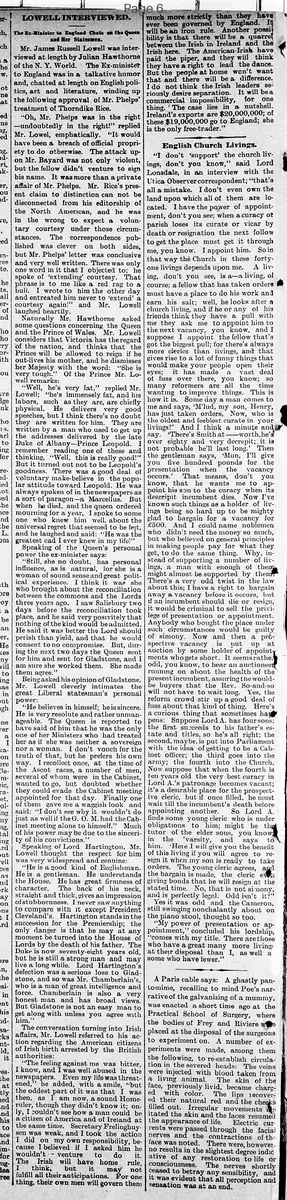
The Ex-Minister to England Chats on the Queen and Her Statesmen,
Mr. James Russell Lowell was interviewed at length by Julian Hawthorne of the N. Y. World. The Ex-minister to England was in a talkative humor and, chatted at length on English politics, art and literature, winding up the following approval of Mr. Phelps treatment of Thorndike Rice.
"Oh, Mr. Phelps was in the right—undoubtedly in the right!" replied Mr. Lowell, emphatically. "It would have been a breach of official propriety to do otherwise. The attack upon Mr. Bayard was not only violent, but the fellow didn't venture to sign his name. It was more than a private affair of Mr. Phelps. Mr. Rice's present claim to distinction can not be disconnected from his editorship of the North American, and he was in the wrong to expect a voluntary courtesy under those circumstances. The correspondence published was clever on both sides, but Mr. Phelps' letter was conclusive and very well written. There was only one word in it that I objected to; he spoke of 'extending' courtesy. That phrase is to me like a red rag to a bull. I wrote to him the other day and entreated him never to 'extend' a courtesy again!" and Mr. Lowell laughed heartily.
Naturally Mr. Hawthorne asked some questions concerning the Queen and the Prince of Wales. Mr. Lowell considers that Victoria has the regard of the nation, and thinks that the Prince will be allowed to reign if he out-lives his mother, and he dismisses her Majesty with the word: "She is very tough." Of the Prince Mr. Lowell remarks:
"Well, he's very fat," replied Mr. Lowell; "he's immensely fat, and his labors, such as they are, are chiefly physical. He delivers very good speeches, but I think there's no doubt they are written for him. They are written by a man who used to get up the addresses delivered by the late Duke of Albany—Prince Leopold. I remember reading one of these and thinking, 'Well, this is really good!' But it turned out not to be Leopold's goodness. There was a good deal of voluntary make-believe in the popular attitude toward Leopold. He was always spoken of in the newspapers as a sort of paragon—a Marcellus. But when he died, and the queen ordered mourning for a year, I spoke to some one who knew him well, about the universal regret that seemed to be felt, and he laughed and said: 'He was the greatest cad I ever knew in my life!'"
Speaking of the Queen's personal power the ex-minister says:
"Still, she no doubt, has personal influence, as is natural, for she is a woman of sound sense and great political experience. I think it was she who brought about the reconciliation between the commons and the Lords three years ago. I saw Salisbury two days before the reconciliation took place, and he said very positively that nothing of the kind would be admitted. He said it was better the Lord should perish than yield, and that he would consent to no compromise. But, during the next two days the Queen sent for him and sent for Gladstone, and I am sure she worked them. She made them agree."
Being asked his opinion of Gladstone, Mr. Lowell cleverly intimates the great Liberal statesman's personal power:
"He believes in himself; he is sincere. He is very resolute and rather unmanageable. The Queen is reported to have said of him that he was the only one of her Ministers who had treated her as if she was neither a sovereign nor a woman. I don't vouch for the truth of that, but he prefers his own way. I recollect once, at the time of the Ascot races, a number of men, several of whom were in the Cabinet, wanted to go, but doubted whether they could evade the Cabinet meeting appointed for that day. Finally one of them gave me a waggish look and said: 'I don't see why it wouldn't do just as well if the G. O. M. had the Cabinet meeting alone to himself.' Much of his power may be due to the sincerity of his convictions."
Speaking of Lord Hartington, Mr. Lowell thought the respect for him was very widespread and genuine:
"He is a good kind of Englishman. He is a gentleman. He understands the House. He has great firmness of character. The back of his neck, straight and thick, gives an impression of stubbornness. I never saw anything to compare with it except President Cleveland's. Hartington stands in the succession for the Premiership; the only danger is that he may at any moment be turned into the House of Lords by the death of his father. The Duke is now seventy-eight years old, but he is still a strong man and may live a long while. Lord Hartington's defection was a serious loss to Gladstone, and so was Mr. Chamberlain's, who is a man of great intelligence and force. Chamberlain is also a very honest man and has broad views. But Gladstone is not an easy man to get along with unless you agree with him."
The conversation turning into Irish affairs, Mr. Lowell referred to his action regarding the American citizens of Irish birth arrested by the British authorities:
"The feeling against me was bitter, I know, and I was well abused in the newspapers. Even my life was threatened," he added, with a smile, "but the oddest part of it was that I was then, as I am now, a sound Home-ruler, though they didn't know it; only, I couldn't see how a man could be a citizen of America and of Ireland at the same time. Secretary Frelinghuysen was weak, and I took the action I did on my own responsibility, because I believed if I asked him he wouldn't venture to do it.
The Irish will have home rule, I think, but it may not fulfill all their anticipations. For one thing, their own men will govern them much more strictly than they have ever been governed by England. It will be an iron rule. Another possibility is that there will be a quarrel between the Irish in Ireland and the Irish here. The American-Irish have paid the piper, and they will think they have a right to lead the dance. But the people at home won't want that and there will be a difference. I do not think the Irish leaders seriously desire separation. It will be a commercial impossibility, for one thing. The case lies in a nutshell. Ireland's exports are $20,000,000; of these $19,000,000 go to England; she is the only free-trader."
What sub-type of article is it?
What keywords are associated?
What entities or persons were involved?
Where did it happen?
Foreign News Details
Primary Location
England
Key Persons
Event Details
James Russell Lowell, former US Minister to England, interviewed by Julian Hawthorne, discusses English politics, art, literature; defends Mr. Phelps' response to Thorndike Rice's unsigned attack on Mr. Bayard; comments on Queen Victoria's toughness, influence in reconciling Commons and Lords three years ago, and personal power; describes Prince of Wales as fat with ghostwritten speeches; shares anecdote on Prince Leopold; opines on Gladstone's sincerity, resoluteness, and unmanageability; praises Lord Hartington's character and potential premiership; notes losses to Gladstone from Hartington and Chamberlain's defections; recounts his own actions on American-Irish citizens arrested by British, supporting Home Rule but predicting strict self-governance and potential quarrels with American-Irish, emphasizing economic ties to England.