Thank you for visiting SNEWPapers!
Sign up free
Story
July 30, 1854
The Daily Union
Washington, District Of Columbia
What is this article about?
In the US Senate on July 19, Senator Pearce of Maryland supports a bill to pay Texas creditors more than the $5 million owed to Texas under the 1850 Compromise, to settle disputes, relieve suffering creditors, and avoid future claims against the US government.
Clipping
OCR Quality
98%
Excellent
Full Text
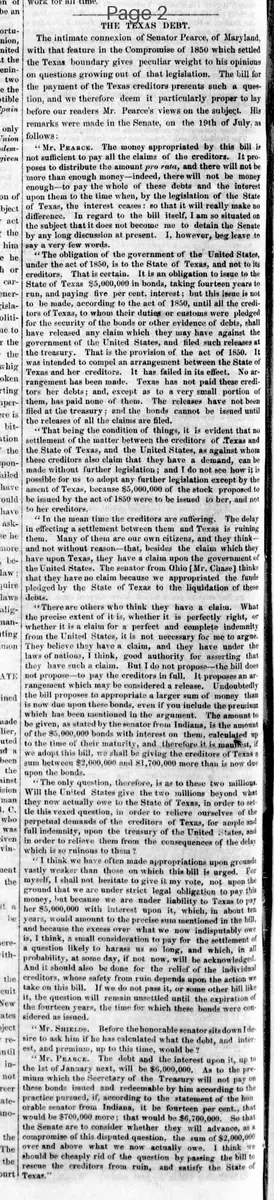
THE TEXAS DEBT.
The intimate connexion of Senator Pearce, of Maryland, with that feature in the Compromise of 1850 which settled the Texas boundary gives peculiar weight to his opinions on questions growing out of that legislation. The bill for the payment of the Texas creditors presents such a question, and we therefore deem it particularly proper to lay before our readers Mr. Pearce's views on the subject. His remarks were made in the Senate, on the 19th of July, as follows:
"Mr. Pearce. The money appropriated by this bill is not sufficient to pay all the claims of the creditors. It proposes to distribute the amount pro rata, and there will not be more than enough money—indeed, there will not be money enough—to pay the whole of these debts and the interest upon them to the time when, by the legislation of the State of Texas, the interest ceases: so that it will really make no difference. In regard to the bill itself, I am so situated on the subject that it does not become me to detain the Senate by any long discussion at present. I, however, beg leave to say a very few words.
"The obligation of the government of the United States under the act of 1850, is to the State of Texas, and not to its creditors. That is certain. It is an obligation to issue to the State of Texas $5,000,000 in bonds, taking fourteen years to run, and paying five per cent. interest; but this issue is not to be made, according to the act of 1850, until all the creditors of Texas, to whom their duties or customs were pledged for the security of the bonds or other evidence of debts, shall have released any claim which they may have against the government of the United States, and filed such releases at the treasury. That is the provision of the act of 1850. It was intended to compel an arrangement between the State of Texas and her creditors. It has failed in its effect. No arrangement has been made. Texas has not paid these creditors her debts; and, except as to a very small portion of them, has paid none of them. The releases have not been filed at the treasury; and the bonds cannot be issued until the releases of all the claims are filed.
"That being the condition of things, it is evident that no settlement of the matter between the creditors of Texas and the State of Texas, and the United States, as against whom these creditors also claim that they have a demand, can be made without further legislation; and I do not see how it is possible for us to adopt any further legislation except by the assent of Texas, because $5,000,000 of the stock proposed to be issued by the act of 1850 were to be issued to her, and not to her creditors.
"In the mean time the creditors are suffering. The delay in effecting a settlement between them and Texas is ruining them. Many of them are our own citizens, and they think—and not without reason—that, besides the claim which they have upon Texas, they have a claim upon the government of the United States. The senator from Ohio [Mr. Chase] thinks that they have no claim because we appropriated the funds pledged by the State of Texas to the liquidation of these debts.
"There are others who think they have a claim. What the precise extent of it is, whether it is perfectly right, or whether it is a claim for a perfect and complete indemnity from the United States, it is not necessary for me to argue. They believe they have a claim, and they have under the laws of nations, I think, good authority for asserting that they have such a claim. But I do not propose—the bill does not propose—to pay the creditors in full. It proposes an arrangement which may be considered a release. Undoubtedly the bill proposes to appropriate a larger sum of money than is now due upon these bonds, even if you include the premium which has been mentioned in the argument. The amount to be given, as stated by the senator from Indiana, is the amount of the $5,000,000 bonds with interest on them, calculated up to the time of their maturity, and therefore it is manifest, if we adopt this bill, we shall be giving the creditors of Texas a sum between $2,000,000 and $1,700,000 more than is now due upon the bonds.
"The only question, therefore, is as to these two millions. Will the United States give the two millions beyond what they now actually owe to the State of Texas, in order to settle this vexed question, in order to relieve ourselves of the perpetual demands of the creditors of Texas, for ample and full indemnity, upon the treasury of the United States, and in order to relieve them from the consequences of the delay which is so ruinous to them?
"I think we have often made appropriations upon grounds vastly weaker than those on which this bill is urged. For myself, I shall not hesitate to give it my vote, not upon the ground that we are under strict legal obligation to pay this money, but because we are under liability to Texas to pay her $5,000,000 with interest upon it, which, in about ten years, would amount to the precise sum mentioned in the bill; and because the excess over what we now indisputably owe is, I think, a small consideration to pay for the settlement of a question likely to harass us so long, and which, in all probability, at some day, if not now, will be acknowledged. And it should also be done for the relief of the individual creditors, whose safety from ruin depends upon the action we take on this bill. If we do not pass it, or some other bill like it, the question will remain unsettled until the expiration of the fourteen years, the time for which these bonds were considered as issued.
"Mr. Shields. Before the honorable senator sits down I desire to ask him if he has calculated what the debt, and interest, and premium, up to this time, would be?
"Mr. Pearce. The debt and the interest upon it, up to the 1st of January next, will be $6,000,000. As to the premium which the Secretary of the Treasury will not pay on these bonds issued and redeemable by him according to the practice pursued, if, according to the statement of the honorable senator from Indiana, it be fourteen per cent., that would be $700,000 more; that would be $6,700,000. So that the Senate are to consider whether they will advance, as a compromise of this disputed question, the sum of $2,000,000 over and above what we now actually owe. I think we should be cheaply rid of the question by passing the bill to rescue the creditors from ruin, and satisfy the State of Texas."
The intimate connexion of Senator Pearce, of Maryland, with that feature in the Compromise of 1850 which settled the Texas boundary gives peculiar weight to his opinions on questions growing out of that legislation. The bill for the payment of the Texas creditors presents such a question, and we therefore deem it particularly proper to lay before our readers Mr. Pearce's views on the subject. His remarks were made in the Senate, on the 19th of July, as follows:
"Mr. Pearce. The money appropriated by this bill is not sufficient to pay all the claims of the creditors. It proposes to distribute the amount pro rata, and there will not be more than enough money—indeed, there will not be money enough—to pay the whole of these debts and the interest upon them to the time when, by the legislation of the State of Texas, the interest ceases: so that it will really make no difference. In regard to the bill itself, I am so situated on the subject that it does not become me to detain the Senate by any long discussion at present. I, however, beg leave to say a very few words.
"The obligation of the government of the United States under the act of 1850, is to the State of Texas, and not to its creditors. That is certain. It is an obligation to issue to the State of Texas $5,000,000 in bonds, taking fourteen years to run, and paying five per cent. interest; but this issue is not to be made, according to the act of 1850, until all the creditors of Texas, to whom their duties or customs were pledged for the security of the bonds or other evidence of debts, shall have released any claim which they may have against the government of the United States, and filed such releases at the treasury. That is the provision of the act of 1850. It was intended to compel an arrangement between the State of Texas and her creditors. It has failed in its effect. No arrangement has been made. Texas has not paid these creditors her debts; and, except as to a very small portion of them, has paid none of them. The releases have not been filed at the treasury; and the bonds cannot be issued until the releases of all the claims are filed.
"That being the condition of things, it is evident that no settlement of the matter between the creditors of Texas and the State of Texas, and the United States, as against whom these creditors also claim that they have a demand, can be made without further legislation; and I do not see how it is possible for us to adopt any further legislation except by the assent of Texas, because $5,000,000 of the stock proposed to be issued by the act of 1850 were to be issued to her, and not to her creditors.
"In the mean time the creditors are suffering. The delay in effecting a settlement between them and Texas is ruining them. Many of them are our own citizens, and they think—and not without reason—that, besides the claim which they have upon Texas, they have a claim upon the government of the United States. The senator from Ohio [Mr. Chase] thinks that they have no claim because we appropriated the funds pledged by the State of Texas to the liquidation of these debts.
"There are others who think they have a claim. What the precise extent of it is, whether it is perfectly right, or whether it is a claim for a perfect and complete indemnity from the United States, it is not necessary for me to argue. They believe they have a claim, and they have under the laws of nations, I think, good authority for asserting that they have such a claim. But I do not propose—the bill does not propose—to pay the creditors in full. It proposes an arrangement which may be considered a release. Undoubtedly the bill proposes to appropriate a larger sum of money than is now due upon these bonds, even if you include the premium which has been mentioned in the argument. The amount to be given, as stated by the senator from Indiana, is the amount of the $5,000,000 bonds with interest on them, calculated up to the time of their maturity, and therefore it is manifest, if we adopt this bill, we shall be giving the creditors of Texas a sum between $2,000,000 and $1,700,000 more than is now due upon the bonds.
"The only question, therefore, is as to these two millions. Will the United States give the two millions beyond what they now actually owe to the State of Texas, in order to settle this vexed question, in order to relieve ourselves of the perpetual demands of the creditors of Texas, for ample and full indemnity, upon the treasury of the United States, and in order to relieve them from the consequences of the delay which is so ruinous to them?
"I think we have often made appropriations upon grounds vastly weaker than those on which this bill is urged. For myself, I shall not hesitate to give it my vote, not upon the ground that we are under strict legal obligation to pay this money, but because we are under liability to Texas to pay her $5,000,000 with interest upon it, which, in about ten years, would amount to the precise sum mentioned in the bill; and because the excess over what we now indisputably owe is, I think, a small consideration to pay for the settlement of a question likely to harass us so long, and which, in all probability, at some day, if not now, will be acknowledged. And it should also be done for the relief of the individual creditors, whose safety from ruin depends upon the action we take on this bill. If we do not pass it, or some other bill like it, the question will remain unsettled until the expiration of the fourteen years, the time for which these bonds were considered as issued.
"Mr. Shields. Before the honorable senator sits down I desire to ask him if he has calculated what the debt, and interest, and premium, up to this time, would be?
"Mr. Pearce. The debt and the interest upon it, up to the 1st of January next, will be $6,000,000. As to the premium which the Secretary of the Treasury will not pay on these bonds issued and redeemable by him according to the practice pursued, if, according to the statement of the honorable senator from Indiana, it be fourteen per cent., that would be $700,000 more; that would be $6,700,000. So that the Senate are to consider whether they will advance, as a compromise of this disputed question, the sum of $2,000,000 over and above what we now actually owe. I think we should be cheaply rid of the question by passing the bill to rescue the creditors from ruin, and satisfy the State of Texas."
What sub-type of article is it?
Historical Event
What themes does it cover?
Justice
Misfortune
What keywords are associated?
Texas Debt
Compromise 1850
Senator Pearce
Creditors Payment
Us Senate Debate
Bond Issuance
What entities or persons were involved?
Senator Pearce
Mr. Chase
Mr. Shields
Senator From Indiana
Where did it happen?
Us Senate
Story Details
Key Persons
Senator Pearce
Mr. Chase
Mr. Shields
Senator From Indiana
Location
Us Senate
Event Date
19th Of July
Story Details
Senator Pearce argues in favor of a bill appropriating funds to Texas creditors beyond the strict $5 million obligation to the state under the 1850 act, to settle ongoing disputes, prevent future claims against the US, and alleviate the financial ruin of the creditors due to delays.