Thank you for visiting SNEWPapers!
Sign up free
Daily National Intelligencer
Washington, District Of Columbia
What is this article about?
Transcript of U.S. House debate on internal improvements (roads, canals) on March 9-10, 1818. Mr. Simkins (S.C.) supports federal action for economic, military benefits and union consolidation, deriving power from Constitution's war and welfare clauses. Mr. Johnson (Va.) opposes, advocating strict construction, citing Jefferson and historical precedents against implied powers.
Merged-components note: Continuation of the debate on internal improvements across pages 2 and 3, with sequential reading orders indicating they form a single coherent article.
Clippings
1 of 2
OCR Quality
Full Text
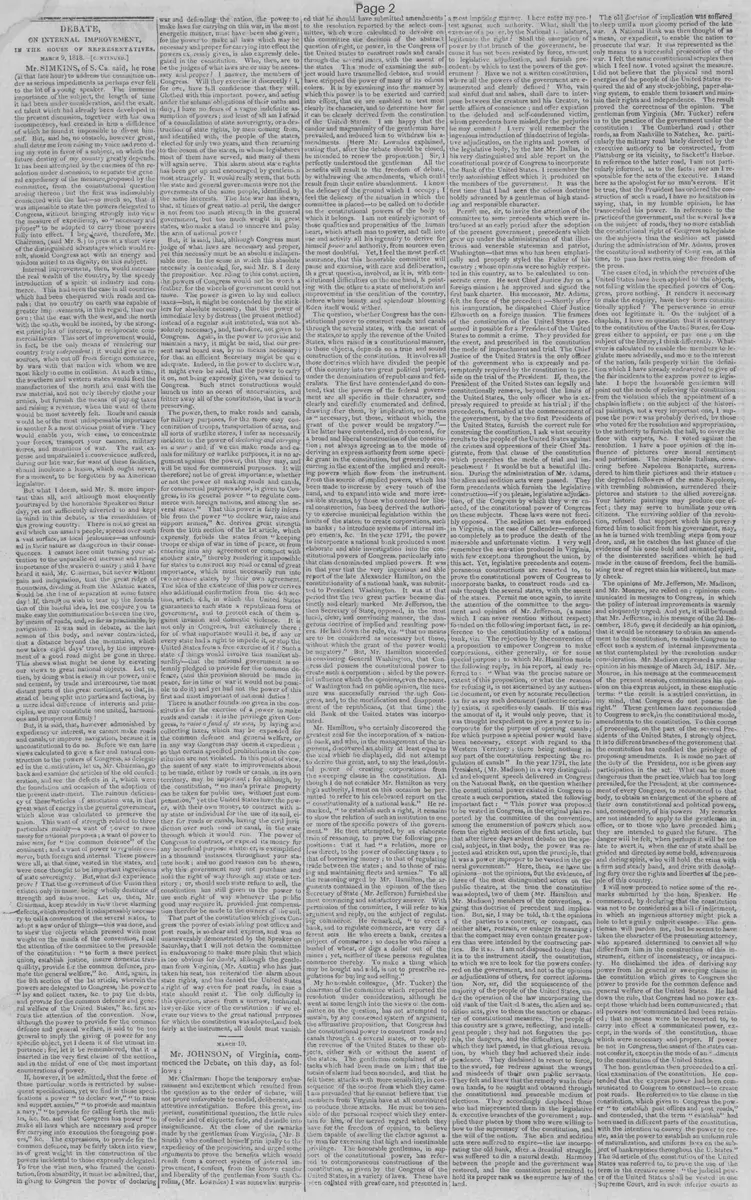
ON INTERNAL IMPROVEMENT,
IN THE HOUSE OF REPRESENTATIVES.
MARCH 9, 1818.—[CONTINUED.]
Mr. SIMKINS, of S. C. said, he rose (at that late hour) to address the committee under as serious impediments as perhaps ever fell to the lot of a young speaker. The immense importance of the subject, the length of time it had been under consideration, and the exalted talent which had already been developed in the present discussion, together with his own incompetency, had created in him a diffidence of which he found it impossible to divest himself. But, said he, no obstacle, however great, shall deter me from raising my voice and recording my vote in favor of a subject, on which the future destiny of my country greatly depends.
It has been attempted by the enemies of the resolution under discussion, to separate the general expediency of the measure proposed by the committee, from the constitutional question arising thereon; but the first was indissolubly connected with the last—so much so, that it was impossible to state the powers delegated to Congress, without bringing strongly into view the measure of expediency, so "necessary and proper" to be adopted to carry those powers fully into effect. I beg leave, therefore, Mr. Chairman, (said Mr. S.) to present a short view of the distinguished advantages which would result, should Congress act with an energy and wisdom suited to its dignity, on this subject.
Internal improvement, then, would increase the real wealth of the country, by the speedy introduction of a spirit of industry and commerce. This had been the case in all countries which had been chequered with roads and canals; that no country on earth was capable of greater improvements, in this regard, than our own; that the east with the west, and the north with the south, would be incited, by the strongest principles of interest, to reciprocate commercial favors. This sort of improvement would, in fact, be the only means of rendering our country truly independent; it would give us resources, when cut off from foreign commerce, by wars with that nation with whom we are most likely to come in collision. At such a time, the southern and western states would feed the manufactories of the north and east with the raw material, and not only thereby clothe your armies, but furnish the means of paying taxes and raising a revenue, when the want of them would be most severely felt. Roads and canals would be of the most indispensable importance in another & a most obvious point of view. They would enable you, with ease, to concentrate your forces, transport your cannon, military stores, and munitions of war. The vast expense and unparalleled inconvenience suffered, during our late war, for want of these facilities, should inculcate a lesson, which ought never, for a moment, to be forgotten by an American legislator.
But what I deem, said Mr. S. more important than all, and although most eloquently pourtrayed by the honorable Speaker on Saturday, yet not sufficiently adverted to and kept in mind in this debate, is the consolidation of this growing country. There is not so great an evil which can assail a people, spread over such a vast surface, as local jealousies—as unfounded in their nature as dangerous in their consequences. I cannot here omit turning your attention to the unparalleled increase and rising importance of the western country; and I have heard it said, Mr. Chairman, but never without pain and indignation, that the great ridge of mountains, dividing it from the Atlantic states, would be the line of separation at some future day! If, then, you wish to tear up the foundation of this baneful idea, let me conjure you to make easy the communication between the two by means of roads, and, so far as practicable, by navigation. It was said in debate, at the last session of this body, and never contradicted, that a distance beyond the mountains, which now takes eight days' travel, by the improvement of a good road might be gone in three. This shews what might be done by elevating our views to great national objects. Let us, then, by doing what is easily in our power, unite and cement, by trade and intercourse, the most distant parts of this great continent, so that, instead of being split into parties and factions, by a mere ideal difference of interests and principles, we may constitute one united, harmonious and prosperous family!
But, it is said, that, however admonished by expediency or interest, we cannot make roads and canals, or improve navigation, because it is unconstitutional to do so. Before we can have views calculated to give a fair and natural construction to the powers of Congress, as delegated in the constitution, let us, Mr. Chairman, go back and examine the articles of the old confederation, and see the defects in it, which were the foundation and occasion of the adoption of the present instrument. The ruinous deficiency of these articles of association was, in that great want of energy in the general government, which alone was calculated to preserve the union. This want of strength related to three particulars mainly—a want of power to raise money for national purposes; a want of power to raise men, for "the common defence" of the continent; and a want of power to regulate commerce, both foreign and internal. These powers were all, at that time, vested in the states, and were once thought to be important ingredients of state sovereignty. But, what did experience prove? That the government of the Union then existed only in name, being wholly destitute of strength and substance. Let us, then, Mr. Chairman, keep steadily in view these alarming defects, which rendered it indispensably necessary to call a convention of the several states, to adopt a new order of things—this was done, and to shew the objects which pressed with most weight on the minds of the convention, I call the attention of the committee to the preamble of the constitution: "to form a more perfect union, establish justice, insure domestic tranquillity, provide for the common defence, promote the general welfare," &c. And, again, in the 8th section of the 1st article, wherein the powers are delegated to Congress, the power to "lay and collect taxes, &c. to pay the debts, and provide for the common defence and general welfare of the United States," &c. first arrests the attention of the convention. Now although the power to provide for the common defence and general welfare, is said to be too general to imply the giving of power for any specific object, yet I deem it of the utmost importance; for, let it be remembered, that it is inserted in the very first clause of the section and in the midst of one of the most important enumerations of power.
If, however, it be admitted, that the force of these particular words is restricted by subsequent specifications, yet we find in those specifications a power "to declare war," "to raise and support armies," "to provide and maintain a navy," "to provide for calling forth the militia, &c. &c. and that Congress has power "to make all laws which are necessary and proper for carrying into execution the foregoing powers," &c. The expressions, to provide for the common defence, may be fairly taken into view, as of great weight in the construction of the powers incidental to those expressly delegated. To free the wise men, who framed the constitution, from absurdity, it must be admitted, that, in giving to Congress the power of declaring war and defending the nation, the power to make laws for carrying on this war, in the most energetic manner, must have been also given; for the power to make all laws which may be necessary and proper for carrying into effect the powers expressly given, is also expressly delegated in the constitution. Who, then, are to be the judges of what laws are or may be necessary and proper? I answer, the members of Congress. Will they exercise it discreetly? I, for one, have full confidence that they will. Clothed with this important power, and acting under the solemn obligations of their oaths and duty, I have no fears of a vague indefinite assumption of powers; and least of all am I afraid of a consolidation of state sovereignty, or a destruction of state rights, by men coming from, and identified with, the people of the states, elected for only two years, and then returning to the bosom of the states, in whose legislatures most of them have served, and many of them will again serve. This alarm about state rights has been got up and encouraged by gentlemen most strangely. It would really seem, that both the state and general governments were not the governments of the same people, identified by the same interests. The late war has shewn, that, at times of great national peril, the danger is not from too much strength in the general government, but too much weight in great states, who make a stand to unnerve and palsy the arm of national power!
But, it is said, that, although Congress must judge of what laws are necessary and proper, yet this necessity must be an absolute indispensable one. In the sense in which this absolute necessity is contended for, said Mr. S. I deny the proposition. According to this construction the powers of Congress would not be worth a feather, for the wheels of government could not move. The power is given to lay and collect taxes—but, it might be contended by the sticklers for absolute necessity, that the power of immediate levy by distress (the present method) instead of a regular suit instituted, was not absolutely necessary, and, therefore, not given to Congress. Again, in the power to provide and maintain a navy, it might be said, that our present naval board was, by no means necessary; for that an efficient Secretary might be quite adequate. Indeed, in the power to declare war, it might even be said, that the power to carry it on, not being expressly given, was denied to Congress. Such strict constructions would launch us into an ocean of uncertainties, and fritter away all of the constitution, that is worth preserving.
The power, then, to make roads and canals, for military purposes, for the more easy concentration of troops, transportation of arms, and all sorts of warlike stores, I infer as necessarily incident to the power of declaring and carrying on a war; and, if we can make roads and canals for military or warlike purposes, it is no argument against the power, that they may, and will be used for commercial purposes. It will therefore, not be of great importance, whether or not the power of making roads and canals, for commercial purposes alone, is given to Congress, in its general power "to regulate commerce with foreign nations, and among the several states." That this power is fairly inferable from the power "to declare war, raise and support armies," &c. derives great strength from the 10th section of the 1st article, which expressly forbids the states from "keeping troops or ships of war in time of peace, or from entering into any agreement or compact with another state," thereby rendering it impossible for states to construct any road or canal of great importance, which must necessarily run into two or more states, by their own agreement. The idea of the existence of this power derives also additional confirmation from the 4th section, article 4th, in which the United States guarantees to each state a republican form of government, and to protect each of them against invasion and domestic violence. It is not only in Congress, but exclusively there; for of what importance would it be, if any or every state had a right to impede it, or stop the United States from a free exercise of it? Such a state of things would involve the manifest absurdity—that the national government is solemnly pledged to provide for the common defence, (and this provision should be made in peace, for in time of war it would not be possible to do it) and yet had not the power of this first and most important of national duties!
There is another foundation given in the constitution for the exercise of a power to make roads and canals: it is the privilege given Congress, to raise a fund of its own, by laying and collecting taxes, which may be expended for the common defence and general welfare, or in any way Congress may deem it expedient; so that certain specified prohibitions in the constitution are not violated. In this point of view, the assent of any state to improvements about to be made, either by roads or canals, in its own territory, may be important; for although, by the constitution, "no man's private property can be taken for public use, without just compensation," yet the United States have the power, with their own money, to contract with any state or individual for the use of its soil, either for roads or canals, having the civil jurisdiction over such road or canal, in the state through which it would run. The power of Congress to contract, or expend its money for any beneficial purpose whatever, is exemplified in a thousand instances, throughout your statute book; and no good reason can be shewn, why this government may not purchase and hold the right of way through any state or territory; or, should such state refuse to sell, the constitution has still given us the power to use such right of way whenever the public good may require it, provided just compensation therefor be made to the owners of the soil.
That part of the constitution which gives Congress the power of establishing post offices and post roads, is so clear and express, and was so unanswerably demonstrated by the Speaker on Saturday, that I will not detain the committee in endeavoring to make more plain that which is too obvious for doubt, although the gentleman from Virginia, (Mr. Austin) who has just taken his seat, has reiterated the alarm about state rights, and has denied the United States a right of way even for post roads, in case a state should resist it. The only difficulty in this question, arises from a narrow, technical, lawyer-like view of the constitution: if we elevate our views to the great national purposes for which the constitution was adopted, and look fairly at the instrument, all doubt must vanish.
MARCH 10.
Mr. JOHNSON, of Virginia, commenced the Debate, on this day, as follows:
Mr. Chairman: I hope the temporary embarrassment and excitement which resulted from the question as to the order of debate, will not prove unfavorable to candid, deliberate, and attentive investigation. Before this great, important, constitutional question, the little rules of order and of etiquette fade, and dwindle into insignificance. At the close of the remarks made by the gentleman from Virginia, (Mr. B. Smith) who confined himself principally to the expediency of the proposition, and urged some arguments to prove the benefits which would result from a correct system of internal improvement, I confess, from the known candor and liberality of the gentleman from South Carolina, (Mr. Lowndes) I was somewhat surprised that he should have submitted amendments to the resolution reported by the select committee, which were calculated to devolve on this committee the decision of the abstract question of right, or power, in the Congress of the United States to construct roads and canals through the several states, with the assent of the states. This mode of examining the subject would have trammelled debate, and would have stripped the power of many of its odious colors. It is by examining into the manner by which this power is to be exerted and carried into effect, that we are enabled to test most clearly its character, and to determine how far it can be clearly derived from the constitution of the United States. I am happy that the candor and magnanimity of the gentleman have prevailed, and induced him to withdraw his amendments. [Here Mr. Lowndes explained, stating that, after the debate should be closed, he intended to renew the proposition.] Sir, I perfectly understood the gentleman. All the benefits will result to the freedom of debate, by withdrawing the amendments, which could result from their entire abandonment. I know the delicacy of the ground which I occupy; I feel the delicacy of the situation in which the committee is placed—to be called on to decide on the constitutional powers of the body to which it belongs. I am not entirely ignorant of those qualities and propensities of the human heart, which attach man to power, and call into use and activity all his ingenuity to derive for himself power and authority, from sources even the most doubtful. Yet, I feel the most perfect assurance, that this honorable committee will pause and examine, with care and deliberation, this great question, involved, as it is, with constitutional difficulties on the one hand, & pointing with the other to a state of amelioration and improvement in the condition of the country, before whose beauty and splendour blooming Eden itself would wither.
The question, whether Congress has the constitutional power to construct roads and canals through the several states, with the assent of the states, or to apply the revenue of the United States, when raised in a constitutional manner, to those objects, depends on a true and sound construction of the constitution. It involves all those doctrines which have divided the people of this country into two great political parties, under the denomination of republicans and federalists. The first have contended, and do contend, that the powers of the federal government are all specific in their character, and clearly and carefully enumerated and defined, drawing after them, by implication, no means as "necessary, but those, without which, the grant of the power would be nugatory."
The latter have contended, and do contend, for a broad and liberal construction of the constitution; not always agreeing as to the mode of deriving an express authority from some specific grant in the constitution, but generally concurring in the extent of the implied and resulting powers which flow from the instrument. From this source of implied powers, which has been made to increase by every touch of the hand, and to expand into wide and more irresistible streams, by those who contend for liberal construction, has been derived the authority to exercise municipal legislation within the limits of the states; to create corporations, such as banks; to introduce systems of internal improvements, &c. In the year 1791, the power to incorporate a national bank produced a most elaborate and able investigation into the constitutional powers of Congress, particularly into that class denominated implied powers. It was in that year that the very ingenious and able report of the late Alexander Hamilton, on the constitutionality of a national bank, was submitted to President Washington. It was at that period that the two great parties became distinctly and clearly marked. Mr. Jefferson, the then Secretary of State, opposed, in the most lucid, clear, and convincing manner, the dangerous doctrine of implied and resulting powers. He laid down the rule, viz. "that no means are to be considered as necessary but those, without which the grant of the power would be nugatory." But, Mr. Hamilton succeeded in convincing General Washington, that Congress did possess the constitutional power to create such a corporation; aided by the powerful influence which the opinions, even the name, of Washington had on public opinion, the measure was successfully carried through Congress, and, to the mortification and disappointment of the republicans, (at that time) the old Bank of the United States was incorporated.
Mr. Hamilton, who certainly discovered the greatest zeal for the incorporation of a national bank, and who, in the management of the argument, discovered an ability at least equal to the zeal which he displayed, did not attempt to derive this great, and, to say the least, doubtful power of creating corporations from the sweeping clause in the constitution. Although I do not consider Mr. Hamilton as very high authority, I must on this occasion be permitted to refer to his celebrated report on the "constitutionality of a national bank." He remarked, "to establish such a right, it remains to show the relation of such an institution to one or more of the specific powers of the government." He then attempted, by an elaborate train of reasoning, to prove the following propositions: that it had "a relation, more or less direct, to the power of collecting taxes; to that of borrowing money; to that of regulating trade between the states; and to those of raising and maintaining fleets and armies." To all the reasoning urged by Mr. Hamilton, the arguments contained in the opinion of the then Secretary of State (Mr. Jefferson) furnished the most convincing and satisfactory answer. With permission of the committee, I will refer to his argument and reply, on the subject of regulating commerce. He remarked, "to erect a bank, and to regulate commerce, are very different acts. He who erects a bank, creates a subject of commerce; so does he who raises a bushel of wheat, or digs a dollar out of the mines; yet, neither of these persons regulates commerce thereby. To make a thing which may be bought and sold, is not to prescribe regulations for buying and selling."
My honorable colleague, (Mr. Tucker) the chairman of the committee which reported the resolution under consideration, although he went at some length into the views of the committee on the question, has not attempted to sustain, by any connected system of argument, the affirmative proposition, that Congress had the constitutional power to construct roads and canals through the several states, or to apply the revenue of the United States to these objects, either with or without the assent of the states. The gentleman complained of attacks which had been made on him; that the tocsin of alarm had been sounded, and that he felt these attacks with more sensibility, in consequence of the source from which they came. I am persuaded that he cannot believe that the members from Virginia have at all contributed to produce these attacks. He must be too sensible of the personal respect which they entertain for him, of the sacred regard which they have for the freedom of opinion, to believe them capable of swelling the clamor against any man for exercising that high and inestimable privilege. The honorable gentleman, in support of the constitutional power, has referred to contemporaneous constructions of the constitution, as given by the Congress of the United States, in a variety of laws. These have been collated with great care, and presented in a most imposing manner. I here enter my protest against such authority. What, shall the exercise of a power, by the National Legislature, legitimate the right? Shall the usurpation of power by that branch of the government, because it has not been resisted by force, amount to legislative adjudication, and furnish precedent by which to test the powers of the government? Have we not a written constitution where all the powers of the government are enumerated and clearly defined? Who, vain and sinful dust and ashes, shall dare to interpose between the creature and his Creator, to settle affairs of conscience; and offer expiation to the deluded and self-condemned victim, whom precedents have misled, for the perjuries he may commit? I very well remember the ingenious introduction of this doctrine of legislative adjudication, on the rights and powers of the legislative body, by the late Mr. Dallas, in his very distinguished and able report on the constitutional power of Congress to incorporate the Bank of the United States. I remember the truly astonishing effect which it produced on the members of the government. It was the first time that I had seen the odious doctrine boldly advanced by a gentleman of high standing and responsible character.
Permit me, sir, to invite the attention of the committee to some precedents which were introduced at an early period after the adoption of the present government; precedents which grew up under the administration of that illustrious and venerable statesman and patriot, Washington—that man who has been emphatically and properly styled the Father of his country; whose opinions were so highly respected in this country, as to be calculated to consecrate error. He sent Chief Justice Jay on a foreign mission; he approved and signed the first bank charter. His successor, Mr. Adams, felt the force of the precedent:—Shortly after his inauguration, he dispatched Chief Justice Ellsworth on a foreign mission. The framers of the constitution of the United States presumed it possible for a President of the United States to commit a crime. They provided for the event, and prescribed in the constitution the mode of impeachment and trial. The Chief Justice of the United States is the only officer of the government who is expressly and peremptorily required by the constitution to preside on the trial of the President. If, then, the President of the United States can legally and constitutionally remove, beyond the limits of the United States, the only officer who is expressly required to preside at his trial: if the precedents, furnished at the commencement of the government, by the two first Presidents of the United States, furnish the correct rule for construing the constitution, I ask what security results to the people of the United States against the crimes and oppressions of their Chief Magistrate, from that clause of the constitution which prescribes the mode of trial and impeachment? It would be but a beautiful illusion. During the administration of Mr. Adams, the alien and sedition acts were passed. They form precedents which furnish the legislative construction—if you please, legislative adjudication, of the Congress by which they were enacted, of the constitutional power of Congress on these subjects. These laws were not forcibly opposed. The sedition act was enforced in Virginia, in the case of Callender—enforced so completely as to produce the death of the miserable and unfortunate victim. I very well remember the sensation produced in Virginia, with few exceptions throughout the union, by this act. Yet, legislative precedents and contemporaneous constructions are resorted to, to prove the constitutional powers of Congress to incorporate banks, to construct roads and canals through the several states, with the assent of the states. Permit me once again, to invite the attention of the committee to the argument and opinion of Mr. Jefferson, (a name which I can never mention without respect) founded on the following important fact, in reference to the constitutionality of a national bank, viz; The rejection by the convention of a proposition to empower Congress to make corporations, either generally, or for some special purpose; to which Mr. Hamilton made the following reply, in his report, already referred to: "What was the precise nature or extent of this proposition, or what the reasons for refusing it, is not ascertained by any authentic document, or even by accurate recollection. As far as any such document (authentic certainly exists, it specifies only canals. If this was the amount of it, it would only prove, that it was thought inexpedient to give a power to incorporate for the purpose of opening canals; for which purpose a special power would have been necessary, except with regard to the Western Territory; there being nothing in any part of the constitution respecting the regulation of canals" In the year 1791, the late President, (Mr. Madison) in a very distinguished and eloquent speech delivered in Congress on the National Bank, on the question whether the constitutional power existed in Congress to create a such corporation, stated the following important fact: "This power was proposed to be vested in Congress, in the original plan reported by the committee of the convention, among the enumeration of powers which now form the eighth section of the first article, but that after three days ardent debate on the special, subject, in that body, the power was rejected and stricken out, upon the principle, that it was a power improper to be vested in the general government." Here, then, we have the opinions— not the opinions, but the evidence, of three of the most distinguished actors on the public theatre, at the time the constitution was adopted, two of them (Mr. Hamilton and Mr. Madison) members of the convention, against this doctrine of precedent and implication. But, sir, I may be told, that the opinions of the parties to a contract, or compact, can neither alter, restrain, or enlarge its meaning; that the compact may even contain greater powers than were intended by the contracting parties. Be it so. I am not disposed to deny that it is to the instrument itself, the constitution, to which we are to look for the powers conferred on the government, and not to the opinions or adjudications of others, for correct information. Nor, sir, did the acquiescence of the majority of the people of the United States, under the operation of the law incorporating the old Bank of the United States, the alien and sedition acts, give to them the sanction or character of constitutional measures. The people of this country are a grave, reflecting, and intelligent people; they had not forgotten the perils, the dangers, and the difficulties, through which they had passed, in that glorious revolution, by which they had achieved their independence. They disdained to resort to force, to the sword, for redress against the wrongs and misdeds of their own public servants. They felt and knew that the remedy was in their own hands, to be sought and obtained through the constitutional and peaceable medium of elections. They accordingly displaced those who had misrepresented them in the legislative & executive branches of the government; supplied their places by those who were willing to bow to the supremacy of the constitution, and the will of the nation. The alien and sedition acts were suffered to expire—the law incorporating the old bank, after a dreadful struggle was suffered to die a natural death. Harmony between the people and the government was restored, and the constitution permitted to hold its proper rank as the supreme law of the land.
The old doctrine of implication was suffered to sleep until a most gloomy period of the late war. A National Bank was then thought of as a mean, or expedient, to enable the nation to prosecute that war. It was represented as the only means to a successful prosecution of the war. I felt the same constitutional scruples then which I feel now. I voted against the measure. I did not believe that the physical and moral energies of the people of the United States required the aid of any stock-jobbing, paper-shaving system, to enable them to assert and maintain their rights and independence. The result proved the correctness of the opinion. The gentleman from Virginia (Mr. Tucker) refers us to the practice of the government under the constitution: The Cumberland road; other roads, as from Nashville to Natchez, &c. particularly the military road lately directed by the executive authority to be constructed, from Plattsburg or its vicinity, to Sackett's Harbor. In reference to the latter road, I am not particularly informed, as to the facts; nor am I responsible for the acts of the executive. I stand here as the apologist for no man's errors. If it be true, that the President has ordered the construction of such a road, I have no hesitation in saying, that, in my humble opinion, he has transcended his power. In reference to the practice of the government, and the several laws on the subject of roads, they no more establish the constitutional right of Congress to legislate on the subjects than the sedition act passed during the administration of Mr. Adams, proves the constitutional authority of Congress, at this time, to pass laws restraining the freedom of the press.
The cases cited, in which the revenues of the United States have been applied to the objects, not falling within the specified powers of Congress, prove nothing. It renders it necessary to make the enquiry, have they been constitutionally applied? The perseverance in error does not legitimate it. On the subject of a chaplain, I have no question that it is contrary to the constitution of the United States, for Congress either to appoint, or pay one; on the subject of the library, I think differently. Whatever is calculated to enable the members to legislate more advisedly, and more to the interest of the nation, falls properly within the definition which I have already endeavored to give of the fair incidents to the express power to legislate. I hope the honorable gentleman will point out the mode of relieving the constitution from the violation which the appointment of a chaplain inflicts; on the subject of the historical paintings, not a very important one, I suppose the power was probably derived, by those who voted for the resolution and appropriation, to the authority to furnish the hall, to cover the floor with carpets, &c. I voted against the resolution. I have a poor opinion of the influence of pictures over moral sentiment and patriotism. The miserable Italians, cowering before Napoleon Bonaparte, surrendered to him their pictures and their statues; the degraded followers of the same Napoleon, with trembling submission, surrendered their pictures and statues to the allied sovereigns. Your historic paintings may produce one effect; they may serve to humiliate your own citizens. The surviving soldier of the revolution, refused that support which his poverty forced him to solicit from his government, may, as he is turned with trembling steps from your door, and, as he catches the last glance of the evidence of his once bold and animated spirit, of the disinterested sacrifices which he had made in the cause of freedom, feel the humiliating tear of regret stain his withered, but manly cheek.
The opinions of Mr. Jefferson, Mr. Madison, and Mr. Monroe, are relied on; opinions communicated in messages to Congress, in which the policy of internal improvements is warmly and eloquently urged. And yet, it will be found that Mr. Jefferson, in his message of the 2d December, 1806, gave it decidedly as his opinion that it would be necessary to obtain an amendment to the constitution, to enable Congress to effect such a system of internal improvements as that contemplated by the resolution under consideration. Mr. Madison expressed a similar opinion in his message of March 3d, 1817. Mr. Monroe, in his message at the commencement of the present session, communicates his opinion on this express subject, in these emphatic terms: "the result is a settled conviction, in my mind, that Congress do not possess the right." These gentlemen have recommended to Congress to seek, in the constitutional mode, amendments to the constitution. To this course of proceeding, on the part of the several Presidents of the United States, I strongly object. It is to different branches of the government that the constitution has confided the privilege of proposing amendments. It is made no part of the duty of the President, nor is he given any participation in the act. What can be more dangerous than the practice, which has too long prevailed, for the President, at the commencement of every Congress, to recommend to that body, to obtain an enlargement of the sphere of their own constitutional and political powers, and, consequently, of his powers? My remarks are not intended to apply to the gentleman in office, or to those who have preceded him; they are intended to guard the future. The danger will be felt, when perhaps it will be too late to avert it, when the car of state shall be guided and directed by some bold, adventurous and daring spirit, who will hold the reins with a firm and steady hand, and drive with desolating fury over the rights and liberties of the people of this country.
I will now proceed to notice some of the remarks submitted by the hon. Speaker. He commenced, by declaring that the constitution was not to be considered as a bill of indictment, in which an ingenious attorney might pick a hole to let a guilty culprit escape. The gentleman will pardon me, but he seems to have taken the character of the prosecuting attorney, who appeared determined to convict all who differ from him in the construction of this instrument, either of inconsistency, or incapacity. He disclaimed the idea of deriving any power from the general or sweeping clause in the constitution which gives to Congress the power to provide for the common defence and general welfare of the United States. He laid down the rule, that Congress had no power except those which had been communicated; that all powers not communicated had been retained; that no means were to be resorted to, to carry into effect a communicated power, except, in the words of the constitution, those which were necessary and proper. If power be not in Congress, the assent of the states can not confer it, except in the mode of amendments to the constitution of the United States.
The hon. gentleman then proceeded to a critical examination of the constitution. He contended that the express power had been communicated to Congress to construct—to create post roads. He referred us to the clause in the constitution, which gives to Congress the power "to establish post offices and post roads," and contended, that the term "establish" had been used in different parts of the constitution, with the intention to convey the power to create, as in the power to establish an uniform rule of naturalization, and uniform laws on the subject of bankruptcies throughout the U. States." The 3d article of the constitution of the United States was referred to, to prove the use of the term in the creative sense: "the judicial power of the United States shall be vested in one Supreme Court, and in such inferior courts as
the Congress may, from time to time, ordain and establish ;" and he contended, that the term had been used in every part of the constitution with the same signification and meaning. Here, sir, the gentleman is certainly mistaken. The term is used singly and independently, when applied to the post offices and post roads, and can mean nothing more than to designate. In defining the judicial power of the United States, the term establish is used in connection with the term ordain, and is merely descriptive of a power before vested in Congress. In the 8th section of the 1st article, which contains an enumeration of the powers vested in Congress, it is expressly provided, that Congress shall have power "to constitute tribunals inferior to the Supreme Court." The Speaker was more unfortunate in his reference to the use of the term in the preamble, "We, the people of the United States, in order to form a more perfect union, establish justice." Can it be possible that any man can seriously believe, that justice was created by the convention that formed the constitution of the United States? That, in the formation of this instrument, it created, for the first time, this divinity to bless mankind? I had always been led to believe, that justice was created in Heaven, and sent on earth at the creation of the world; that its principles were eternal and immutable, that systems and worlds might perish, but that the principles of justice would survive the wreck, and remain unaltered and unchanged. I entertain a very high opinion of the integrity, the talents, and the virtue, of the distinguished men who composed that convention; but I never believed that they possessed the attributes of the Deity. The term establish has two significations: the one literal, the other figurative. To determine in which sense it is used, it must always be referred to the subject matter with which it is connected. Much stress is laid by the gentleman on the expressions used in the letter of Gen. Washington to the President of Congress, in which the constitution was submitted to the U. States in Congress assembled; the terms are, "in all our deliberations on the subject, we kept steadily in our view, that which appears to us the greatest interest of every true American— the consolidation of our union." It was attempted to be shewn, how the effect would be produced by a judicious exercise of the power claimed in the resolution before the committee. It was admitted, that it would not be correct to impose taxes for the purpose of making the contemplated internal improvements; but that as we had, fortunately, by the creation of the Bank of the United States, gotten into our possession a considerable sum of money, it would be right and proper to use this money on objects of such great national importance.— What, sir! shall one monster be created in order to generate others? Violate the constitution, by creating a monopoly, by incorporating a national bank, and, with the premium for the monopoly, inflict a still further violation on the state authorities, by usurping municipal legislation, within their known and acknowledged limits? We are told, that money is power. I know it is. When organized in a body without a soul, it is a most dangerous power. As an appendage and dependent on the federal government, it places in its hands a lever, which may be felt from Maine to Georgia. Where will gentlemen place its fulcrum or prop—on the bosom of the constitution of the United States? Every motion will produce consolidation, not in the union but in the form of the government. Every sweep will strike off some of the few remaining attributes of sovereignty from the states, until they will be reduced to the condition of mere electoral colleges. We are informed by the honorable Speaker, that every man who would entitle himself to the character of a wise and worthy statesman, must elevate his views beyond such narrow constructions. I have never aspired to attain the sublime height, from which the Speaker looks down upon the present condition, and views in prospect the destinies of this great nation. Permit me to follow, at a humble distance, the honorable gentleman, in an examination of the consequences which he deduces from his liberal constructions. He presents us with a new system of political economy; commerce is to be diverted from its wonted channel; agriculture to assume a new character; human skill and industry to be placed under the tutelage of the government; the condition of the people, in the different sections of the country, to be rendered precisely equal, by an artificial system of legislation. To enforce his new doctrine his imagination presented to us commerce and agriculture under two most imposing figures; Commerce is represented as the spoiled daughter of this country, in the richest costume, glittering with the most costly diamonds and precious jewels; whilst her hand maid, Agriculture, was scarcely allowed a garment of the most indifferent homespun. For one, I desire that government may not interfere with agriculture; place no fetters on her limbs; permit her to roam at large, in the pursuit of her vocation, free as the winds which fan her into health, and kindle the colors of Aurora upon her cheek. But, sir, from what source does the gentleman derive his principles of political economy? I presume, from the same elevated fountain from which flow his liberal rules of construction. Would he incorporate companies to encourage agriculture, domestic manufactures, and commerce? Make them all flourish, with equal vigor, under the fostering care of the government? I have always believed, that human industry would receive the best direction, and be most beneficially exerted, when left to individual skill and enterprize; that that system was the most perfect, which left the citizen the most freedom, and permitted him, under the influence of interest, to pursue his own fortune and prosperity. The Speaker considered it an object of great importance, to determine how revenue is to be expended, and where. He informed the committee of the vast sums which had been expended in the Atlantic states for commerce, in the erection of light houses, buoys, &c. He contended that it was time for Congress to turn its attention to the western states, to bestow on them some of its care and its revenue, in furnishing the facility to domestic commerce, or the commerce between the states. He informed us of the scramble between Boston, Norfolk, and other towns, for a naval depot, and of the vast sums expended in particular sections of the country, on these objects; of the partial operation of such a system of legislation.— I presume, whenever the naval interest of the country requires the establishment of a depot, the Speaker would ascertain the expenditure, and require an annual amount to be expended in constructing canals in Kentucky. Strange principle of legislation! Does the gentleman really consider that every thing which is expended for the promotion of that species of commerce which relates to imports and exports, is exclusively beneficial to those persons immediately engaged in that description of trade, or to those who reside convenient to navigation? Does not commerce at this time support almost the entire expenditure of the government, and thereby relieve the people of the western country from the whole system of internal taxes?— Surely the gentleman considers the navy as the property of the nation. Is he willing to renounce the claim of Kentucky to the unfading glory achieved by the heroes of the mountain wave during the late war? I believe he will claim for Kentucky a full share of the honor acquired in the late contest by Lawrence, Jones, Hull, Perry, Macdonough, and the other illustrious heroes of the ocean. But, sir, apply the Speaker's doctrine of equal legislation to the subject under consideration, or to that branch of it which he thought proper to discuss. What would be the result? You could do nothing— In the United States there are between three and four thousand post offices; I presume about a thousand post roads; some of them fifteen hundred miles in length from the seat of government. Without opening any new roads on the gentleman's plan of equal legislation, what sum would be required to pave or turnpike the existing roads? Take the average estimate for the Cumberland road, which is from ten thousand to sixteen thousand dollars per mile: how far would your dividends on the stock held in the Bank of the United States, and your bonus, when divided among these roads, effect the gentleman's object? The sum would not be dust in the balance. I will not attempt to prove to the committee, that, if the power be not conferred by the constitution, the assent of the states (except by way of amendment to the constitution) cannot confer it. Because my honorable colleague, (Mr. Barbour) has furnished an answer to this branch of the enquiry, which has not been answered, and, I will venture to predict, will not be answered. I think the honorable Speaker had better at once have taken the bold ground assumed by the gentleman from South Carolina (Mr. Simkins) and have derived the power from the sweeping clause of the constitution, which gives Congress the power to provide for the common defence and general welfare, or considered it as an attribute to the sovereign authority of the United States. The doctrine of precedent and contemporaneous exposition is again urged upon us—the inconsistencies of our Chief Magistrate, and some of his predecessors, forcibly pointed out. How many men who have been ten or twelve years in public life, can point to the page of history, which contains a faithful record of their public acts, without finding inconsistency somewhere marked on the page? Do gentlemen recollect no cases of at least equal inconsistency; of opinions against the constitutional power of Congress to create corporations; to charter National Banks; these opinions asserted with great zeal, and supported with great ability and eloquence; subsequently, these opinions abandoned or changed, & the opposite doctrine supported with equal zeal and ability? Mr. Chairman. I have endeavored to shew the danger of relying on precedent, as furnishing the true sense and meaning, of the constitution; I have endeavored to fix a limit against the abuse of implied powers; I have endeavored, even at the fearful hazard of being classed among the quibbling lawyer politicians, to guard the constitution from violation. But, sir, if it must be shaken from its firm basis, I will cling to its pillars, if I am buried in its ruins. (Debate to be continued.)
What sub-type of article is it?
What themes does it cover?
What keywords are associated?
What entities or persons were involved?
Where did it happen?
Story Details
Key Persons
Location
House Of Representatives
Event Date
March 9, 1818 And March 10, 1818
Story Details
Mr. Simkins argues for constitutional power to fund internal improvements for economic growth, military readiness, and national unity against sectionalism. Mr. Johnson counters with strict constructionism, rejecting implied powers, citing historical precedents like the national bank debate and presidential opinions favoring amendments.