Thank you for visiting SNEWPapers!
Sign up free
Story
August 21, 1871
Daily Kennebec Journal
Augusta, Kennebec County, Maine
What is this article about?
Article contrasts Portland Argus's criticism of Speaker James G. Blaine's Saratoga speech as shallow and unscrupulous with praise from New York Tribune and Evening Post for his insightful political commentary on national and local issues.
Clipping
OCR Quality
98%
Excellent
Full Text
VARYING OPINIONS OF SPEAKER BLAINE.
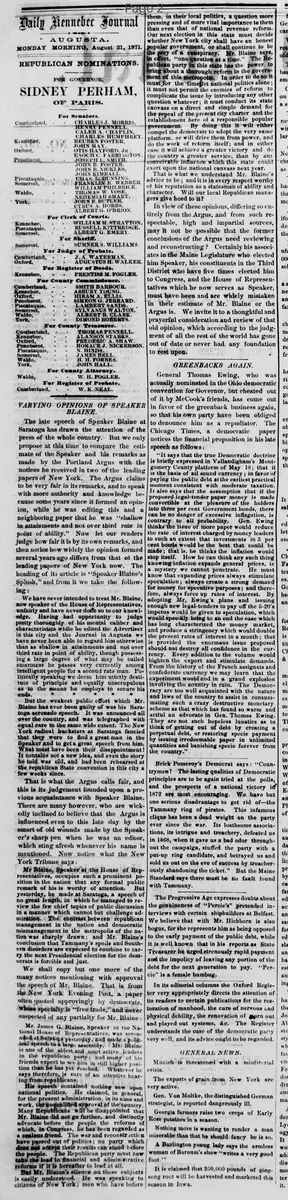
The late speech of Speaker Blaine at Saratoga has drawn the attention of the press of the whole country. But we only propose at this time to compare the estimate of the Speaker and his remarks as made by the Portland Argus with the notices he received in two of the leading papers of New York. The Argus claims to be very fair in its remarks, and to speak with more authority and knowledge because some years since it formed an opinion, while he was editing this and a neighboring paper that he was "shallow in attainments and not over third rate in point of ability." Now let our readers judge how fair it is by its own remarks, and then notice how widely the opinion formed several years ago differs from that of the leading papers of New York now. The heading of its article is "Speaker Blaine's Slosh," and from it we take the following:
We have never intended to treat Mr. Blaine now speaker of the House of Representatives, unfairly and have never done so to our knowledge. Having had opportunity to judge pretty thoroughly of his mental caliber and characteristics while he edited the Advertiser in this city and the Journal in Augusta we have never been able to regard him otherwise than as shallow in attainments and not over third rate in point of ability, though possessing a large degree of what may be called smartness he passes very currently among intelligent people for a second rate man. Politically speaking we deem him utterly destitute of principle and equally unscrupulous as to the means he employs to secure his ends.
But the weakest public effort which Mr. Blaine has ever been guilty of was his Saratoga serenade speech. It was announced all over the country, and was telegraphed with equal care to the same wide extent. The New York radical hucksters at Saratoga fancied that they were to find a great man in the Speaker and to get a great speech from him. What must have been their disappointment! It contains not a new idea, and even the story he told was old, and had been rehearsed at the republican State convention in this city a few weeks since.
That is what the Argus calls fair, and this is its judgement founded upon a previous acquaintance with Speaker Blaine There are many however, who are wickedly inclined to believe that the Argus is influenced even to this late day by the smart of old wounds made by the Speaker's sharp pen when he was an editor, which sting afresh whenever his name is mentioned. Now notice what the New York Tribune says:
Mr Blaine, Speaker of the House of Representatives, occupies such a prominent position in the nation that any formal public remark of his is worthy of attention. But yesterday, he made at Saratoga, a speech of no great length, in which he managed to review the few chief topics of public discussion in a manner which cannot but challenge admiration. The contrast between republican management in the nation and democratic mismanagement in the metropolis of the nation was sharply drawn; and Mr. Blaine's conclusion that Tammany's spoils and Southern disorders are expected to combine to carry the next Presidential election for the democrats is forcible and just.
We shall copy but one more of the many notices mentioning with approval the speech of Mr. Blaine. That is from the New York Evening Post, a paper often quoted approvingly by democrats, whose specialty is "free trade," and never suspected of any partiality for Mr. Blaine :
Mr. James G. Blaine, Speaker of the National House of Representatives, was serenaded at Saratoga yesterday. and made a political speech to a large assembly. Mr. Blaine is one of the ablest and most active leaders in the republican party; and many of his friends expect to see him in still higher position than he has yet reached. Whatever he says therefore, is sure of an attentive hearing from republicans.
His speech contained nothing new upon national politics. He claimed, in general, for the present administration, in its aims and work, the unqualified approval of the country. Many Republicans will be disappointed that Mr. Blaine did not go further, and distinctly advocate before the people the reforms of which, in Congress, he has been regarded as a zealous friend. The war and reconstruction have passed out of politics; no party which does not accept their results can stand before the people. The Republican party must now take the lead in financial and administrative reforms if it is hereafter to lead at all.
But Mr. Blaine's silence on these subjects is easily understood. He was speaking to citizens of New York; men who have before them, in their local politics, a question more pressing and of more vital importance to them than even that of national revenue reform. Our next election in this state must decide whether New York city shall have an honest popular government, or shall continue to be the prey of a conspiracy. Mr. Blaine says, in effect, "one question at a time." The Republican party in this state has the power to bring about a thorough reform in the government of this metropolis. In order to do so it must for the time let national politics alone; it must not permit the enemies of reform to complicate the issue by introducing any other question whatever; it must conduct its state canvass on a direct and simple demand for the repeal of the present city charter and the establishment here of a responsible popular government. By doing this it will either compel the democrats to adopt the very same platform, or will drive them from power, and do the work of reform itself; and in either case it will achieve a greater victory and do the country a greater service, than by any conceivable influence which this state could exert upon the national canvass next year.
That is what we understand Mr. Blaine's advice to be; and it is in every respect worthy of his reputation as a statesman of ability and character. Will our local Republican managers give heed to it?
In view of these opinions, differing so entirely from the Argus, and from such respectable, high and impartial sources, may it not be possible that the former conclusions of the Argus need reviewing and reconstructing? Certainly his associates in the Maine Legislature who elected him Speaker. his constituents in the Third District who have five times elected him to Congress, and the House of Representatives which he now serves as Speaker, must have been and are widely mistaken in their estimate of Mr. Blaine or the Argus is. We invite it to a thoughtful and prayerful consideration and review of that old opinion, which according to the judgement of all the rest of the world has gone out of date or never had any foundation to rest upon.
The late speech of Speaker Blaine at Saratoga has drawn the attention of the press of the whole country. But we only propose at this time to compare the estimate of the Speaker and his remarks as made by the Portland Argus with the notices he received in two of the leading papers of New York. The Argus claims to be very fair in its remarks, and to speak with more authority and knowledge because some years since it formed an opinion, while he was editing this and a neighboring paper that he was "shallow in attainments and not over third rate in point of ability." Now let our readers judge how fair it is by its own remarks, and then notice how widely the opinion formed several years ago differs from that of the leading papers of New York now. The heading of its article is "Speaker Blaine's Slosh," and from it we take the following:
We have never intended to treat Mr. Blaine now speaker of the House of Representatives, unfairly and have never done so to our knowledge. Having had opportunity to judge pretty thoroughly of his mental caliber and characteristics while he edited the Advertiser in this city and the Journal in Augusta we have never been able to regard him otherwise than as shallow in attainments and not over third rate in point of ability, though possessing a large degree of what may be called smartness he passes very currently among intelligent people for a second rate man. Politically speaking we deem him utterly destitute of principle and equally unscrupulous as to the means he employs to secure his ends.
But the weakest public effort which Mr. Blaine has ever been guilty of was his Saratoga serenade speech. It was announced all over the country, and was telegraphed with equal care to the same wide extent. The New York radical hucksters at Saratoga fancied that they were to find a great man in the Speaker and to get a great speech from him. What must have been their disappointment! It contains not a new idea, and even the story he told was old, and had been rehearsed at the republican State convention in this city a few weeks since.
That is what the Argus calls fair, and this is its judgement founded upon a previous acquaintance with Speaker Blaine There are many however, who are wickedly inclined to believe that the Argus is influenced even to this late day by the smart of old wounds made by the Speaker's sharp pen when he was an editor, which sting afresh whenever his name is mentioned. Now notice what the New York Tribune says:
Mr Blaine, Speaker of the House of Representatives, occupies such a prominent position in the nation that any formal public remark of his is worthy of attention. But yesterday, he made at Saratoga, a speech of no great length, in which he managed to review the few chief topics of public discussion in a manner which cannot but challenge admiration. The contrast between republican management in the nation and democratic mismanagement in the metropolis of the nation was sharply drawn; and Mr. Blaine's conclusion that Tammany's spoils and Southern disorders are expected to combine to carry the next Presidential election for the democrats is forcible and just.
We shall copy but one more of the many notices mentioning with approval the speech of Mr. Blaine. That is from the New York Evening Post, a paper often quoted approvingly by democrats, whose specialty is "free trade," and never suspected of any partiality for Mr. Blaine :
Mr. James G. Blaine, Speaker of the National House of Representatives, was serenaded at Saratoga yesterday. and made a political speech to a large assembly. Mr. Blaine is one of the ablest and most active leaders in the republican party; and many of his friends expect to see him in still higher position than he has yet reached. Whatever he says therefore, is sure of an attentive hearing from republicans.
His speech contained nothing new upon national politics. He claimed, in general, for the present administration, in its aims and work, the unqualified approval of the country. Many Republicans will be disappointed that Mr. Blaine did not go further, and distinctly advocate before the people the reforms of which, in Congress, he has been regarded as a zealous friend. The war and reconstruction have passed out of politics; no party which does not accept their results can stand before the people. The Republican party must now take the lead in financial and administrative reforms if it is hereafter to lead at all.
But Mr. Blaine's silence on these subjects is easily understood. He was speaking to citizens of New York; men who have before them, in their local politics, a question more pressing and of more vital importance to them than even that of national revenue reform. Our next election in this state must decide whether New York city shall have an honest popular government, or shall continue to be the prey of a conspiracy. Mr. Blaine says, in effect, "one question at a time." The Republican party in this state has the power to bring about a thorough reform in the government of this metropolis. In order to do so it must for the time let national politics alone; it must not permit the enemies of reform to complicate the issue by introducing any other question whatever; it must conduct its state canvass on a direct and simple demand for the repeal of the present city charter and the establishment here of a responsible popular government. By doing this it will either compel the democrats to adopt the very same platform, or will drive them from power, and do the work of reform itself; and in either case it will achieve a greater victory and do the country a greater service, than by any conceivable influence which this state could exert upon the national canvass next year.
That is what we understand Mr. Blaine's advice to be; and it is in every respect worthy of his reputation as a statesman of ability and character. Will our local Republican managers give heed to it?
In view of these opinions, differing so entirely from the Argus, and from such respectable, high and impartial sources, may it not be possible that the former conclusions of the Argus need reviewing and reconstructing? Certainly his associates in the Maine Legislature who elected him Speaker. his constituents in the Third District who have five times elected him to Congress, and the House of Representatives which he now serves as Speaker, must have been and are widely mistaken in their estimate of Mr. Blaine or the Argus is. We invite it to a thoughtful and prayerful consideration and review of that old opinion, which according to the judgement of all the rest of the world has gone out of date or never had any foundation to rest upon.
What sub-type of article is it?
Biography
Historical Event
What themes does it cover?
Social Manners
Justice
What keywords are associated?
Blaine Speech
Saratoga
Portland Argus
New York Tribune
Political Opinions
Speaker Blaine
What entities or persons were involved?
James G. Blaine
Speaker Blaine
Where did it happen?
Saratoga
Story Details
Key Persons
James G. Blaine
Speaker Blaine
Location
Saratoga
Story Details
The article compares the Portland Argus's negative assessment of Speaker Blaine's Saratoga speech, calling it shallow and unprincipled, with positive reviews from the New York Tribune and Evening Post, which praise his ability and advice on political reforms.