Thank you for visiting SNEWPapers!
Sign up free
Editorial
October 8, 1841
Southern Christian Advocate
Charleston, Charleston County, South Carolina
What is this article about?
An editorial critiques the excessive reading of novels by young women, arguing it seduces the mind from pure intellectual pursuits, vitiates taste for substantial literature like history and biography, and provides no enduring intellectual nourishment, contrasting it with works by authors like Milton and biographies of great figures.
Clipping
OCR Quality
98%
Excellent
Full Text
YOUNG LADIES.
NOVEL READING
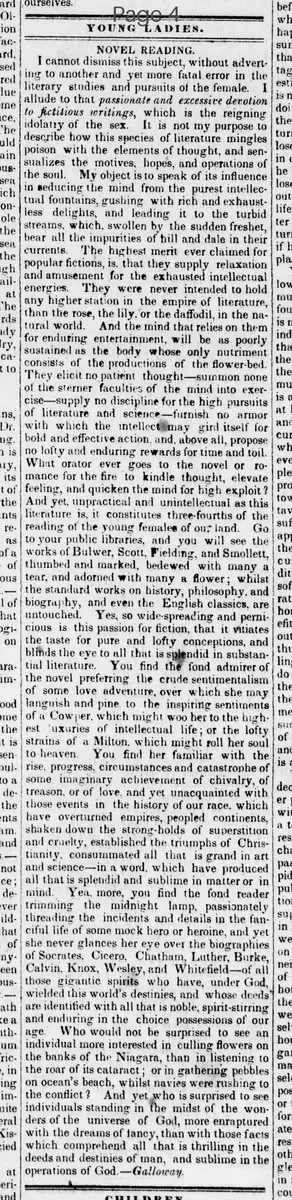
I cannot dismiss this subject, without adverting to another and yet more fatal error in the literary studies and pursuits of the female. I allude to that passionate and excessive devotion to fictitious writings, which is the reigning idolatry of the sex. It is not my purpose to describe how this species of literature mingles poison with the elements of thought, and sensualizes the motives, hopes, and operations of the soul. My object is to speak of its influence in seducing the mind from the purest intellectual fountains, gushing with rich and exhaustless delights, and leading it to the turbid streams, which, swollen by the sudden freshet, bear all the impurities of hill and dale in their currents. The highest merit ever claimed for popular fictions, is, that they supply relaxation and amusement for the exhausted intellectual energies. They were never intended to hold any higher station in the empire of literature, than the rose, the lily, or the daffodil, in the natural world. And the mind that relies on them for enduring entertainment, will be as poorly sustained as the body whose only nutriment consists of the productions of the flower-bed.
They elicit no patient thought--summon none of the sterner faculties of the mind into exercise--supply no discipline for the high pursuits of literature and science--furnish no armor with which the intellect may gird itself for bold and effective action, and, above all, propose no lofty and enduring rewards for time and toil. What orator ever goes to the novel or romance for the fire to kindle thought, elevate feeling, and quicken the mind for high exploit? And yet, unpractical and unintellectual as this literature is, it constitutes three-fourths of the reading of the young females of our land. Go to your public libraries, and you will see the works of Bulwer, Scott, Fielding, and Smollett, thumbed and marked, bedewed with many a tear, and adorned with many a flower; whilst the standard works on history, philosophy, and biography, and even the English classics, are untouched. Yes, so wide-spreading and pernicious is this passion for fiction, that it vitiates the taste for pure and lofty conceptions, and blinds the eye to all that is splendid in substantial literature. You find the fond admirer of the novel preferring the crude sentimentalism of some love adventure, over which she may languish and pine to the inspiring sentiments of a Cowper, which might woo her to the highest luxuries of intellectual life; or the lofty strains of a Milton, which might roll her soul to heaven. You find her familiar with the rise, progress, circumstances and catastrophe of some imaginary achievement of chivalry, of treason, or of love, and yet unacquainted with those events in the history of our race, which have overturned empires, peopled continents, shaken down the strong-holds of superstition and cruelty, established the triumphs of Christianity, consummated all that is grand in art and science--in a word, which have produced all that is splendid and sublime in matter or in mind. Yea, more, you find the fond reader trimming the midnight lamp, passionately threading the incidents and details in the fanciful life of some mock hero or heroine, and yet she never glances her eye over the biographies of Socrates, Cicero, Chatham, Luther, Burke, Calvin, Knox, Wesley, and Whitefield--of all those gigantic spirits who have, under God, wielded this world's destinies, and whose deeds are identified with all that is noble, spirit-stirring and enduring in the choice possessions of our age. Who would not be surprised to see an individual more interested in culling flowers on the banks of the Niagara, than in listening to the roar of its cataract; or in gathering pebbles on ocean's beach, whilst navies were rushing to the conflict? And yet who is surprised to see individuals standing in the midst of the wonders of the universe of God, more enraptured with the dreams of fancy, than with those facts which comprehend all that is thrilling in the deeds and destinies of man, and sublime in the operations of God.--Galloway.
NOVEL READING
I cannot dismiss this subject, without adverting to another and yet more fatal error in the literary studies and pursuits of the female. I allude to that passionate and excessive devotion to fictitious writings, which is the reigning idolatry of the sex. It is not my purpose to describe how this species of literature mingles poison with the elements of thought, and sensualizes the motives, hopes, and operations of the soul. My object is to speak of its influence in seducing the mind from the purest intellectual fountains, gushing with rich and exhaustless delights, and leading it to the turbid streams, which, swollen by the sudden freshet, bear all the impurities of hill and dale in their currents. The highest merit ever claimed for popular fictions, is, that they supply relaxation and amusement for the exhausted intellectual energies. They were never intended to hold any higher station in the empire of literature, than the rose, the lily, or the daffodil, in the natural world. And the mind that relies on them for enduring entertainment, will be as poorly sustained as the body whose only nutriment consists of the productions of the flower-bed.
They elicit no patient thought--summon none of the sterner faculties of the mind into exercise--supply no discipline for the high pursuits of literature and science--furnish no armor with which the intellect may gird itself for bold and effective action, and, above all, propose no lofty and enduring rewards for time and toil. What orator ever goes to the novel or romance for the fire to kindle thought, elevate feeling, and quicken the mind for high exploit? And yet, unpractical and unintellectual as this literature is, it constitutes three-fourths of the reading of the young females of our land. Go to your public libraries, and you will see the works of Bulwer, Scott, Fielding, and Smollett, thumbed and marked, bedewed with many a tear, and adorned with many a flower; whilst the standard works on history, philosophy, and biography, and even the English classics, are untouched. Yes, so wide-spreading and pernicious is this passion for fiction, that it vitiates the taste for pure and lofty conceptions, and blinds the eye to all that is splendid in substantial literature. You find the fond admirer of the novel preferring the crude sentimentalism of some love adventure, over which she may languish and pine to the inspiring sentiments of a Cowper, which might woo her to the highest luxuries of intellectual life; or the lofty strains of a Milton, which might roll her soul to heaven. You find her familiar with the rise, progress, circumstances and catastrophe of some imaginary achievement of chivalry, of treason, or of love, and yet unacquainted with those events in the history of our race, which have overturned empires, peopled continents, shaken down the strong-holds of superstition and cruelty, established the triumphs of Christianity, consummated all that is grand in art and science--in a word, which have produced all that is splendid and sublime in matter or in mind. Yea, more, you find the fond reader trimming the midnight lamp, passionately threading the incidents and details in the fanciful life of some mock hero or heroine, and yet she never glances her eye over the biographies of Socrates, Cicero, Chatham, Luther, Burke, Calvin, Knox, Wesley, and Whitefield--of all those gigantic spirits who have, under God, wielded this world's destinies, and whose deeds are identified with all that is noble, spirit-stirring and enduring in the choice possessions of our age. Who would not be surprised to see an individual more interested in culling flowers on the banks of the Niagara, than in listening to the roar of its cataract; or in gathering pebbles on ocean's beach, whilst navies were rushing to the conflict? And yet who is surprised to see individuals standing in the midst of the wonders of the universe of God, more enraptured with the dreams of fancy, than with those facts which comprehend all that is thrilling in the deeds and destinies of man, and sublime in the operations of God.--Galloway.
What sub-type of article is it?
Moral Or Religious
Education
Social Reform
What keywords are associated?
Novel Reading
Young Women
Intellectual Pursuits
Fiction Dangers
Literary Taste
Moral Influence
Female Education
What entities or persons were involved?
Bulwer
Scott
Fielding
Smollett
Cowper
Milton
Socrates
Cicero
Chatham
Luther
Burke
Calvin
Knox
Wesley
Whitefield
Editorial Details
Primary Topic
Excessive Novel Reading By Young Women
Stance / Tone
Strong Condemnation
Key Figures
Bulwer
Scott
Fielding
Smollett
Cowper
Milton
Socrates
Cicero
Chatham
Luther
Burke
Calvin
Knox
Wesley
Whitefield
Key Arguments
Novels Poison The Mind And Sensualize Motives
They Distract From Pure Intellectual Sources Like History And Philosophy
Novels Provide Only Temporary Amusement, Not Enduring Nourishment
Young Women Prefer Novels Over Classics And Biographies
This Passion Vitiates Taste For Lofty Literature
Readers Ignore Real Historical Events And Great Figures' Lives