Thank you for visiting SNEWPapers!
Sign up free
The Western Democrat
Charlotte, Mecklenburg County, North Carolina
What is this article about?
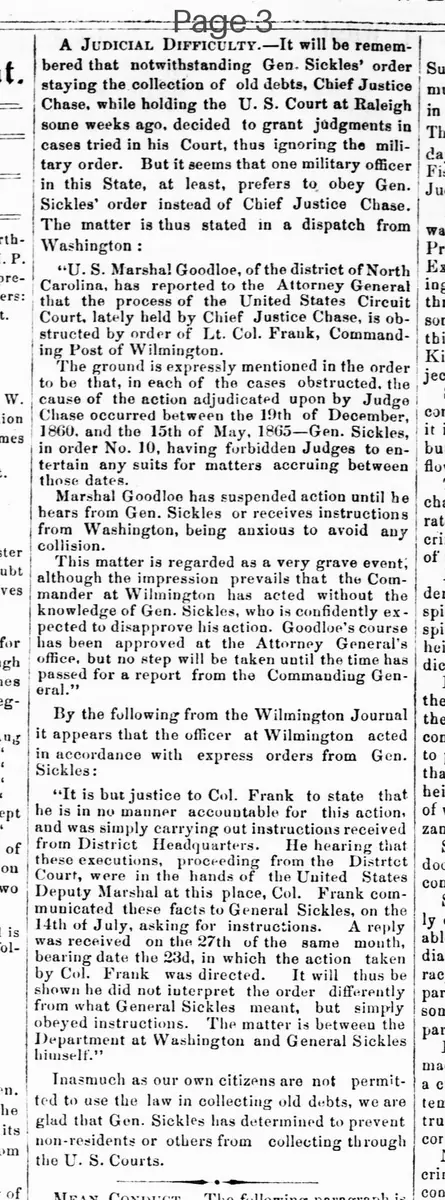
In post-Civil War North Carolina, a conflict arises between Gen. Sickles' military order barring collection of debts accrued between Dec. 19, 1860, and May 15, 1865, and Chief Justice Chase's U.S. Court decisions granting judgments on such cases. U.S. Marshal Goodloe suspends enforcement in Wilmington due to Lt. Col. Frank's obstruction per Sickles' instructions, awaiting resolution from Washington.
Clipping
OCR Quality
Full Text
The matter is thus stated in a dispatch from Washington:
"U. S. Marshal Goodloe, of the district of North Carolina, has reported to the Attorney General that the process of the United States Circuit Court, lately held by Chief Justice Chase, is obstructed by order of Lt. Col. Frank, Commanding Post of Wilmington.
The ground is expressly mentioned in the order to be that, in each of the cases obstructed, the cause of the action adjudicated upon by Judge Chase occurred between the 19th of December, 1860, and the 15th of May, 1865—Gen. Sickles, in order No. 10, having forbidden Judges to entertain any suits for matters accruing between those dates.
Marshal Goodloe has suspended action until he hears from Gen. Sickles or receives instructions from Washington, being anxious to avoid any collision.
This matter is regarded as a very grave event; although the impression prevails that the Commander at Wilmington has acted without the knowledge of Gen. Sickles, who is confidently expected to disapprove his action. Goodloe's course has been approved at the Attorney General's office, but no step will be taken until the time has passed for a report from the Commanding General."
By the following from the Wilmington Journal it appears that the officer at Wilmington acted in accordance with express orders from Gen. Sickles:
"It is but justice to Col. Frank to state that he is in no manner accountable for this action, and was simply carrying out instructions received from District Headquarters. He hearing that these executions, proceeding from the District Court, were in the hands of the United States Deputy Marshal at this place, Col. Frank communicated these facts to General Sickles, on the 14th of July, asking for instructions. A reply was received on the 27th of the same month, bearing date the 23d, in which the action taken by Col. Frank was directed. It will thus be shown he did not interpret the order differently from what General Sickles meant, but simply obeyed instructions. The matter is between the Department at Washington and General Sickles himself.""
Inasmuch as our own citizens are not permitted to use the law in collecting old debts, we are glad that Gen. Sickles has determined to prevent non-residents or others from collecting through the U. S. Courts.
What sub-type of article is it?
What themes does it cover?
What keywords are associated?
What entities or persons were involved?
Where did it happen?
Story Details
Key Persons
Location
North Carolina, Raleigh, Wilmington
Event Date
Between December 19, 1860 And May 15, 1865; July 1867
Story Details
Gen. Sickles' military order prohibits collecting debts from 1860-1865, conflicting with Chief Justice Chase's court judgments in Raleigh. In Wilmington, Lt. Col. Frank obstructs U.S. Marshal Goodloe's enforcement per Sickles' direct instructions, suspending actions to avoid collision; matter escalates to Washington.