Thank you for visiting SNEWPapers!
Sign up free
Literary
September 20, 1828
Literary Cadet And Rhode Island Statesman
Providence, Providence County, Rhode Island
What is this article about?
In this sentimental tale, a traveler aids a remorseful hermit who murdered his betrothed Maria in jealousy, granting him forgiveness through a dream vision. Companion William reunites with his faithful love Azubah in America after years of doubt, emphasizing themes of redemption, constancy, and love. They marry happily.
Clipping
OCR Quality
95%
Excellent
Full Text
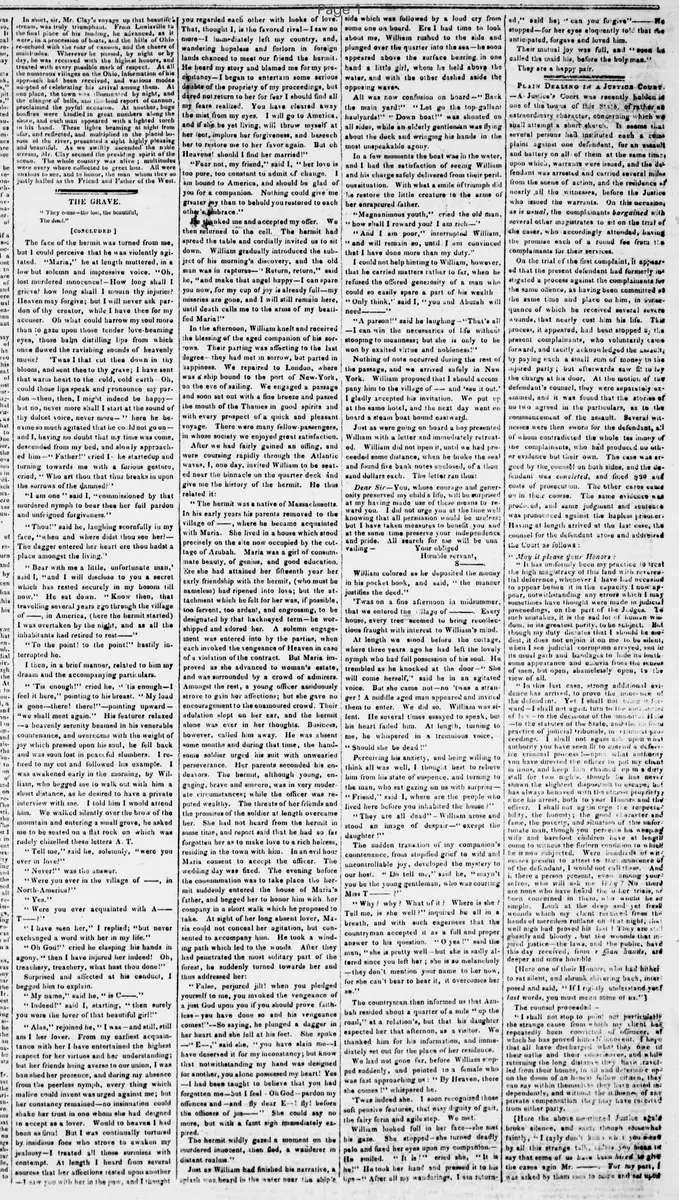
THE GRAVE.
"They come—the lost, the beautiful—The dead."
[CONCLUDED]
The face of the hermit was turned from me, but I could perceive that he was violently agitated. "Maria," he at length muttered, in a low but solemn and impressive voice. "Oh, lost murdered innocence!—How long shall I grieve? how long shall I mourn thy injuries? Heaven may forgive; but I will never ask pardon of thy creator, while I have thee for my accuser. Oh what could harrow my soul more than to gaze upon those tender love-beaming eyes, those balm distilling lips from which once flowed the ravishing sounds of heavenly music?
'Twas I that cut thee down in thy bloom, and sent thee to thy grave; I have sent that warm heart to the cold, cold earth—Oh, could those lips speak and pronounce my pardon—then, then, I might indeed be happy—but no, never more shall I start at the sound of thy dulcet voice, never more—” here he became so much agitated that he could not go on—and I, having no doubt that my time was come, descended from my bed, and slowly approached him—“Father!” cried I—he started up and turning towards me with a furious gesture, cried, “Who art thou that thus breaks in upon the sorrows of the damned?”
“I am one,” said I, “commissioned by that murdered nymph to bear thee her full pardon and unfeigned forgiveness.”
“Thou!” said he, laughing scornfully in my face, “when and where didst thou see her?—The dagger entered her heart ere thou hadst a place amongst the living.”
“Bear with me a little, unfortunate man,” said I, “and I will disclose to you a secret which has rested securely in my bosom till now.”
He sat down. “Know then, that travelling several years ago through the village of —, in America, (here the hermit started) I was overtaken by the night, and as all the inhabitants had retired to rest
“To the point! to the point!” hastily interrupted he.
I then, in a brief manner, related to him my dream and the accompanying particulars.
“ 'Tis enough!” cried he, “ 'tis enough—I feel it here,” pointing to his breast. “My load is gone—there! there!”—pointing upward—“we shall meet again.” His features relaxed—a heavenly serenity beamed in his venerable countenance, and overcome with the weight of joy which pressed upon his soul, he fell back and was soon lost in peaceful slumbers. I retired to my cot and followed his example. I was awakened early in the morning, by William, who begged me to walk out with him a short distance, as he desired to have a private interview with me. I told him I would attend him. We walked silently over the brow of the mountain and entering a small grove, he asked me to be seated on a flat rock on which was rudely chiselled these letters A. T.
“Tell me,” said he, solemnly, “were you ever in love?”
“Never!” was the answer.
“Were you ever in the village of ——, in North-America?”
“Yes.”
“Were you ever acquainted with A——T——?”
“I have seen her,” I replied; “but never exchanged a word with her in my life.”
“Oh God!” cried he clasping his hands in agony, “then I have injured her indeed! Oh, treachery, treachery, what hast thou done!”
Surprised and affected at his conduct, I begged him to explain.
“My name,” said he, “is C——.”
“Indeed!” said I, starting, “then surely you were the lover of that beautiful girl!”
“Alas,” rejoined he, “I was—and still, still am I her lover. From my earliest acquaintance with her I have entertained the highest respect for her virtues and her understanding; but her friends being averse to our union, I was banished her presence, and during my absence from the peerless nymph, every thing which malice could invent was urged against me; but her constancy remained—no insinuation could shake her trust in one whom she had deigned to accept as a lover. Would to heaven I had been as firm! But I was continually tortured by insidious foes who strove to awaken my jealousy—I treated all those surmises with contempt. At length I heard from several sources that her affections rested upon another—I saw you with her in the pew, and I thought you regarded each other with looks of love. That, thought I, is the favored rival—I saw no more—I immediately left my country, and, wandering hopeless and forlorn in foreign lands chanced to meet our friend the hermit. He heard my story and blamed me for my precipitancy—I began to entertain some serious doubts of the propriety of my proceedings, but dared not return to her for fear I should find all my fears realized. You have cleared away the mist from my eyes. I will go to America, and if she be yet living, will throw myself at her feet, implore her forgiveness, and beseech her to restore me to her favor again. But oh Heavens! should I find her married!”
“Fear not, my friend,” said I, “her love is too pure, too constant to admit of change. I am bound to America, and should be glad of you for a companion. Nothing could give me greater joy than to behold you restored to each other's embrace.”
I thanked me and accepted my offer. We then returned to the cell. The hermit had spread the table and cordially invited us to sit down. William gradually introduced the subject of his morning's discovery, and the old man was in raptures—“Return, return,” said he, “and make that angel happy—I can spare you now, for my cup of joy is already full—my miseries are gone, and I will still remain here, until death calls me to the arms of my beatified Maria!”
In the afternoon, William knelt and received the blessing of the aged companion of his sorrows. Their parting was affecting to the last degree—they had met in sorrow, but parted in happiness. We repaired to London, where was a ship bound to the port of New-York, on the eve of sailing. We engaged a passage and soon set out with a fine breeze and passed the mouth of the Thames in good spirits and with every prospect of a quick and pleasant voyage. There were many fellow-passengers, in whose society we enjoyed great satisfaction. After we had fairly gained an offing, and were coursing rapidly through the Atlantic waves, I, one day, invited William to be seated near the binnacle on the quarter deck and give me the history of the hermit. He thus related it:
“The hermit was a native of Massachusetts. In his early years his parents removed to the village of —, where he became acquainted with Maria. She lived in a house which stood precisely on the site now occupied by the cottage of Azubah. Maria was a girl of consummate beauty, of genius, and good education. Ere she had attained her fifteenth year her early friendship with the hermit, (who must be nameless) had ripened into love; but the attachment which he felt for her was, if possible, too fervent, too ardent, and engrossing, to be designated by that hackneyed term—he worshipped and adored her. A solemn engagement was entered into by the parties, when each invoked the vengeance of Heaven in case of a violation of the contract. But Maria improved as she advanced to woman's estate, and was surrounded by a crowd of admirers. Amongst the rest, a young officer assiduously strove to gain her affections; but she gave no encouragement to the enamoured crowd. Their adulation slept on her ear, and the hermit alone was ever in her thoughts. Business, however, called him away. He was absent some months and during that time, the handsome soldier urged his suit with unwearied perseverance. Her parents seconded his endeavors. The hermit, although young, engaging, brave and sincere, was in very moderate circumstances; while the officer was reputed wealthy. The threats of her friends and the promises of the soldier at length overcame her. She had not heard from the hermit in some time, and report said that he had so far forgotten her as to make love to a rich heiress, residing in the town with him. In an evil hour Maria consented to accept the officer. The wedding day was fixed. The evening before the consummation was to take place the hermit suddenly entered the house of Maria's father, and begged her to honor him with her company in a short walk which he proposed to take. At sight of her long absent lover, Maria could not conceal her agitation, but consented to accompany him. He took a winding path which led to the woods. After they had penetrated the most solitary part of the forest, he suddenly turned towards her and thus addressed her:
“False, perjured jilt! when you pledged yourself to me, you invoked the vengeance of a just God upon you if you should prove faithless—you have done so and his vengeance comes!”—So saying, he plunged a dagger in her heart and she fell at his feet. She spoke—“E——,” said she, “you have slain me—I have deserved it for my inconstancy; but know that notwithstanding my hand was designed for another, you alone possessed my heart! Yes—I had been taught to believe that you had forgotten me—But I feel—Oh God—pardon my offences and—and—my dear E——! fly! before the officers of jus—” She could say no more, but with a faint sigh immediately expired.
The hermit wildly gazed a moment on the murdered innocent, then fled, a wanderer in distant realms.”
Just as William had finished his narrative, a splash was heard in the water near the ship's side which was followed by a loud cry from some one on board. Ere I had time to look about me, William rushed to the side and plunged over the quarter into the sea—he soon appeared above the surface bearing in one hand a little girl, whom he held above the water, and with the other dashed aside the opposing wave.
All was now confusion on board—“Back the main yard!” “Let go the top-gallant haulyards!” “Down boat!” was shouted on all sides, while an elderly gentleman was flying about the deck and wringing his hands in the most unspeakable agony.
In a few moments the boat was in the water, and I had the satisfaction of seeing William and his charge safely delivered from their perilous situation. With what a smile of triumph did he restore the little creature to the arms of her enraptured father.
“Magnanimous youth,” cried the old man, “how shall I reward you? I am rich—”
“And I am poor,” interrupted William, “and will remain so, until I am convinced that I have done more than my duty.”
I could not help hinting to William, however, that he carried matters rather too far, when he refused the offered generosity of a man who could so easily spare a part of his wealth.
“Only think,” said I, “you and Azubah will need—"
“A parson!” said he laughing—“That's all—I can win the necessaries of life without stooping to meanness; but she is only to be won by exalted virtue and nobleness!”
Nothing of note occurred during the rest of the passage, and we arrived safely in New York. William proposed that I should accompany him to the village of —— and 'see it out.' I gladly accepted his invitation. We put up at the same hotel, and the next day went on board a steamboat bound eastward.
Just as we were going on board a boy presented William with a letter and immediately retreated. William did not open it, until we had proceeded some distance, when he broke the seal and found five bank notes enclosed, of a thousand dollars each. The letter ran thus:
Dear Sir—You, whose courage and generosity preserved my child's life, will be surprised at my having made use of these means to reward you. I did not urge you at the time well knowing that all persuasion would be useless; but I have taken measures to benefit you and at the same time preserve your independence and pride.
All search for me will be unavailing
Your obliged
Humble servant,
S
William colored as he deposited the money in his pocket book, and said, “the manner justifies the deed.”
'Twas on a fine afternoon in midsummer, that we entered the village of ——. Every house, every tree seemed to bring recollections fraught with interest to William's mind. At length we stood before the cottage, where three years ago he had left the lovely nymph who had full possession of his soul. He trembled as he knocked at the door—“She will come herself,” said he in an agitated voice. But she came not—'twas a stranger! A middle aged man appeared and invited them to enter. We did so. William was silent. He several times essayed to speak, but his heart failed him. At length, turning to me, he whispered in a tremulous voice,
“Should she be dead!”
Perceiving his anxiety, and being willing to think all was well, I thought best to relieve him from his state of suspense, and turning to the man, who sat gazing on us with surprise—
“Friend,” said I, “where are the people who lived here before you inhabited the house?”
“They are all dead”—William arose and stood an image of despair—“except the daughter!”
The sudden transition of my companion's countenance, from stupified grief to wild and uncontrollable joy, developed the mystery to our host. “Do tell me,” said he, “mayn't you be the young gentleman, who was courting Miss T——?”
“Why? why? What of it? Where is she? Tell me, is she well?” inquired he all in a breath, and with such eagerness that the countryman accepted it as a full and proper answer to his question. “O yes!” said the man, “she is pretty well—but she is sadly altered since you left her; she is so melancholy—they don't mention your name to her now, for she can't bear to hear it. It overcomes her so.”
The countryman then informed us that Azubah resided about a quarter of a mile "up the road," at a relation's, but that his daughter expected her that afternoon, as a visitor. We thanked him for his information, and immediately set out for the place of her residence. We had not gone far, before William stopped suddenly, and pointed to a female who was fast approaching us: “By Heaven, there she comes!” whispered he.
'Twas indeed she. I soon recognized those soft pensive features, that easy dignity of gait, the fairy form and agile step. We met. William looked full in her face—she met his gaze. She stopped—she turned deadly pale and fixed her eyes upon my companion.—He smiled. “It is!” cried she, “It is he!” He took her hand and pressed it to his lips—“After all my wanderings, I am returned,” said he; “can you forgive”—and—he stopped—for her eyes eloquently told that she anticipated, forgave and loved him.
Their mutual joy was full, and "soon he called the maid his, before the holy man."
They are a happy pair.
"They come—the lost, the beautiful—The dead."
[CONCLUDED]
The face of the hermit was turned from me, but I could perceive that he was violently agitated. "Maria," he at length muttered, in a low but solemn and impressive voice. "Oh, lost murdered innocence!—How long shall I grieve? how long shall I mourn thy injuries? Heaven may forgive; but I will never ask pardon of thy creator, while I have thee for my accuser. Oh what could harrow my soul more than to gaze upon those tender love-beaming eyes, those balm distilling lips from which once flowed the ravishing sounds of heavenly music?
'Twas I that cut thee down in thy bloom, and sent thee to thy grave; I have sent that warm heart to the cold, cold earth—Oh, could those lips speak and pronounce my pardon—then, then, I might indeed be happy—but no, never more shall I start at the sound of thy dulcet voice, never more—” here he became so much agitated that he could not go on—and I, having no doubt that my time was come, descended from my bed, and slowly approached him—“Father!” cried I—he started up and turning towards me with a furious gesture, cried, “Who art thou that thus breaks in upon the sorrows of the damned?”
“I am one,” said I, “commissioned by that murdered nymph to bear thee her full pardon and unfeigned forgiveness.”
“Thou!” said he, laughing scornfully in my face, “when and where didst thou see her?—The dagger entered her heart ere thou hadst a place amongst the living.”
“Bear with me a little, unfortunate man,” said I, “and I will disclose to you a secret which has rested securely in my bosom till now.”
He sat down. “Know then, that travelling several years ago through the village of —, in America, (here the hermit started) I was overtaken by the night, and as all the inhabitants had retired to rest
“To the point! to the point!” hastily interrupted he.
I then, in a brief manner, related to him my dream and the accompanying particulars.
“ 'Tis enough!” cried he, “ 'tis enough—I feel it here,” pointing to his breast. “My load is gone—there! there!”—pointing upward—“we shall meet again.” His features relaxed—a heavenly serenity beamed in his venerable countenance, and overcome with the weight of joy which pressed upon his soul, he fell back and was soon lost in peaceful slumbers. I retired to my cot and followed his example. I was awakened early in the morning, by William, who begged me to walk out with him a short distance, as he desired to have a private interview with me. I told him I would attend him. We walked silently over the brow of the mountain and entering a small grove, he asked me to be seated on a flat rock on which was rudely chiselled these letters A. T.
“Tell me,” said he, solemnly, “were you ever in love?”
“Never!” was the answer.
“Were you ever in the village of ——, in North-America?”
“Yes.”
“Were you ever acquainted with A——T——?”
“I have seen her,” I replied; “but never exchanged a word with her in my life.”
“Oh God!” cried he clasping his hands in agony, “then I have injured her indeed! Oh, treachery, treachery, what hast thou done!”
Surprised and affected at his conduct, I begged him to explain.
“My name,” said he, “is C——.”
“Indeed!” said I, starting, “then surely you were the lover of that beautiful girl!”
“Alas,” rejoined he, “I was—and still, still am I her lover. From my earliest acquaintance with her I have entertained the highest respect for her virtues and her understanding; but her friends being averse to our union, I was banished her presence, and during my absence from the peerless nymph, every thing which malice could invent was urged against me; but her constancy remained—no insinuation could shake her trust in one whom she had deigned to accept as a lover. Would to heaven I had been as firm! But I was continually tortured by insidious foes who strove to awaken my jealousy—I treated all those surmises with contempt. At length I heard from several sources that her affections rested upon another—I saw you with her in the pew, and I thought you regarded each other with looks of love. That, thought I, is the favored rival—I saw no more—I immediately left my country, and, wandering hopeless and forlorn in foreign lands chanced to meet our friend the hermit. He heard my story and blamed me for my precipitancy—I began to entertain some serious doubts of the propriety of my proceedings, but dared not return to her for fear I should find all my fears realized. You have cleared away the mist from my eyes. I will go to America, and if she be yet living, will throw myself at her feet, implore her forgiveness, and beseech her to restore me to her favor again. But oh Heavens! should I find her married!”
“Fear not, my friend,” said I, “her love is too pure, too constant to admit of change. I am bound to America, and should be glad of you for a companion. Nothing could give me greater joy than to behold you restored to each other's embrace.”
I thanked me and accepted my offer. We then returned to the cell. The hermit had spread the table and cordially invited us to sit down. William gradually introduced the subject of his morning's discovery, and the old man was in raptures—“Return, return,” said he, “and make that angel happy—I can spare you now, for my cup of joy is already full—my miseries are gone, and I will still remain here, until death calls me to the arms of my beatified Maria!”
In the afternoon, William knelt and received the blessing of the aged companion of his sorrows. Their parting was affecting to the last degree—they had met in sorrow, but parted in happiness. We repaired to London, where was a ship bound to the port of New-York, on the eve of sailing. We engaged a passage and soon set out with a fine breeze and passed the mouth of the Thames in good spirits and with every prospect of a quick and pleasant voyage. There were many fellow-passengers, in whose society we enjoyed great satisfaction. After we had fairly gained an offing, and were coursing rapidly through the Atlantic waves, I, one day, invited William to be seated near the binnacle on the quarter deck and give me the history of the hermit. He thus related it:
“The hermit was a native of Massachusetts. In his early years his parents removed to the village of —, where he became acquainted with Maria. She lived in a house which stood precisely on the site now occupied by the cottage of Azubah. Maria was a girl of consummate beauty, of genius, and good education. Ere she had attained her fifteenth year her early friendship with the hermit, (who must be nameless) had ripened into love; but the attachment which he felt for her was, if possible, too fervent, too ardent, and engrossing, to be designated by that hackneyed term—he worshipped and adored her. A solemn engagement was entered into by the parties, when each invoked the vengeance of Heaven in case of a violation of the contract. But Maria improved as she advanced to woman's estate, and was surrounded by a crowd of admirers. Amongst the rest, a young officer assiduously strove to gain her affections; but she gave no encouragement to the enamoured crowd. Their adulation slept on her ear, and the hermit alone was ever in her thoughts. Business, however, called him away. He was absent some months and during that time, the handsome soldier urged his suit with unwearied perseverance. Her parents seconded his endeavors. The hermit, although young, engaging, brave and sincere, was in very moderate circumstances; while the officer was reputed wealthy. The threats of her friends and the promises of the soldier at length overcame her. She had not heard from the hermit in some time, and report said that he had so far forgotten her as to make love to a rich heiress, residing in the town with him. In an evil hour Maria consented to accept the officer. The wedding day was fixed. The evening before the consummation was to take place the hermit suddenly entered the house of Maria's father, and begged her to honor him with her company in a short walk which he proposed to take. At sight of her long absent lover, Maria could not conceal her agitation, but consented to accompany him. He took a winding path which led to the woods. After they had penetrated the most solitary part of the forest, he suddenly turned towards her and thus addressed her:
“False, perjured jilt! when you pledged yourself to me, you invoked the vengeance of a just God upon you if you should prove faithless—you have done so and his vengeance comes!”—So saying, he plunged a dagger in her heart and she fell at his feet. She spoke—“E——,” said she, “you have slain me—I have deserved it for my inconstancy; but know that notwithstanding my hand was designed for another, you alone possessed my heart! Yes—I had been taught to believe that you had forgotten me—But I feel—Oh God—pardon my offences and—and—my dear E——! fly! before the officers of jus—” She could say no more, but with a faint sigh immediately expired.
The hermit wildly gazed a moment on the murdered innocent, then fled, a wanderer in distant realms.”
Just as William had finished his narrative, a splash was heard in the water near the ship's side which was followed by a loud cry from some one on board. Ere I had time to look about me, William rushed to the side and plunged over the quarter into the sea—he soon appeared above the surface bearing in one hand a little girl, whom he held above the water, and with the other dashed aside the opposing wave.
All was now confusion on board—“Back the main yard!” “Let go the top-gallant haulyards!” “Down boat!” was shouted on all sides, while an elderly gentleman was flying about the deck and wringing his hands in the most unspeakable agony.
In a few moments the boat was in the water, and I had the satisfaction of seeing William and his charge safely delivered from their perilous situation. With what a smile of triumph did he restore the little creature to the arms of her enraptured father.
“Magnanimous youth,” cried the old man, “how shall I reward you? I am rich—”
“And I am poor,” interrupted William, “and will remain so, until I am convinced that I have done more than my duty.”
I could not help hinting to William, however, that he carried matters rather too far, when he refused the offered generosity of a man who could so easily spare a part of his wealth.
“Only think,” said I, “you and Azubah will need—"
“A parson!” said he laughing—“That's all—I can win the necessaries of life without stooping to meanness; but she is only to be won by exalted virtue and nobleness!”
Nothing of note occurred during the rest of the passage, and we arrived safely in New York. William proposed that I should accompany him to the village of —— and 'see it out.' I gladly accepted his invitation. We put up at the same hotel, and the next day went on board a steamboat bound eastward.
Just as we were going on board a boy presented William with a letter and immediately retreated. William did not open it, until we had proceeded some distance, when he broke the seal and found five bank notes enclosed, of a thousand dollars each. The letter ran thus:
Dear Sir—You, whose courage and generosity preserved my child's life, will be surprised at my having made use of these means to reward you. I did not urge you at the time well knowing that all persuasion would be useless; but I have taken measures to benefit you and at the same time preserve your independence and pride.
All search for me will be unavailing
Your obliged
Humble servant,
S
William colored as he deposited the money in his pocket book, and said, “the manner justifies the deed.”
'Twas on a fine afternoon in midsummer, that we entered the village of ——. Every house, every tree seemed to bring recollections fraught with interest to William's mind. At length we stood before the cottage, where three years ago he had left the lovely nymph who had full possession of his soul. He trembled as he knocked at the door—“She will come herself,” said he in an agitated voice. But she came not—'twas a stranger! A middle aged man appeared and invited them to enter. We did so. William was silent. He several times essayed to speak, but his heart failed him. At length, turning to me, he whispered in a tremulous voice,
“Should she be dead!”
Perceiving his anxiety, and being willing to think all was well, I thought best to relieve him from his state of suspense, and turning to the man, who sat gazing on us with surprise—
“Friend,” said I, “where are the people who lived here before you inhabited the house?”
“They are all dead”—William arose and stood an image of despair—“except the daughter!”
The sudden transition of my companion's countenance, from stupified grief to wild and uncontrollable joy, developed the mystery to our host. “Do tell me,” said he, “mayn't you be the young gentleman, who was courting Miss T——?”
“Why? why? What of it? Where is she? Tell me, is she well?” inquired he all in a breath, and with such eagerness that the countryman accepted it as a full and proper answer to his question. “O yes!” said the man, “she is pretty well—but she is sadly altered since you left her; she is so melancholy—they don't mention your name to her now, for she can't bear to hear it. It overcomes her so.”
The countryman then informed us that Azubah resided about a quarter of a mile "up the road," at a relation's, but that his daughter expected her that afternoon, as a visitor. We thanked him for his information, and immediately set out for the place of her residence. We had not gone far, before William stopped suddenly, and pointed to a female who was fast approaching us: “By Heaven, there she comes!” whispered he.
'Twas indeed she. I soon recognized those soft pensive features, that easy dignity of gait, the fairy form and agile step. We met. William looked full in her face—she met his gaze. She stopped—she turned deadly pale and fixed her eyes upon my companion.—He smiled. “It is!” cried she, “It is he!” He took her hand and pressed it to his lips—“After all my wanderings, I am returned,” said he; “can you forgive”—and—he stopped—for her eyes eloquently told that she anticipated, forgave and loved him.
Their mutual joy was full, and "soon he called the maid his, before the holy man."
They are a happy pair.
What sub-type of article is it?
Prose Fiction
Dialogue
What themes does it cover?
Love Romance
Moral Virtue
Death Mortality
What keywords are associated?
Grave
Hermit
Murder
Forgiveness
Love
Jealousy
Reunion
America
Literary Details
Title
The Grave.
Key Lines
"They Come—The Lost, The Beautiful—The Dead."
"False, Perjured Jilt! When You Pledged Yourself To Me, You Invoked The Vengeance Of A Just God Upon You If You Should Prove Faithless—You Have Done So And His Vengeance Comes!"
"E——," Said She, "You Have Slain Me—I Have Deserved It For My Inconstancy; But Know That Notwithstanding My Hand Was Designed For Another, You Alone Possessed My Heart!"
"It Is!" Cried She, "It Is He!"
Their Mutual Joy Was Full, And "Soon He Called The Maid His, Before The Holy Man."