Thank you for visiting SNEWPapers!
Sign up free
Letter to Editor
September 14, 1825
The Massachusetts Spy, And Worcester County Advertiser
Worcester, Worcester County, Massachusetts
What is this article about?
Traveler VIATOR describes a 36-hour excursion to the Merrimack River, visiting the hotel in Lowell, observing a Freemasons meeting, exploring East Chelmsford, Nashua village, and Tyngsborough, noting local businesses, infrastructure, customs, and returning via Hollis and Pepperell.
Clipping
OCR Quality
98%
Excellent
Full Text
[For the Massachusetts Spy.]
RIDE TO THE MERRIMACK.
[Concluded.]
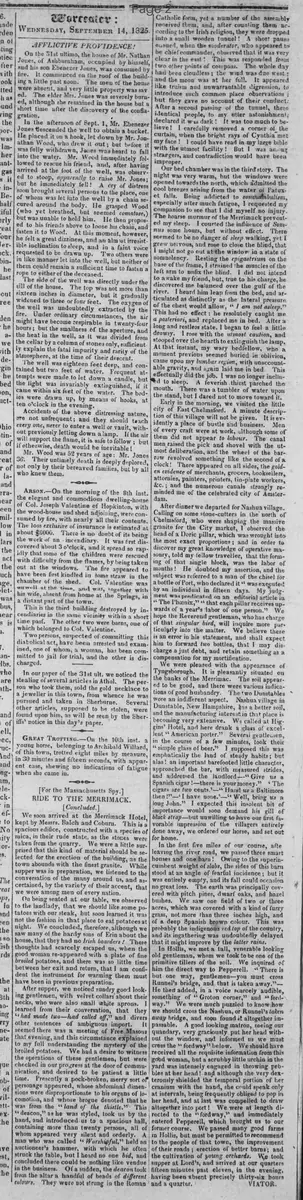
We soon arrived at the Merrimack Hotel, kept by Messrs. Balch and Coburn. This is a spacious edifice, constructed with a species of mica, in their rude state, as the stones were taken from the quarry. We were a little surprised that this kind of material should be selected for the erection of the building, as the town abounds with the finest granite. While supper was in preparation, we listened to the conversation of the many around us, and ascertained, by the variety of their accent, that we were among men of every nation.
On being seated at our table, we observed to the landlady, that we should like some potatoes with our steak, but soon learned it was not the fashion in that place to eat potatoes at night. We concluded, therefore, although we saw many of the hardy sons of Erin about the house, that they had no Irish boarders! These thoughts had scarcely escaped us, when the good woman re-appeared with a plate of fine broiled potatoes, and there was so little time between her exit and return, that I am confident the instrument for warming them must have been in previous preparation.
After supper, we noticed sundry good looking gentlemen, with velvet collars about their necks, who wore also small white aprons. I learned from their conversation, that they "had made two—had called off," and divers other sentences of ambiguous import. It seemed there was a meeting of Free Masons that evening, and this circumstance explained to my full understanding the mystery of the broiled potatoes. We had a desire to witness the operations of these gentlemen, but were checked in our progress at the door of communication, and desired to be patient a little time. Presently a pock-broken, merry sort of personage appeared, whose abdominal dimensions were disproportionate to his organs of locomotion, and whose brogue denoted that he was from the "land of the thistle." This "deacon," as he was styled, took us by the hand, and introduced us to a spacious hall, containing more than twenty persons, all of whom appeared very silent and orderly. A man who was called "Worshipful," held an auctioneer's hammer, with which he often struck the table, but I heard no one bid, and concluded there could be nothing like vendue in the business. Of a sudden, the deacon took from the altar a handful of beads of different colours. They were not strung in the Roman Catholic form, yet a number of the assembly received them, and, after counting them according to the Irish religion, they were dropped into a small wooden tunnel! A short pause ensued, when the moderator, who appeared to be chief commander, observed that it was very clear in the east! This was responded from two other points of compass. The whole day had been cloudless; the wind was due west; and the moon was at her full. It appeared like truism and unwarrantable digression, to introduce such common place observations; but they gave no account of their conduct: After a second passing of the tunnel, these identical people, to my utter astonishment, declared it was dark! It was too much to believe! I carefully removed a corner of the curtain, when the bright rays of Cynthia met my face! I could have read in my large bible with the utmost facility! But I was among strangers, and contradiction would have been improper.
Our bed chamber was in the third story. The night was very warm, but the windows were opened towards the north, which admitted the cool breezes arising from the water of Pawtucket falls. Being addicted to somnambulism, especially after much fatigue, I requested my companion to see that I did myself no injury. The hoarse murmur of the Merrimack prevented my sleep. I courted the influence of Somnus some hours, but without effect. There seemed to be no danger of sleep walking, yet I grew nervous, and rose to close the blind, that I might not go out at the window in a state of somnolency. Resting the epigastrium on the base of the frame, I strained the muscles of the left arm to unfix the blind. I did not intend to awake my friend, but, true to his charge, he discovered me balanced over the gulf of the river. I heard him leap from the bed, and articulated as distinctly as the lateral pressure of the chest would allow, "I am not asleep." This had no effect: he resolutely caught me a posteriori, and replaced me in bed. After a long and restless state, I began to feel a little drowsy. I rose with the utmost caution, and stooped over the hearth to extinguish the lamp. At that instant, my wary bedfellow, who a moment previous seemed buried in oblivion, came upon my lumbar region, with unaccountable gravity, and again laid me in bed. This effectually did the job. I was no longer inclined to sleep. A feverish thirst parched the mouth. There was a tumbler of water upon the stand, but I dared not to move toward it.
Early in the morning, we visited the little city of East Chelmsford. A minute description of this village will not be given. It is evidently a place of bustle and business. Men of every craft were at work, although some of them did not appear to labour. The canal men raised the pick and shovel with the utmost deliberation, and the wheel of the barrow revolved something like the second of a clock! There appeared on all sides, the golden evidence of merchants, grocers, booksellers, attornies, painters, printers, tin-plate workers, &c.; and the numerous canals strongly reminded me of the celebrated city of Amsterdam.
After dinner we departed for Nashua village. Calling on some stone-cutters in the north of Chelmsford, who were shaping the massive granite for the City market, I observed the head of a Doric pillar, which was wrought into the most exact proportions; and in order to discover my great knowledge of operative masonry, told my fellow traveller, that the forming of that single block, was the labor of months! He doubted my assertion, and the subject was referred to a man of the chisel for a bottle of Port, who declared it "was executed by an individual in fifteen days." My judgment was predicated on an editorial article in "The Phoenix," that each pillar receives upwards of a year's labor of one person." We hope the Reverend gentleman, who has charge of that singular bird, will inquire more particularly into the matter. We believe there is an error in his statement, and shall expect him to forward two bottles, that I may discharge a just debt, and retain something as a compensation for my mortification.
We were pleased with the appearance of Tyngsborough. It is pleasantly situated on the banks of the Merrimac. The soil appeared to be good, and there were various indications of good husbandry. The two Dunstables wore an indifferent aspect. Nashua village in Dunstable, New Hampshire, has a better soil, and the manufacturing interest in that place is becoming very extensive. We called at Higgins' Hotel, and here drank a glass of excellent "American porter." Several gentlemen, in the course of a few minutes, took their "simple glass of beer." I supposed this was emphatically the land of steady habits; but alas! an important barefooted little character, approached the bar, with measured strides, and addressed the landlord—."Give us a Spanish cigar!—there is your money." The cigars are two cents.'—"Hand us a Baltimore then!" 'I have none.' "Well, bring us a long John." I expected this insolent bit of importance would soon demand his gill of black strap—but unwilling to have our first favorable impression of the villagers entirely done away, we ordered our horse, and set out for home.
In the first five miles of our course, after leaving the river road, we passed three smart houses and one barn! Owing to the superincumbent weight of slabs, the sides of this barn stood at an angle of fearful incidence; but it was entirely empty, and its fall could occasion no great loss. The earth was principally covered with pitch pines, dwarf oaks, and hazel bushes. We saw one field of two or three acres, which was covered with a kind of furzy grass, not more than three inches high, and of a deep Spanish brown colour. This was probably the indigenous red top of the country, and its ingathering was undoubtedly delayed that it might improve by the latter rains.
In Hollis, we met a tall, venerable looking old gentleman, whom we took to be one of the primitive tillers of the soil. We inquired of him the direct way to Pepperell. "There is but one way, gentlemen—you must cross Runnel's bridge, and that is taken away." He then added, in a voice scarcely audible, something of "Groton corner," and "fordway." We were much puzzled to know how we should cross the Nashua, or Runnel's taken away bridge, and soon found it altogether impassable. A good looking matron, seeing our quandary, very graciously put her head without the window, and informed us we must cross the "fordway" below. We should have received all the requisite information from this good woman, but a scrubby little urchin in the yard was intensely engaged in throwing pebbles at her head! and although she very dexterously shielded the temporal portion of her cranium with the hand, she could speak only at intervals, being frequently obliged to pop in her head, and at last was compelled to draw altogether into port! We were at length directed to the "fordway," and immediately entered Pepperell, which brought us to our former course. We passed many good farms in Hollis, but must be permitted to recommend to the people of that town, the improvement of their roads; erection of better barns; and the cultivation of young orchards. We took supper at Lord's, and arrived at our quarters fifteen minutes past eleven, in the evening, having been absent precisely thirty-six hours and a quarter.
VIATOR.
RIDE TO THE MERRIMACK.
[Concluded.]
We soon arrived at the Merrimack Hotel, kept by Messrs. Balch and Coburn. This is a spacious edifice, constructed with a species of mica, in their rude state, as the stones were taken from the quarry. We were a little surprised that this kind of material should be selected for the erection of the building, as the town abounds with the finest granite. While supper was in preparation, we listened to the conversation of the many around us, and ascertained, by the variety of their accent, that we were among men of every nation.
On being seated at our table, we observed to the landlady, that we should like some potatoes with our steak, but soon learned it was not the fashion in that place to eat potatoes at night. We concluded, therefore, although we saw many of the hardy sons of Erin about the house, that they had no Irish boarders! These thoughts had scarcely escaped us, when the good woman re-appeared with a plate of fine broiled potatoes, and there was so little time between her exit and return, that I am confident the instrument for warming them must have been in previous preparation.
After supper, we noticed sundry good looking gentlemen, with velvet collars about their necks, who wore also small white aprons. I learned from their conversation, that they "had made two—had called off," and divers other sentences of ambiguous import. It seemed there was a meeting of Free Masons that evening, and this circumstance explained to my full understanding the mystery of the broiled potatoes. We had a desire to witness the operations of these gentlemen, but were checked in our progress at the door of communication, and desired to be patient a little time. Presently a pock-broken, merry sort of personage appeared, whose abdominal dimensions were disproportionate to his organs of locomotion, and whose brogue denoted that he was from the "land of the thistle." This "deacon," as he was styled, took us by the hand, and introduced us to a spacious hall, containing more than twenty persons, all of whom appeared very silent and orderly. A man who was called "Worshipful," held an auctioneer's hammer, with which he often struck the table, but I heard no one bid, and concluded there could be nothing like vendue in the business. Of a sudden, the deacon took from the altar a handful of beads of different colours. They were not strung in the Roman Catholic form, yet a number of the assembly received them, and, after counting them according to the Irish religion, they were dropped into a small wooden tunnel! A short pause ensued, when the moderator, who appeared to be chief commander, observed that it was very clear in the east! This was responded from two other points of compass. The whole day had been cloudless; the wind was due west; and the moon was at her full. It appeared like truism and unwarrantable digression, to introduce such common place observations; but they gave no account of their conduct: After a second passing of the tunnel, these identical people, to my utter astonishment, declared it was dark! It was too much to believe! I carefully removed a corner of the curtain, when the bright rays of Cynthia met my face! I could have read in my large bible with the utmost facility! But I was among strangers, and contradiction would have been improper.
Our bed chamber was in the third story. The night was very warm, but the windows were opened towards the north, which admitted the cool breezes arising from the water of Pawtucket falls. Being addicted to somnambulism, especially after much fatigue, I requested my companion to see that I did myself no injury. The hoarse murmur of the Merrimack prevented my sleep. I courted the influence of Somnus some hours, but without effect. There seemed to be no danger of sleep walking, yet I grew nervous, and rose to close the blind, that I might not go out at the window in a state of somnolency. Resting the epigastrium on the base of the frame, I strained the muscles of the left arm to unfix the blind. I did not intend to awake my friend, but, true to his charge, he discovered me balanced over the gulf of the river. I heard him leap from the bed, and articulated as distinctly as the lateral pressure of the chest would allow, "I am not asleep." This had no effect: he resolutely caught me a posteriori, and replaced me in bed. After a long and restless state, I began to feel a little drowsy. I rose with the utmost caution, and stooped over the hearth to extinguish the lamp. At that instant, my wary bedfellow, who a moment previous seemed buried in oblivion, came upon my lumbar region, with unaccountable gravity, and again laid me in bed. This effectually did the job. I was no longer inclined to sleep. A feverish thirst parched the mouth. There was a tumbler of water upon the stand, but I dared not to move toward it.
Early in the morning, we visited the little city of East Chelmsford. A minute description of this village will not be given. It is evidently a place of bustle and business. Men of every craft were at work, although some of them did not appear to labour. The canal men raised the pick and shovel with the utmost deliberation, and the wheel of the barrow revolved something like the second of a clock! There appeared on all sides, the golden evidence of merchants, grocers, booksellers, attornies, painters, printers, tin-plate workers, &c.; and the numerous canals strongly reminded me of the celebrated city of Amsterdam.
After dinner we departed for Nashua village. Calling on some stone-cutters in the north of Chelmsford, who were shaping the massive granite for the City market, I observed the head of a Doric pillar, which was wrought into the most exact proportions; and in order to discover my great knowledge of operative masonry, told my fellow traveller, that the forming of that single block, was the labor of months! He doubted my assertion, and the subject was referred to a man of the chisel for a bottle of Port, who declared it "was executed by an individual in fifteen days." My judgment was predicated on an editorial article in "The Phoenix," that each pillar receives upwards of a year's labor of one person." We hope the Reverend gentleman, who has charge of that singular bird, will inquire more particularly into the matter. We believe there is an error in his statement, and shall expect him to forward two bottles, that I may discharge a just debt, and retain something as a compensation for my mortification.
We were pleased with the appearance of Tyngsborough. It is pleasantly situated on the banks of the Merrimac. The soil appeared to be good, and there were various indications of good husbandry. The two Dunstables wore an indifferent aspect. Nashua village in Dunstable, New Hampshire, has a better soil, and the manufacturing interest in that place is becoming very extensive. We called at Higgins' Hotel, and here drank a glass of excellent "American porter." Several gentlemen, in the course of a few minutes, took their "simple glass of beer." I supposed this was emphatically the land of steady habits; but alas! an important barefooted little character, approached the bar, with measured strides, and addressed the landlord—."Give us a Spanish cigar!—there is your money." The cigars are two cents.'—"Hand us a Baltimore then!" 'I have none.' "Well, bring us a long John." I expected this insolent bit of importance would soon demand his gill of black strap—but unwilling to have our first favorable impression of the villagers entirely done away, we ordered our horse, and set out for home.
In the first five miles of our course, after leaving the river road, we passed three smart houses and one barn! Owing to the superincumbent weight of slabs, the sides of this barn stood at an angle of fearful incidence; but it was entirely empty, and its fall could occasion no great loss. The earth was principally covered with pitch pines, dwarf oaks, and hazel bushes. We saw one field of two or three acres, which was covered with a kind of furzy grass, not more than three inches high, and of a deep Spanish brown colour. This was probably the indigenous red top of the country, and its ingathering was undoubtedly delayed that it might improve by the latter rains.
In Hollis, we met a tall, venerable looking old gentleman, whom we took to be one of the primitive tillers of the soil. We inquired of him the direct way to Pepperell. "There is but one way, gentlemen—you must cross Runnel's bridge, and that is taken away." He then added, in a voice scarcely audible, something of "Groton corner," and "fordway." We were much puzzled to know how we should cross the Nashua, or Runnel's taken away bridge, and soon found it altogether impassable. A good looking matron, seeing our quandary, very graciously put her head without the window, and informed us we must cross the "fordway" below. We should have received all the requisite information from this good woman, but a scrubby little urchin in the yard was intensely engaged in throwing pebbles at her head! and although she very dexterously shielded the temporal portion of her cranium with the hand, she could speak only at intervals, being frequently obliged to pop in her head, and at last was compelled to draw altogether into port! We were at length directed to the "fordway," and immediately entered Pepperell, which brought us to our former course. We passed many good farms in Hollis, but must be permitted to recommend to the people of that town, the improvement of their roads; erection of better barns; and the cultivation of young orchards. We took supper at Lord's, and arrived at our quarters fifteen minutes past eleven, in the evening, having been absent precisely thirty-six hours and a quarter.
VIATOR.
What sub-type of article is it?
Informative
Reflective
Comedic
What themes does it cover?
Infrastructure
Social Issues
Agriculture
What keywords are associated?
Merrimack River
Travel Account
Freemasons Meeting
Nashua Village
East Chelmsford
Tyngsborough
Hollis Roads
Pawtucket Falls
What entities or persons were involved?
Viator.
Massachusetts Spy
Letter to Editor Details
Author
Viator.
Recipient
Massachusetts Spy
Main Argument
recounts a journey along the merrimack river, describing local accommodations, social gatherings, businesses, landscapes, and suggesting improvements to roads and farms in hollis.
Notable Details
Mystery Of Broiled Potatoes Explained By Freemasons Meeting
Incident Of Somnambulism In The Hotel
Observation Of Stone Cutting For Doric Pillar And Bet On Labor Time
Encounter With Barefooted Child Demanding Cigars
Recommendations For Road And Barn Improvements In Hollis