Thank you for visiting SNEWPapers!
Sign up free
Story
November 6, 1852
Anti Slavery Bugle
New Lisbon, Salem, Columbiana County, Ohio
What is this article about?
Rev. John Rankin defends his claims of slavery existing in practice in Liberia, despite its legal absence, citing testimonies from Presbyterian ladies, a British officer, and logical arguments based on colonists' backgrounds and temptations.
Clipping
OCR Quality
95%
Excellent
Full Text
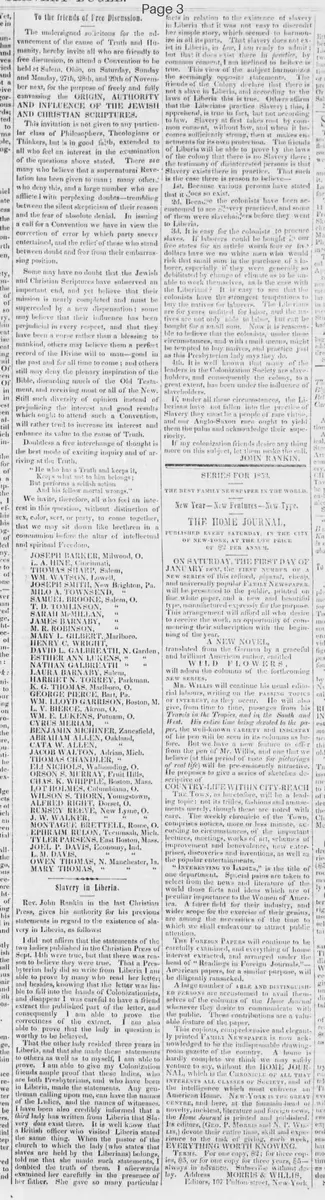
Slavery in Liberia.
Rev. John Rankin in the last Christian Press, gives his authority for his previous statements in regard to the existence of slavery in Liberia, as follows:
I did not affirm that the statements of the two ladies published in the Christian Press of Sept. 14th were true, but that there was reason to believe they were true. That a Presbyterian lady did so write from Liberia I am able to prove by many who read her letter; and besides, knowing that the letter was liable to fall into the hands of Colonizationists, and disappear I was careful to have a friend extract the published part of the letter, and consequently I am able to prove the correctness of the extract. I am also able to prove that the lady in question is worthy to be believed.
That the other lady resided three years in Liberia, and that she made these statements to others as well as to myself, I am able to prove. I am able to give my Colonization friends ample proof that these ladies, who are both Presbyterians, and who have been in Liberia, made the statements. Any gentleman calling upon me, can have the names of the Ladies, and the names of witnesses.
I have been also credibly informed that a third lady has written from Liberia that Slavery does exist there. It is well known that a British officer who visited Liberia stated the same thing. When the pastor of the church to which the lady (who states that slaves are held by the Liberians) belongs, told me that she made such statements, I doubted the truth of them. Afterwards I examined her carefully in the presence of her father. She gave so many particulars facts in relation to the existence of slavery in Liberia that it was not easy to discredit her simple story, which seemed to harmonize in all its parts. That slavery does not exist in Liberia, in law, I am ready to admit; but that it does exist there in practice, by common consent, I am inclined to believe is true. This view of the subject harmonizes the seemingly opposite statements. The friends of the Colony declare that there is not a slave in Liberia, and according to the laws of Liberia this is true. Others affirm that the Liberians practice Slavery: this, I apprehend, is true in fact, but not according to law. Slavery at first takes root by common consent, without law, and when it becomes sufficiently strong, then it makes enactments for its own protection. The friends of Liberia will be able to prove by the laws of the colony that there is no Slavery there; the testimony of disinterested persons is that Slavery exists there in practice. That such is the case there is reason to believe—
1st. Because various persons have stated that it does so exist.
2d. Because the colonists have been accustomed to see Slavery practiced, and some of them were slaveholders before they went to Liberia.
3d. It is easy for the colonists to procure slaves, if laborers could be bought in our free states for an article worth four or five dollars have we no white men who would risk that small sum in the purchase of a laborer, especially, if they were generally so debilitated by change of climate as to be unable to work themselves, as is the case with the Liberians? It is easy to see that the colonists have the strongest temptations to buy the natives for laborers. The Liberians are for years unfitted for labor, and the natives are not only able to labor, but can be bought for a small sum. Now it is reasonable to believe that the colonists, under these circumstances, and with small means, might be tempted to buy natives, and practice just as this Presbyterian lady says they do.
4th. It is well known that many of the leaders in the Colonization Society are slaveholders, and consequently the colony, to a great extent, has been under the influence of slaveholders.
5, under all these circumstances, the Liberians have not fallen into the practice of Slavery they must be a people of rare virtue, and our Anglo-Saxon race ought to yield them the palm and acknowledge their superiority.
If my colonization friends desire any thing more on this subject, let them make the call.
JOHN RANKIN.
Rev. John Rankin in the last Christian Press, gives his authority for his previous statements in regard to the existence of slavery in Liberia, as follows:
I did not affirm that the statements of the two ladies published in the Christian Press of Sept. 14th were true, but that there was reason to believe they were true. That a Presbyterian lady did so write from Liberia I am able to prove by many who read her letter; and besides, knowing that the letter was liable to fall into the hands of Colonizationists, and disappear I was careful to have a friend extract the published part of the letter, and consequently I am able to prove the correctness of the extract. I am also able to prove that the lady in question is worthy to be believed.
That the other lady resided three years in Liberia, and that she made these statements to others as well as to myself, I am able to prove. I am able to give my Colonization friends ample proof that these ladies, who are both Presbyterians, and who have been in Liberia, made the statements. Any gentleman calling upon me, can have the names of the Ladies, and the names of witnesses.
I have been also credibly informed that a third lady has written from Liberia that Slavery does exist there. It is well known that a British officer who visited Liberia stated the same thing. When the pastor of the church to which the lady (who states that slaves are held by the Liberians) belongs, told me that she made such statements, I doubted the truth of them. Afterwards I examined her carefully in the presence of her father. She gave so many particulars facts in relation to the existence of slavery in Liberia that it was not easy to discredit her simple story, which seemed to harmonize in all its parts. That slavery does not exist in Liberia, in law, I am ready to admit; but that it does exist there in practice, by common consent, I am inclined to believe is true. This view of the subject harmonizes the seemingly opposite statements. The friends of the Colony declare that there is not a slave in Liberia, and according to the laws of Liberia this is true. Others affirm that the Liberians practice Slavery: this, I apprehend, is true in fact, but not according to law. Slavery at first takes root by common consent, without law, and when it becomes sufficiently strong, then it makes enactments for its own protection. The friends of Liberia will be able to prove by the laws of the colony that there is no Slavery there; the testimony of disinterested persons is that Slavery exists there in practice. That such is the case there is reason to believe—
1st. Because various persons have stated that it does so exist.
2d. Because the colonists have been accustomed to see Slavery practiced, and some of them were slaveholders before they went to Liberia.
3d. It is easy for the colonists to procure slaves, if laborers could be bought in our free states for an article worth four or five dollars have we no white men who would risk that small sum in the purchase of a laborer, especially, if they were generally so debilitated by change of climate as to be unable to work themselves, as is the case with the Liberians? It is easy to see that the colonists have the strongest temptations to buy the natives for laborers. The Liberians are for years unfitted for labor, and the natives are not only able to labor, but can be bought for a small sum. Now it is reasonable to believe that the colonists, under these circumstances, and with small means, might be tempted to buy natives, and practice just as this Presbyterian lady says they do.
4th. It is well known that many of the leaders in the Colonization Society are slaveholders, and consequently the colony, to a great extent, has been under the influence of slaveholders.
5, under all these circumstances, the Liberians have not fallen into the practice of Slavery they must be a people of rare virtue, and our Anglo-Saxon race ought to yield them the palm and acknowledge their superiority.
If my colonization friends desire any thing more on this subject, let them make the call.
JOHN RANKIN.
What sub-type of article is it?
Historical Event
Curiosity
What themes does it cover?
Moral Virtue
Justice
Misfortune
What keywords are associated?
Slavery In Liberia
Colonization Society
Presbyterian Testimonies
British Officer
Slaveholders Influence
What entities or persons were involved?
Rev. John Rankin
Presbyterian Lady
Other Lady
Third Lady
British Officer
Where did it happen?
Liberia
Story Details
Key Persons
Rev. John Rankin
Presbyterian Lady
Other Lady
Third Lady
British Officer
Location
Liberia
Story Details
Rev. John Rankin provides evidence and reasoning to support claims that slavery exists in practice in Liberia despite legal prohibitions, based on testimonies from women who lived there and observations of colonists' temptations.