Thank you for visiting SNEWPapers!
Sign up free
Daily Press
Newport News, Virginia
What is this article about?
Attorney General William H. Moody sends legal opinion to Senate Interstate Commerce Committee Chairman Stephen B. Elkins affirming federal and state powers to regulate railroad rates, emphasizing reasonableness, impartiality, and judicial oversight to prevent confiscation. (Date: May 5, 1905, Washington, D.C.)
Merged-components note: Continuation of the article on Congress's power to regulate rates from page 1 to page 7.
Clippings
1 of 2
OCR Quality
Full Text
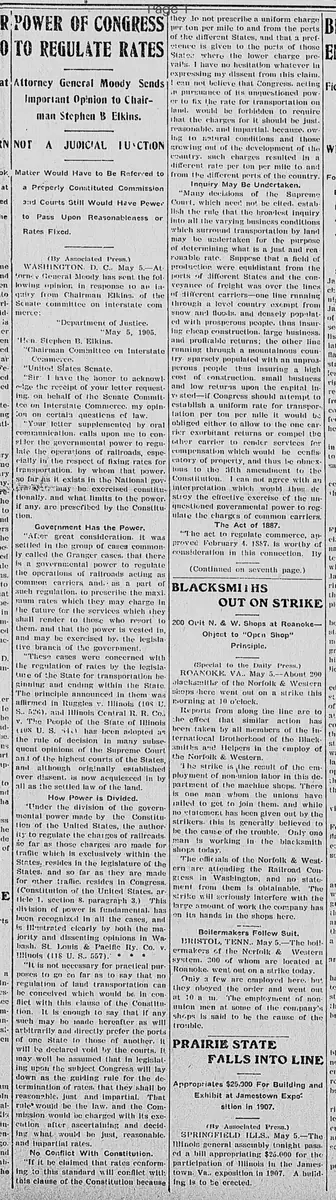
NOT A JUDICIAL QUESTION
Matter Would Have to Be Referred to a Properly Constituted Commission and Courts Still Would Have Power to Pass Upon Reasonableness or Rates Fixed.
(By Associated Press.)
WASHINGTON, D. C., May 5. Attorney General Moody has sent the following opinion in response to an inquiry from Chairman Elkins, of the Senate committee on interstate commerce:
"Department of Justice.
"May 5, 1905.
Hon. Stephen B. Elkins,
"Chairman Committee on Interstate Commerce,
"United States Senate.
"Sir: I have the honor to acknowledge the receipt of your letter requesting, on behalf of the Senate Committee on Interstate Commerce, my opinion on certain questions of law.
"Your letter supplemented by oral communication, calls upon me to consider the governmental power to regulate the operations of railroads, especially in the respect of fixing rates for transportation, by whom that power, so far as it exists in the National government may be exercised constitutionally, and what limits to the power, if any, are prescribed by the Constitution.
Government Has the Power.
"After great consideration, it was settled in the group of cases commonly called the Granger cases, that there is a governmental power to regulate the operations of railroads acting as common carriers and as a part of such regulation, to prescribe the maximum rates which they may charge in the future for the services which they shall render to those who resort to them, and that the power is vested in, and may be exercised by, the legislative branch of the government.
"These cases were concerned with the regulation of rates by the legislature of the State for transportation beginning and ending within the State. The principle announced in them was affirmed in Ruggles v. Illinois (108 U. S. 526), and Illinois Central R. R. Co. v. The People of the State of Illinois (146 U. S. 387) and has been adopted as the rule of decision in many subsequent opinions of the Supreme Court and of the highest courts of the States, and although originally established over dissent, is now acquiesced in by all as the settled law of the land.
How Power is Divided.
Under the division of the governmental power made by the Constitution of the United States, the authority to regulate the charges of railroads, so far as those charges are made for traffic which is exclusively within the States, resides in the legislatures of the States, and so far as they are made for other traffic, resides in Congress. (Constitution of the United States, article 1, section 8, paragraph 3.) This division of power is fundamental, has been recognized in all the cases, and is illustrated clearly by both the majority and dissenting opinions in Wabash, St. Louis & Pacific Ry. Co. v. Illinois (118 U. S., 557).
"It is not necessary for practical purposes to go so far as to say that no regulation of land transportation can be conceived which would be in conflict with this clause of the Constitution. It is enough to say that if any such may be made hereafter as will arbitrarily and directly prefer the ports of one State to those of another, it will be declared void by the courts. It may well be assumed that in legislating upon the subject Congress will lay down as the guiding rule for the determination of rates, that they shall be reasonable, just and impartial. That rule would be the law, and the Commission would be charged with its execution after ascertaining and deciding what would be just, reasonable, and impartial rates.
No Conflict With Constitution.
"If it be claimed that rates conforming to this standard will conflict with this clause of the Constitution because they do not prescribe a uniform charge per ton per mile to and from the ports of the different States, and that a preference is given to the ports of those States where the lower charge prevails, I have no hesitation whatever in expressing my dissent from this claim. I can not believe that Congress, acting in pursuance of its unquestioned power to fix the rate for transportation on land, would be forbidden to require that the charges for it should be just, reasonable, and impartial, because, owing to natural conditions and those growing out of the development of the country, such charges resulted in a different rate per ton per mile to and from the different ports of the country.
Inquiry May Be Undertaken.
"Many decisions of the Supreme Court, which need not be cited, establish the rule that the broadest inquiry into all the varying business conditions which surround transportation by land may be undertaken for the purpose of determining what is a just and reasonable rate. Suppose that a field of production were equidistant from the ports of different States and the conveyance of freight was over the lines of different carriers—one line running through a level country exempt from snow and floods, and densely populated with prosperous people, thus insuring cheap construction, large business, and profitable returns: the other line running through a mountainous country, sparsely populated with an unprosperous people thus insuring a high cost of construction, small business and low returns upon the capital invested—if Congress should attempt to establish a uniform rate for transportation per ton per mile it would be obliged either to allow to the one carrier exorbitant returns or compel the other carrier to render services for compensation which would be confiscatory of property, and thus be obnoxious to the fifth amendment to the Constitution. I can not agree with an interpretation which would thus destroy the effective exercise of the unquestioned governmental power to regulate the charges of common carriers.
The Act of 1887.
"The act to regulate commerce, approved February 4, 1887, is worthy of consideration in this connection.
By (Continued on seventh page.)
POWER OF CONGRESS
TO REGULATE RATES
(Continued from first page.)
If Congress undertook the regulation of railway rates in a comprehensive manner and laid down important rules for its guidance. All carriers engaged in transportation. wholly by railroad or partly by railroad and partly by water were brought within its provisions, and the railroads running to and from the ports were clearly included. It is enacted with regard to them that all charges should be reasonable and just (sec. 1): that no person, or locality, or traffic should be subjected to any undue or unreasonable prejudice or disadvantage. (sec. 3). and that there should not be a greater charge for transportation for a shorter distance than for a longer distance over the same line under substantially the same circumstances and conditions sec.4.
This law was a legislative regulation of railway rates and therefore subject to all constitutional limitations upon the legislative authority. Moreover, the law clearly did not contemplate uniformity in rates as between different carriers. Dissimilarity in rates was expected. if it was reasonable that dissimilarity should exist.
The Conclusion Reached.
I conclude, therefore. that any law for the fixing of rates. according to the standard of reasonableness. impartiality. and justice. or any action taken by a subordinate administrative body in the execution of such a law. would not be obnoxious to article 1. section 9 paragraph 3. of the Constitution. even if it resulted in dissimilar rates to and from the ports of different States.
The views which I have expressed may be stated briefly as follows:
1. There is a governmental power to fix the maximum future charges of carriers by railroad: vested in the legislatures of the States with regard to transportation exclusively within the States. and vested in Congress with regard to all other transportation.
2. Although legislative power properly speaking. can not be delegated (the lawmaking body having enacted into law the standard of charges which shall control, may intrust to an administrative body not exercising in the true sense judicial power the duty to fix rates in conformity with that standard.
4. The rate making power is not a judicial function and can not be conferred constitutionally upon the courts of the United States. either by way of original or appellate jurisdiction.
5. The courts. however. have the power to investigate any rate or rates fixed by legislative authority and to determine whether they are such as would be confiscatory of the property of the carrier. and if they are judicially found to be confiscatory in their effect. to restrain their enforcement.
6. Any law which attempts to deprive the courts of this power is unconstitutional.
7. Any regulation of land transportation. however exercised. would seem to be so indirect in its effect upon the commerce that it could not constitute a preference between the ports of different States within the meaning of article 1 section 9. paragraph 6 of the Constitution.
Reasonable, just, and impartial rates determined by legislative authority are not within the prohibition of article 1. section 9. paragraph 6 of the Constitution. even though they result in a varying charge per ton per mile to and from the ports of the different States.
Very Respectfully
WILLIAM H. MOODY.
Attorney General.
What sub-type of article is it?
What keywords are associated?
What entities or persons were involved?
Where did it happen?
Domestic News Details
Primary Location
Washington, D. C.
Event Date
May 5, 1905
Key Persons
Event Details
Attorney General Moody responds to inquiry from Senate Committee on Interstate Commerce Chairman Elkins with opinion on governmental power to regulate railroad rates, affirming Congress's authority for interstate traffic, state legislatures for intrastate, and judicial review for reasonableness and confiscation.